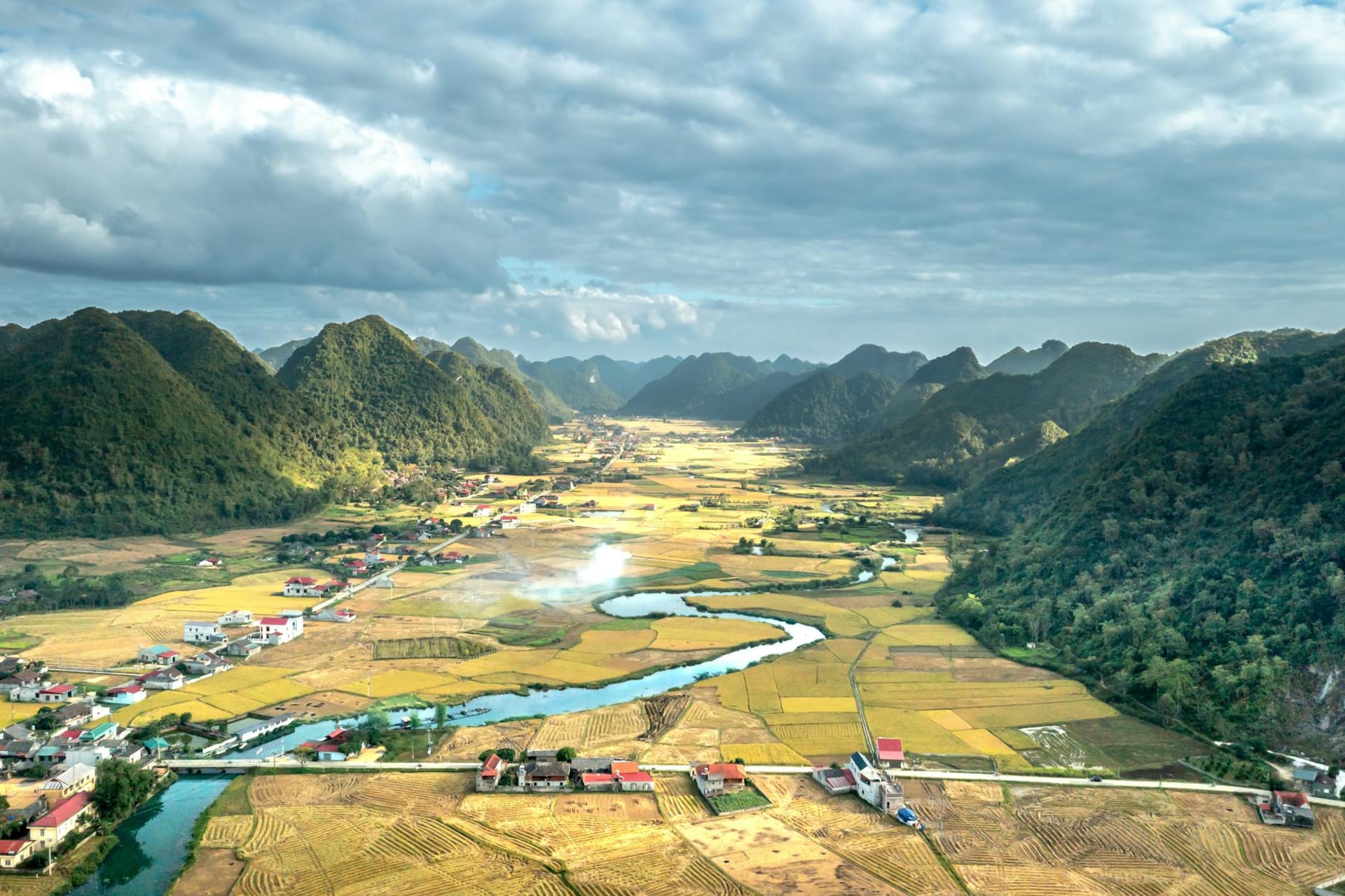
Cao Bang
"Ban Gioc Falls splits two countries at its base, but the water doesn't care about either."
Vietnam's grandest waterfall tumbles across the Chinese border, flanked by limestone karst jungle.
The road from Cao Bang town to Ban Gioc takes two hours and roughly thirty hairpin turns. We drove it on rented motorbikes with helmets that smelled of other people’s journeys, Lia ahead of me on the switchbacks, the karst towers rising like cracked teeth through morning cloud. The province feels forgotten in the best way — no beach, no colonial-era café quarter, no obvious reason to go except the thing at the end of the road.
The Falls
Nothing prepares you for the scale. Ban Gioc is not one fall but three stacked tiers, each broader than the last, the Quay Son River feeding them from both sides of the Chinese border simultaneously. On the Vietnamese side you can hire a bamboo raft to pole you out into the spray, close enough that the roar stops conversation entirely and your shirt soaks through in seconds. The boatman had a transistor radio. I remember Vietnamese pop half-drowned in white noise, the boat pitching gently in the current while China sat fifty meters away doing exactly nothing.
The water runs jade-green in the dry season, white-brown after rain. We arrived in late September when the rains were thinning, and the volume was still enormous — the kind of sound you feel in your sternum rather than hear.
Cao Bang Town
The night before, we stayed in Cao Bang town itself, eating bánh cuốn at a steamed-roll stall on Phố Kim Đồng, the sheets of rice batter thin as cloth, filled with wood-ear mushroom and minced pork, dragged through fish sauce with a floating chili. The town is compact and unhurried, its main market spilling hardware and dried herbs onto the pavement by seven in the morning. There is almost no English spoken and no particular effort made to accommodate tourists. I liked it immediately.
The Cave We Almost Missed
The unexpected thing was Nguom Ngao Cave, three kilometers from Ban Gioc, which we nearly skipped assuming it would be the usual flood-lit karst tourism. It wasn’t. The cave system runs for nearly three kilometers, and deep inside, past the stalactites that guides tap with sticks to produce hollow notes, there is a chamber where the formations look genuinely alien — columns of calcite striped rust and cream, a silence so complete you become aware of your own breathing. We were the only people there past the first hundred meters. I stood still for a long time and thought about nothing in particular, which is its own kind of travel.
When to go: October through April, when the northeast monsoon has cleared and the falls run full but the mud has dried. Avoid July and August — the roads flood and visibility at the falls drops to almost nothing.