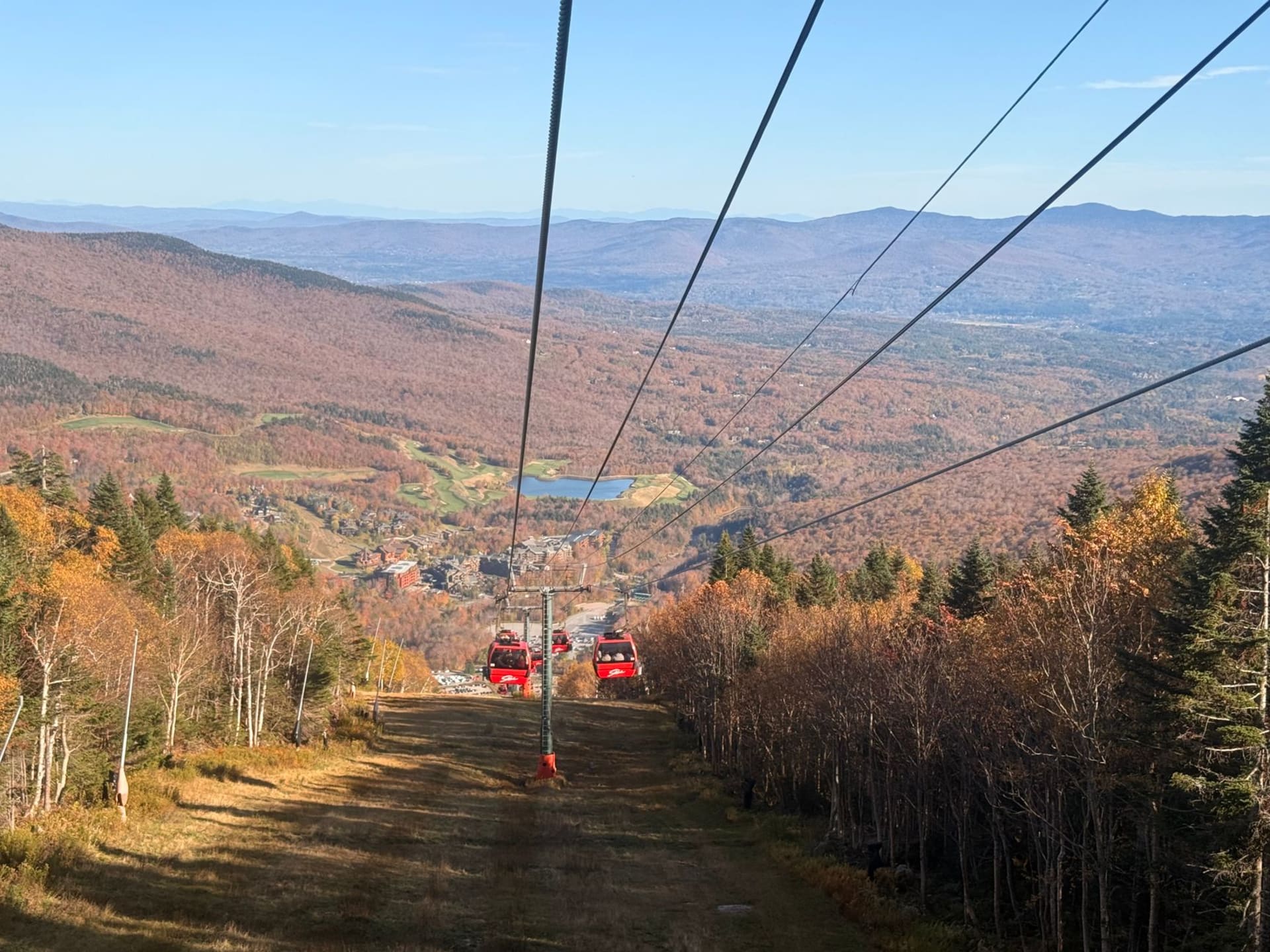
There’s a version of Stowe I expected: the après-ski Instagram tableau, the prices designed for the second-home crowd, the quaintness so aggressively maintained it becomes its own kind of falsehood. That version exists here, I won’t pretend otherwise. But Stowe has enough actual landscape behind it — Mount Mansfield is the highest point in Vermont, the ski terrain is genuinely serious, and the Stowe Recreation Path is one of the better pieces of public infrastructure I’ve encountered in New England — that the postcard stuff feels secondary rather than foundational.
The Mountain Behind Everything
Mount Mansfield defines Stowe the way volcanoes define certain Mexican towns — it’s always in your peripheral vision, setting the weather and the mood. I went up the auto toll road in October when the foliage was past peak but the views were still staggering, the ridgeline trail half-crusted with ice by afternoon. There’s a particular quality of light up there in autumn, low and amber, that makes the valleys look painted rather than real.
In winter, Stowe Mountain Resort splits into two connected areas, Spruce Peak and the main Mansfield face. The front four — National, Liftline, Goat, and Starr — are steep enough to be serious and have a reputation for holding snow well into spring. I’m no expert skier, but even navigating the intermediates on a midweek morning with the mountain mostly to myself felt like the kind of skiing that reminds you why skiing exists.
Main Street Without Condescension
Stowe’s village is compact and walkable and doesn’t entirely pretend that money doesn’t run the place — the real estate window alone is instructive — but it avoids the full trophy-town aesthetic. The Stowe Mercantile is genuinely useful. The farmers market runs Friday evenings in summer and has the kind of produce that makes me reflexively buy too much. The Alchemist Brewery has a tasting room in town now, which means I can pick up Heady Topper without driving to Waterbury, and that alone is worth noting.
For dinner, Harrison’s is the reliable choice — a narrow room with good lighting, a menu that rotates with the season, and a lamb preparation that Lia talked about for two days afterward. The Austrian-inflected fondue at the Trapp Family Lodge, up on the hill, is either romantic or absurd depending on your mood, and I recommend going prepared for both possibilities simultaneously.
The Recreation Path and What’s Around It
The Stowe Recreation Path runs about five miles along the West Branch River from the village toward the mountain, paved and flat and genuinely lovely in all seasons. In October I walked it early enough that mist was still sitting in the valley, the maples dripping with color overhead, almost no one else around. In summer it fills up with cyclists and strollers, which is its own pleasant thing.
Off the path, the Moss Glen Falls are an easy twenty-minute walk and feel disproportionately dramatic for the effort. The old Bingham Falls require a bit more scrambling through forest — the gorge is narrow and the light comes in sideways and it’s exactly the kind of place that justifies the drive to Vermont.
The Off-Season Argument
I want to make a case for Stowe in mud season and late November, the times nobody comes. The prices drop substantially, the town exhales, and you can have a Saturday morning in the village coffee shop without competing for a table. The ski area sometimes opens for early-season in November and closes in April, which bookends the quiet months nicely if you’re willing to gamble on conditions.
When to go: Ski season runs December through April, with February and March being the most reliable for snow. Foliage peaks around early-to-mid October and the town is beautiful but crowded. July brings warm hiking weather and the Stowe Inline Marathon, which I find baffling but admire. Shoulder seasons — May, June, and November — offer the best value and fewest crowds.