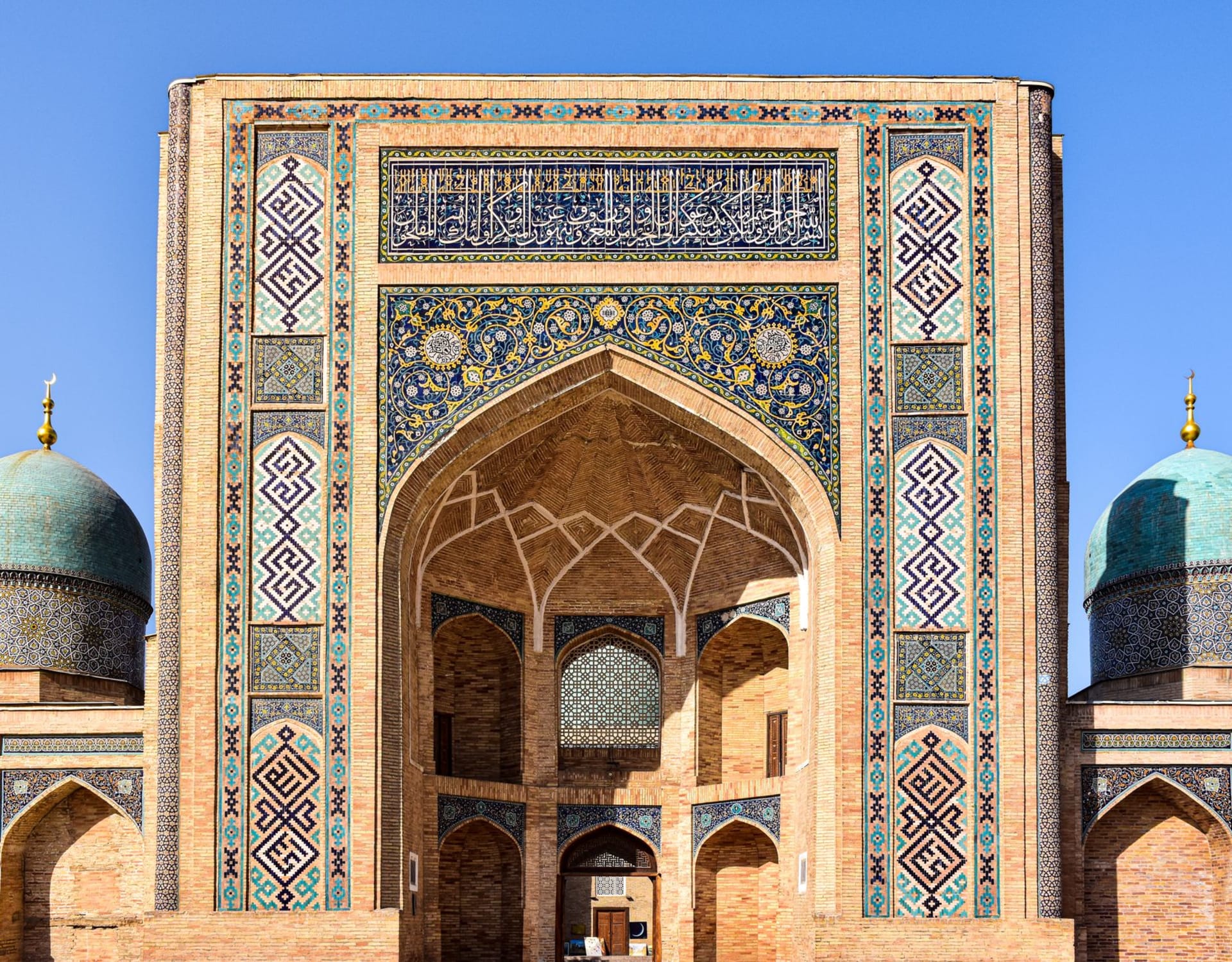
Shakhrisabz
"Timur built Samarkand to impress the world. He built Shakhrisabz for himself."
The drive from Samarkand to Shakhrisabz crosses the Takhtatash Pass through the Zarafshan Range — a road that climbs through scrub and then pine and then briefly above the treeline before descending into a different kind of landscape: a wide green valley, terraced gardens, the Hissar Mountains forming a wall to the south. The city below is low and unhurried in a way that Samarkand, with its monument circuit and coach-tour rhythms, is not.
Shakhrisabz is UNESCO-listed and sees a fraction of the visitors that Samarkand does. Whether this is because the main monument is a ruin rather than a complete building, or because the journey over the mountains is an extra effort, the result is a place where you can stand in front of one of the most extraordinary architectural fragments in Central Asia and be nearly alone.
The Ak-Saray and the Physics of Scale
Timur began building the Ak-Saray — the White Palace — in 1380 as his summer residence and personal triumph. The complex was, at completion, possibly the largest palace in the medieval world: the entrance portal alone stood 65 meters high, decorated floor to lintel with mosaic tilework in blue, white, and gold. Of this, two fragments of the gateway towers remain, reaching about 40 meters, the tilework intact on the upper faces where weather and time worked more slowly.
What survives is already disorienting. You stand between the two tower stubs and tip your head back and try to imagine another 25 meters of arch connecting them, and then try to imagine the palace behind that arch. The attempt gives you a kind of architectural vertigo — the sense of a mind so certain of its own scale that the physical world had to strain to keep up.
Families from the city were picnicking at the base of the towers on a Sunday afternoon when I visited, which was exactly right. The ruins have been integrated into ordinary life in a way that makes them both more accessible and more affecting.
Dorut-Tilovat and the Quiet of the Mausoleums
A ten-minute walk from the Ak-Saray is the Dorut-Tilovat complex: a cluster of mausoleums, mosques, and a working religious school that Timur built as the spiritual center of his hometown. The main mausoleum, housing the tombs of his teacher Sheikh Shamseddin Kulyal and local dynastic figures, has some of the finest Timurid tilework outside Samarkand — cool blue and white in carved patterns, the interior lit only by latticed windows that project moving grids of light across the tiled floor.
I sat in the courtyard for half an hour. A student from the madrassa was memorizing something under a mulberry tree. Two cats were asleep on a warm stone step. The muezzin sounded from somewhere behind the complex. It had the quality of a place that has been this quiet for centuries.
The Green Bazaar and What You Eat Here
Shakhrisabz has a covered bazaar that operates with particular emphasis on dried fruits and local vegetables — the valley’s climate produces apricots, walnuts, and pomegranates of a quality I noticed even compared to the Fergana Valley. A woman selling walnut halves from an enormous sack let me taste before buying, watching my expression with professional seriousness.
Lunch was non (flatbread) from a clay tandoor and a bowl of mastava — rice soup with lamb and tomato — eaten at a plastic table under a vine-covered trellis while a man at the next table watched football on his phone at full volume.
When to go: May through early July, and September. The valley is green and productive in spring, and the mountain views from the city are clearest in the weeks after the last snowmelt. The drive over the Takhtatash Pass is best in good weather — in winter it can close entirely. If you’re driving from Samarkand, allow three hours and take the crossing in daylight.