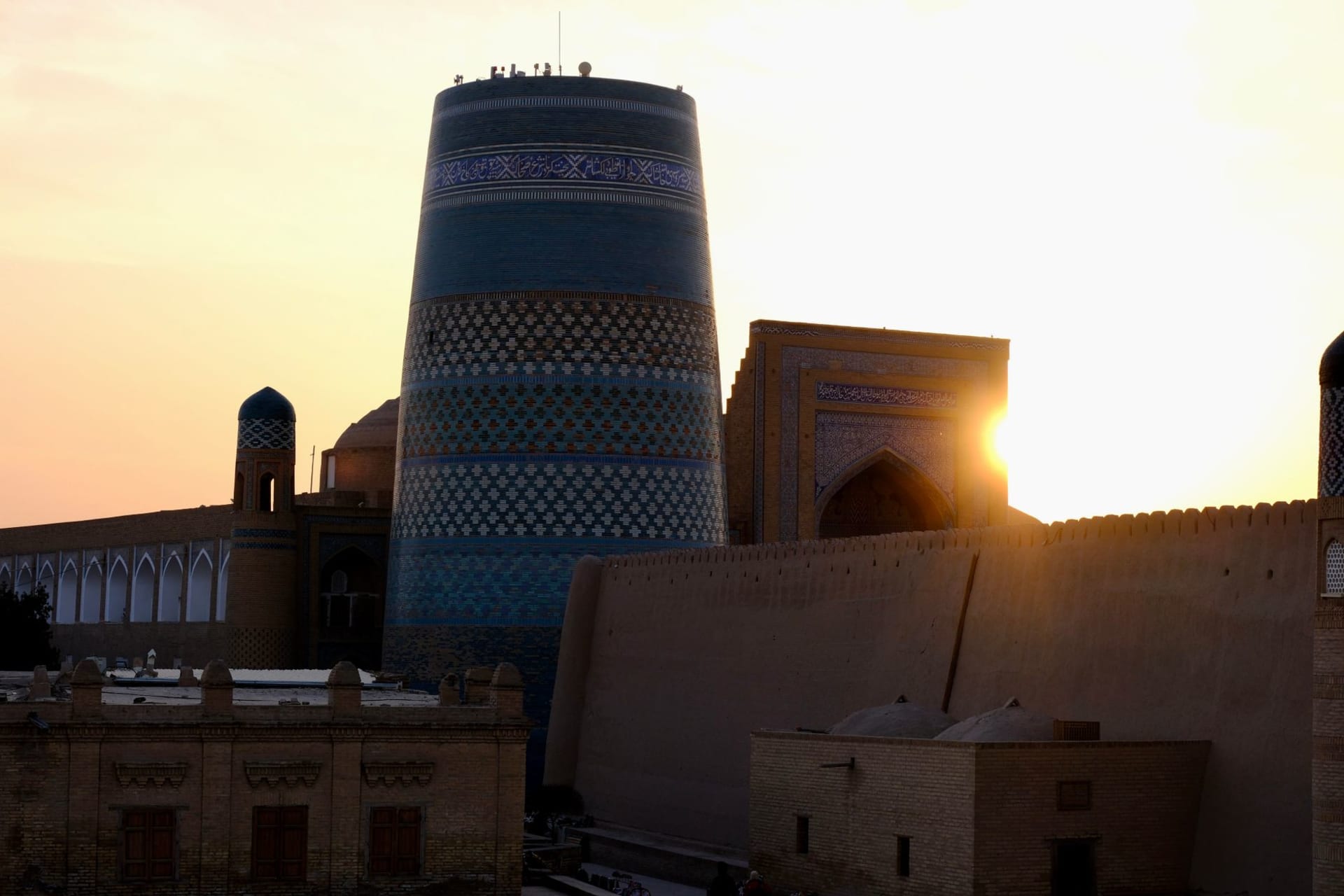
Khiva
"Khiva exists at a frequency slightly outside the one the modern world operates on."
The Ichan-Kala — Khiva’s inner walled city — is UNESCO-listed and has been since 1990, and that status comes with the usual complications. The buildings have been so well restored they occasionally look new. The lanes between them are free of cars, which is wonderful until you realize they’re also suspiciously free of the mess that actual urban life generates. At dusk, with the tourists thinning and the muezzin starting up from three different minarets at once, none of that matters.
I got to Khiva by overnight train from Bukhara, arriving at six in the morning when the desert air was still cold enough to see my breath. The walls of the Ichan-Kala turned pink in the first light. Whatever reservations I’d been carrying about over-restoration evaporated.
The Stump and What It Was Going to Be
The Kalta Minor is arguably Khiva’s most distinctive structure because it is unfinished. Muhammad Amin Khan began building it in the 1850s with the stated intention of making it tall enough to see Bukhara from the top — an ambition that was delusional on several levels, not least geographic. He died in battle in 1855 and the minaret stopped at about a third of its planned height. The result is a perfectly tiled turquoise-and-white stub, 26 meters of ambition cut short, which is both aesthetically remarkable and melancholy in a way that completed things rarely are.
I circled it several times. Up close the tilework is dense and intricate — medallions and arabesques in five shades of blue and white. The minaret is fat at the base, which was designed to support a final height of perhaps 70 meters, so the proportions are wrong in a specific, poignant way.
Inside the Khan’s Palace
The Tosh-Hovli Palace was built in the 1830s by the same Muhammad Amin Khan’s predecessor, Allakuli Khan, who reportedly threatened the architect with death if construction took longer than two years. The architect delivered in two years. The result is one of the most elaborate collections of tile and carved wood in Central Asia, spread across 150 rooms organized around multiple courtyards.
The harem courtyard has a tiled floor, carved wooden columns painted blue, and a gallery of latticed screens that the women of the household could look through without being seen. I stood in that courtyard for a long time trying to reconcile the beauty of the craftsmanship with the system that organized its use. These things don’t resolve neatly. They don’t have to.
Walking the Walls at Sunset
You can climb the mud-brick city walls and walk a section of the perimeter. From the top you look down into the Ichan-Kala — a density of minarets and domes and flat rooftops — and out across the Kyzylkum Desert, which extends to a horizon so flat it looks like something drawn with a ruler. In the hour before sunset the light turns the desert orange and the mud-brick a deeper version of the same color, the whole landscape collapsing into a single warm tone.
A cat followed me along the wall for about fifty meters, then lost interest and sat down to watch the desert.
When to go: April and May, or September and October. Khiva is in a desert basin and summer temperatures regularly exceed 40°C — unpleasant even for heat-adapted travelers. Spring brings mild air and occasional rains that sharpen the desert colors. The tourist season is short and most travelers visit as part of the Tashkent–Samarkand–Bukhara–Khiva route, so mornings are briefly crowded; afternoons belong to whoever stayed an extra night.