Fergana Valley
"Every flat surface in the Fergana Valley is either growing something or drying something — usually both."
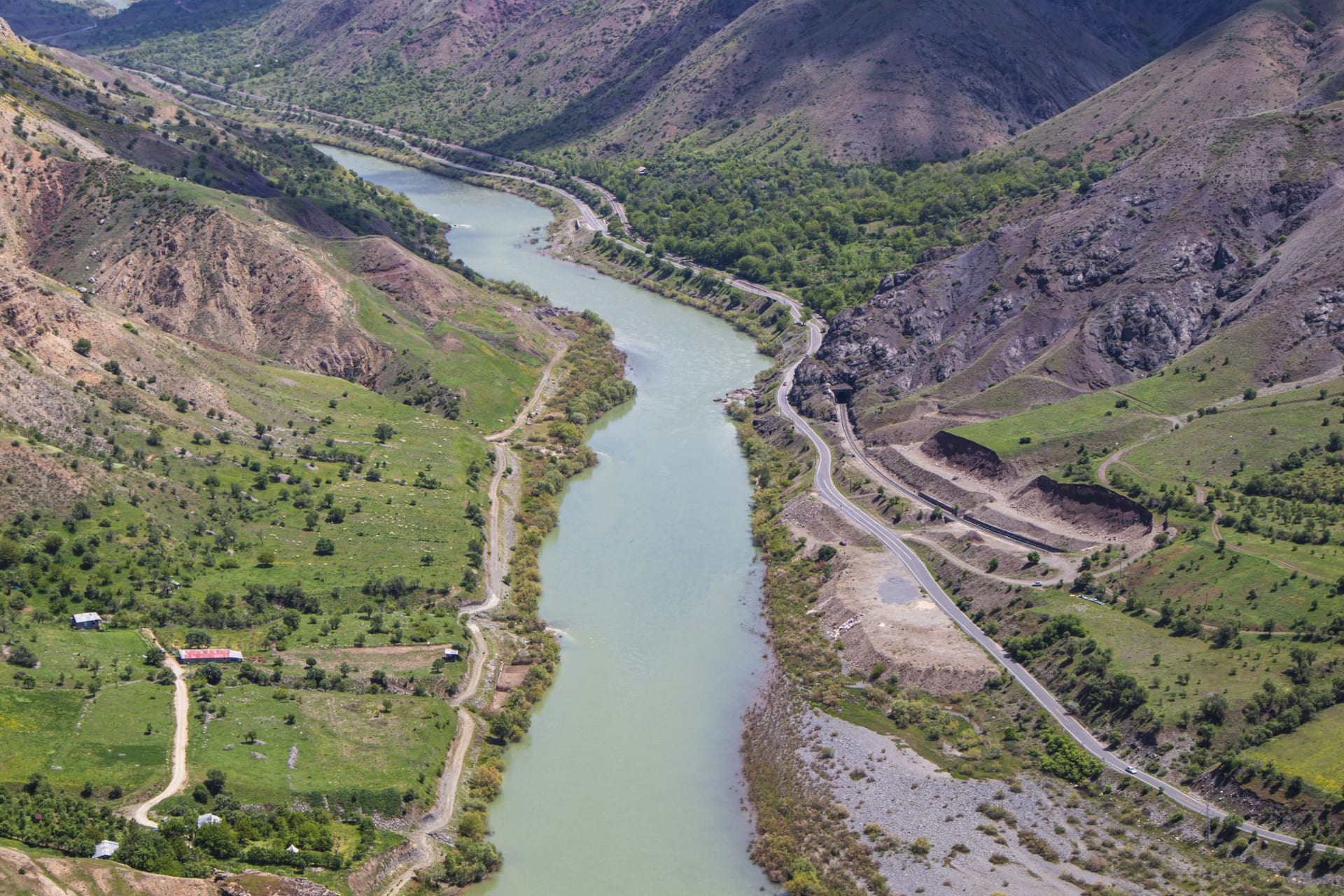
The Fergana Valley is an anomaly in Central Asia’s geography: a broad, fertile plain ringed by mountains, irrigated by two rivers, dense with apricot orchards and mulberry trees and the kind of humid, vegetative warmth that surprises you after the desert. The valley is also carved between Uzbekistan, Tajikistan, and Kyrgyzstan in borders so arbitrary and intricate — Soviet-drawn, ethnicity-based, practically unworkable — that some villages have to cross two international boundaries to reach their own fields. Geopolitics aside, it is extraordinarily beautiful.
I arrived from Tashkent through the Kamchik Pass, a tunnel under the Tian Shan that the Chinese built and finished in 2016. Before the tunnel, this crossing was seasonal. Now it takes twenty minutes by train, and the valley appears suddenly, green and flat, after the brown severity of the climb.
Margilan and the Silk Workshop
The town of Margilan has been a silk center for perhaps fifteen hundred years. At the Yodgorlik Silk Factory — which is both a working mill and a visitor operation — I watched women draw threads from submerged silkworm cocoons using their bare hands, the water scalding enough to cook the proteins that hold the cocoon together. The thread from a single cocoon can run nine hundred meters. The looms in the weaving hall clatter and snap so loudly that the weavers communicate by exaggerated lip movements and gesture.
The ikat silk produced here — adras, atlas — is made by tie-dyeing the warp threads before weaving so the color bleeds at the edges in a specific, deliberately blurred way. Lia had been specific about what she wanted when I called her from the factory floor. I bought three meters of blue-and-green atlas and immediately worried I’d packed wrong for carrying it home.
Rishtan and the Blue Ceramics
The town of Rishtan, a short drive from Fergana city, has been producing blue-and-white ceramic ware for centuries using locally sourced clay and a cobalt glaze derived from lapis lazuli deposits in the hills. The master potters here have apprenticeship traditions that run through families over generations. At one workshop, a man who had been throwing pots for forty years let me hold a bowl he’d just finished. It was still warm, and lighter than it looked, and more irregular than the tourist shops suggest — each one slightly off-round in a way that felt intentional.
The blue is a particular shade: not the deep blue of Bukhara tilework but something cooler, closer to a clear sky, that looks different in sun than in shade.
Kokand and the Palace of the Forgotten Khans
Kokand was once the capital of a khanate powerful enough to challenge both Russia and China simultaneously, which gives you a sense of either its confidence or its miscalculation. The Khudoyar Khan palace, built in the 1870s and now a museum, retains original carved plaster and tilework through about a third of its original rooms — the rest were repurposed or demolished over Soviet decades. The museum’s collection is encyclopedic and undervisited, full of local costumes and weapons and documents in Persian script that a volunteer guide translated for me into approximate but enthusiastic Russian, which I then translated into approximate but enthusiastic French inside my own head.
The bazaar around the palace is the least touristy market in the valley and therefore the most interesting: pyramids of pomegranates beside mobile phone cases beside bolts of Korean polyester beside clay oil lamps.
When to go: May and June for the mulberry harvest and apricot blossom — the landscape is at its most fertile and the light through the orchards is extraordinary. October for pomegranates and autumn color in the surrounding mountains. The valley is accessible year-round but summer heat (though less severe than the desert cities) is still worth avoiding for long walks between markets.