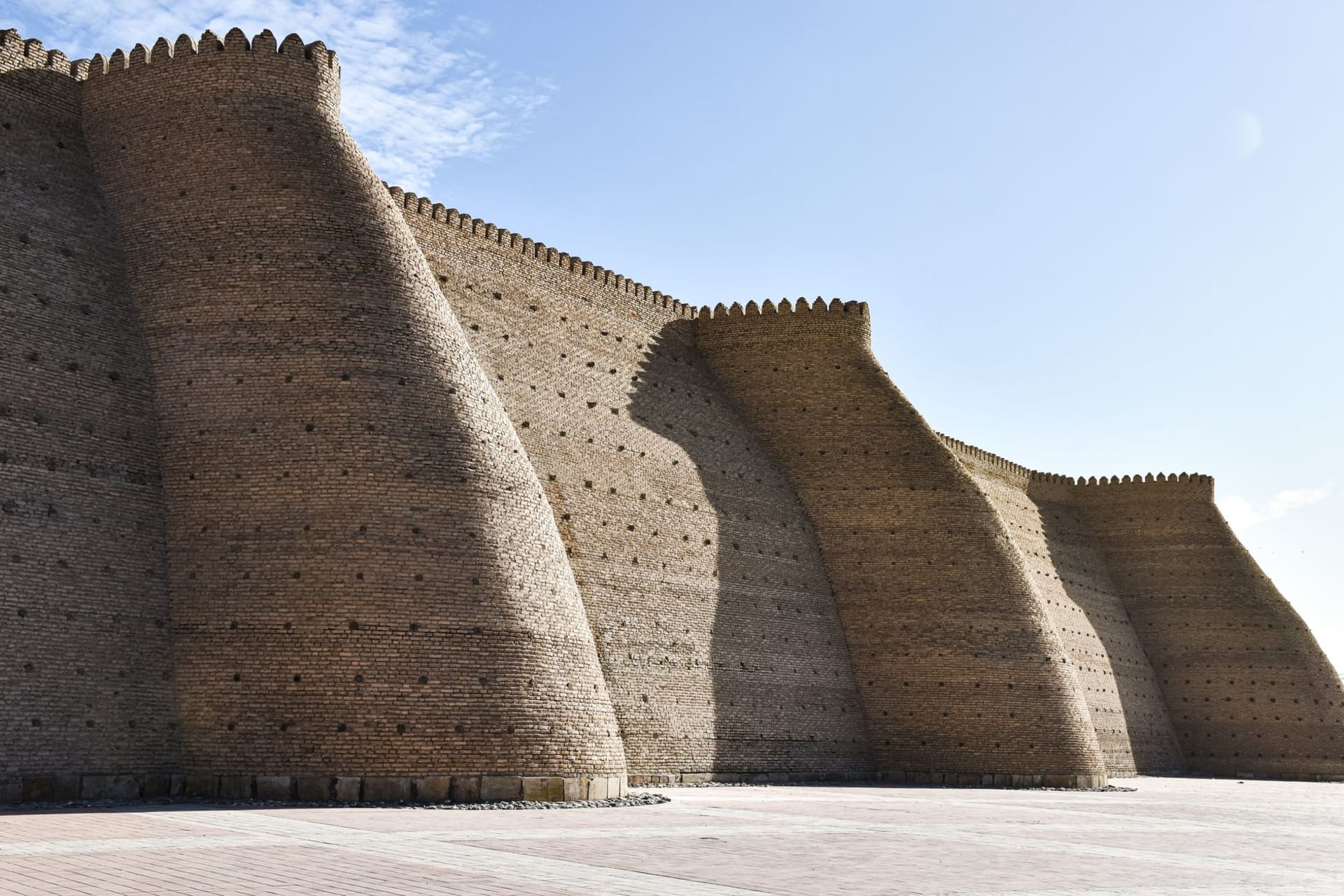
Samarkand announces itself. Bukhara simply exists, and has been existing for so long that the announcement feels unnecessary. This is the city that Genghis Khan supposedly called “the city of fire” after he burned it. It rebuilt. It has been rebuilt and sacked and rebuilt again enough times that resilience stopped being a strategy and became a texture.
I arrived by train from Samarkand at midday and walked from the station into the old city. Within ten minutes I was lost. Within twenty I had stopped trying not to be.
The Kalon and the Weight of Ambition
The Kalon Minaret is one of the few things that Genghis Khan is said to have spared — the story goes that when he rode in to destroy the city, he had to tilt his helmet back to look up at it, and something in that gesture humbled him. The story may be apocryphal. The minaret is not. It stands 47 meters of twelfth-century brick, each band a different geometric pattern, the whole thing tapering into a lantern at the top. I stood underneath it and felt the way you feel under something genuinely tall: small, briefly grateful.
The Kalon Mosque beside it was Friday-busy when I visited. Men were filing in across the massive courtyard, their voices low and unhurried. I stayed at the edge and watched without entering, which felt correct. The quietness of how people moved through these spaces was its own kind of lesson.
The Bazaar Domes and What Gets Sold There
The covered bazaar domes — toki — sit at intersections of the old trading routes and were built to keep merchants cool in summer and warm in winter. They still sell things: silk, spices in open sacks, suzani embroidery that Lia would have wanted more of if she’d been with me, miniature paintings that look ancient and aren’t. The air inside the domes smells of cumin and lanolin and faintly of diesel from the scooters that somehow thread through the pedestrian lanes outside.
What I liked about the bazaars was their matter-of-factness. Nobody was performing commerce for tourists — or at least not entirely. Old women in striped robes moved through with string bags, buying onions. A man was arguing on his phone while selling embroidered skullcaps. The carpets stacked outside one stall had price tags in som that were genuinely negotiable, not theatrically so.
Char Minar and the Quiet Quarter
Away from the main monuments, toward the eastern edge of the old city, is Char Minar: a gatehouse with four small minarets, one at each corner, that serves no obvious purpose beyond being perfect. It’s in a neighborhood of mud-brick lanes that feels genuinely residential — satellite dishes on the rooftops, a cat asleep on a doorstep, chickens in a yard. The gatehouse itself is just standing there in a small courtyard, slightly asymmetrical, the tiles on the minarets missing in patches, the whole thing endearing in a way that none of the grand monuments are.
I went back twice. Once in afternoon light, once in early morning when the lanes were empty. It looked different each time, which is how you know something is actually there.
When to go: March to May is ideal — wildflowers are out in the surrounding steppe and temperatures are mild. September and October are nearly as good and less crowded. Summer heat is extreme and genuine (45°C has been recorded). Winter is cold but vivid — the monuments look extraordinary in low winter light and visitor numbers drop to almost nothing.