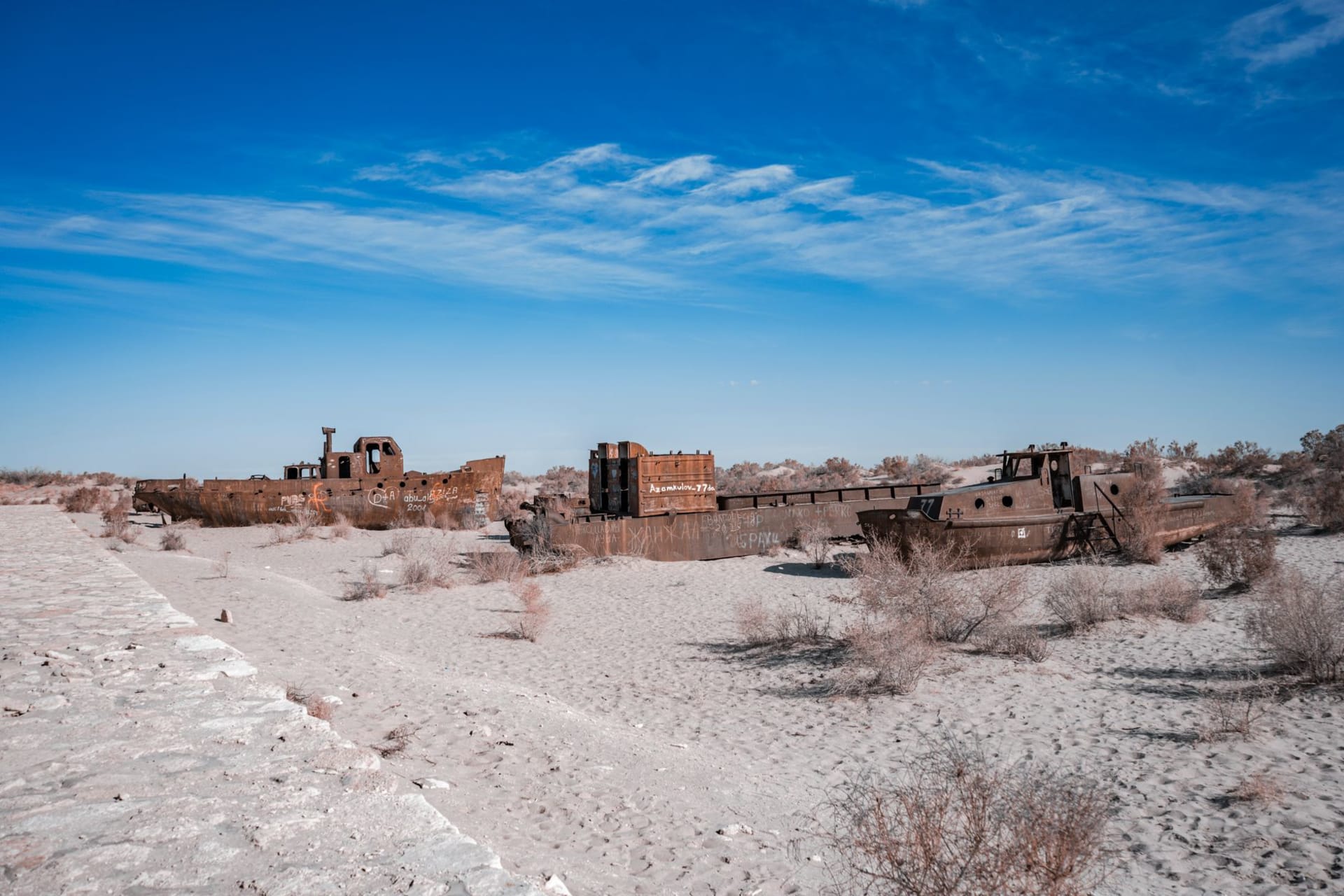
The Aral Sea was once the fourth largest lake in the world. Soviet irrigation projects in the 1960s and 70s diverted its two feeder rivers — the Amu Darya and Syr Darya — to grow cotton in the surrounding desert. The sea began to shrink. By 2007 it had lost ninety percent of its volume. What remains is less a sea than a series of disconnected, shrinking brines. What remains of what was the sea is white salt desert, a horizon of nothing, and a ship graveyard outside the town of Muynak that has become, with dark logic, one of the most visited sites in Central Asia.
I hired a driver in Nukus for the day. The drive takes about three hours. I recommend going early.
The Road and the Diminishing
The road from Nukus runs southwest through scrub and sand. Every twenty kilometers or so there’s a marker indicating what the shoreline was in a specific year — 1960, 1975, 1990, 2000. The markers are the most effective data visualization I’ve encountered: you drive past each one and watch the distance between yourself and the water grow across decades. By the time you reach Muynak, which was a fishing port on the actual sea, you are roughly sixty kilometers from what’s currently left of it.
Muynak itself is a town that time has treated harshly. The population has dropped from over forty thousand to around twelve thousand as the economic base — fishing, fish processing — collapsed with the sea. The buildings still standing carry the aesthetic of a Soviet factory town built for a grander future that didn’t arrive. The people still there are notable for their directness and lack of self-pity, which is either admirable or heartbreaking depending on how you hold it.
The Ship Graveyard
The ship graveyard sits on what was once a harbor, now a sandy plateau above the desert floor. Twelve or fourteen rusting hulls — trawlers and cargo vessels — are arranged in a semi-arc, their lines still carrying the logic of ships even as they tilt and corrode. The paint has blistered and faded to the same red-oxide color. Some have lost their superstructure entirely. Weeds grow through the hull planks.
I walked between them for an hour. The scale is wrong for landscape photography — the boats are smaller than you imagine, and the desert is larger — but wrong in a way that makes the experience more rather than less affecting. These are not dramatic ruins. They are ordinary, specific objects in the wrong place, which is exactly what they are.
The salt on the ground crunches underfoot with a sound like new snow. The air has a faint mineral bitterness that I kept noticing for hours afterward.
The North Aral Sea and What Happened There
Kazakhstan’s portion of the former sea — the North Aral Sea — has actually been partially restored since the completion of a dam in 2005, and water levels are rising. Uzbekistan’s portion continues to shrink. This means that the ship graveyard story, the wider Aral story, is not simply one of irreversible catastrophe but something more complicated: a story of engineering damage and engineering (partial) remedy, and of what gets restored and who decides.
None of this is on the signage at the ship graveyard, which is minimal. But it was what I thought about on the drive back to Nukus, through the marker posts in reverse, as the shoreline years advanced and the light turned orange over the Ustyurt Plateau.
When to go: April to May and September to October. Summer on the dry sea floor is brutally hot and the salt reflects sunlight so intensely it becomes physically disorienting after an hour. Spring and autumn offer manageable temperatures and extraordinary light on the rusted hulls in late afternoon. The drive from Nukus makes this a day trip; there’s simple accommodation in Muynak if you want to spend the night and walk the site at dawn.