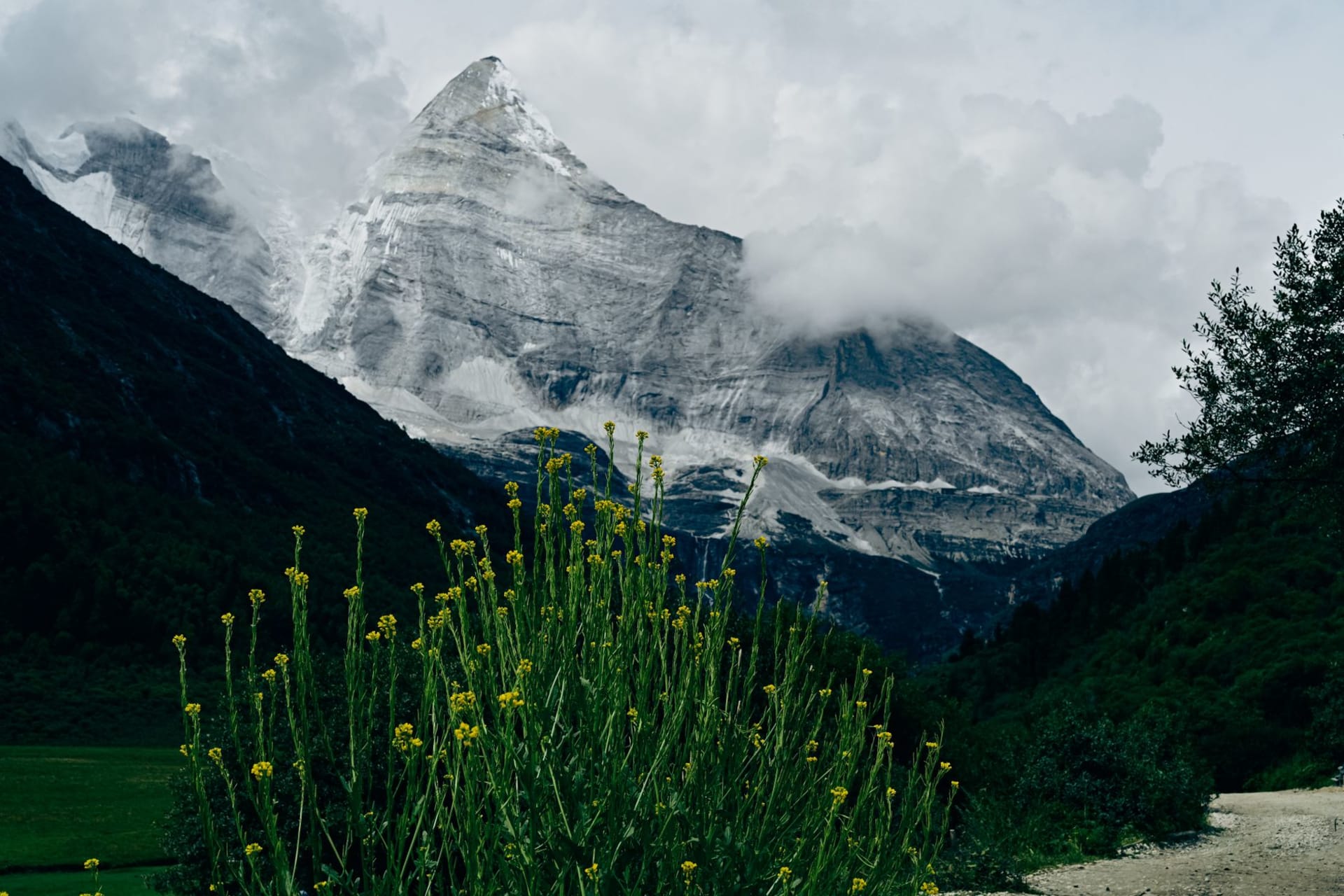
Valley of Flowers
"There's a point where the density of color stops being botanical and starts being something else entirely."
The Valley of Flowers is reached by walking. There is no other way in: sixteen kilometers from Govindghat to Ghangaria, then another three kilometers uphill to the valley entrance, through terrain that climbs steadily and rewards the effort with air that has no competition in it and views that keep revising upward. I did this with Lia in late July, which turned out to be precisely the right moment — the monsoon had been active for three weeks, the valley was at maximum saturation, and the flowers were doing whatever flowers do when they’ve had everything they need.
I’ve seen alpine meadows before. I’ve spent time above the treeline in the Alps and in the Sierra Nevada and I thought I had a reasonable mental model for what a high-altitude flower meadow looks like. The Valley of Flowers corrected this with some force. The scale is different — the valley runs seven kilometers long and two kilometers wide — and the density of species is different. Botanists have recorded over six hundred species of wildflowers here. Walking through it in bloom feels less like a nature experience and more like standing inside a very deliberate installation.
The Walk In
The trail from Govindghat to Ghangaria follows the Pushpawati River through forest that gradually gives way to rocky open hillside as altitude increases. Porters and mules pass regularly on this route (Ghangaria also serves as a base for the Hemkund Sahib Sikh pilgrimage), which means you’re never alone on the path but also that supplies and accommodation exist at the other end. The trail itself is clear and well-maintained. What it is not is flat: the sixteen kilometers involve around two thousand meters of elevation gain, which some people complete in five hours and others in eight. There’s no shame in the latter.
Inside the Valley
The valley floor is protected — no camping, no collection of anything, no deviation from the marked path. Rangers check that people abide by this and the rules feel appropriate given what they’re protecting. I walked the path in both directions over two days and found different things each time: a patch of blue Himalayan poppy I’d missed going south, a snow bridge over the stream that had partially collapsed, a cloud that dropped from the valley rim and moved through the flowers like something alive.
The blue poppy — Meconopsis aculeata, the Himalayan blue poppy — deserves its own sentence. The color is not blue the way cornflowers are blue or the sky is blue. It’s the blue of something that has decided to be as intensely itself as possible.
Hemkund Sahib
From Ghangaria, a second trail climbs four kilometers to Hemkund Sahib, a Sikh gurudwara at 4,329 meters beside a glacial lake. I went on the second day, at dawn, before the main pilgrimage traffic arrived. The lake was completely calm and the temple reflected in it precisely. The walk up had me breathing harder than I wanted to admit; the view across the lake to the ice wall above it made the breathing feel worthwhile.
Logistics
Ghangaria has basic guesthouses and a gurudwara langar (community kitchen) that serves free simple meals to anyone, pilgrim or not. The food is plain and warm and I was grateful for it after the walk in. Accommodation books out during peak pilgrimage weeks — have reservations or arrive early.
When to go: July through August, during the monsoon, is when the valley peaks. Mid-July to mid-August is the flower maximum, with hundreds of species in bloom simultaneously. The valley is closed October through May due to snow. September is quieter and drier but flowers are past peak. Expect rain during July–August; waterproofing is essential.