Haridwar
"Some rituals are old enough that participating feels like stepping into a river — the current was already moving before you arrived."
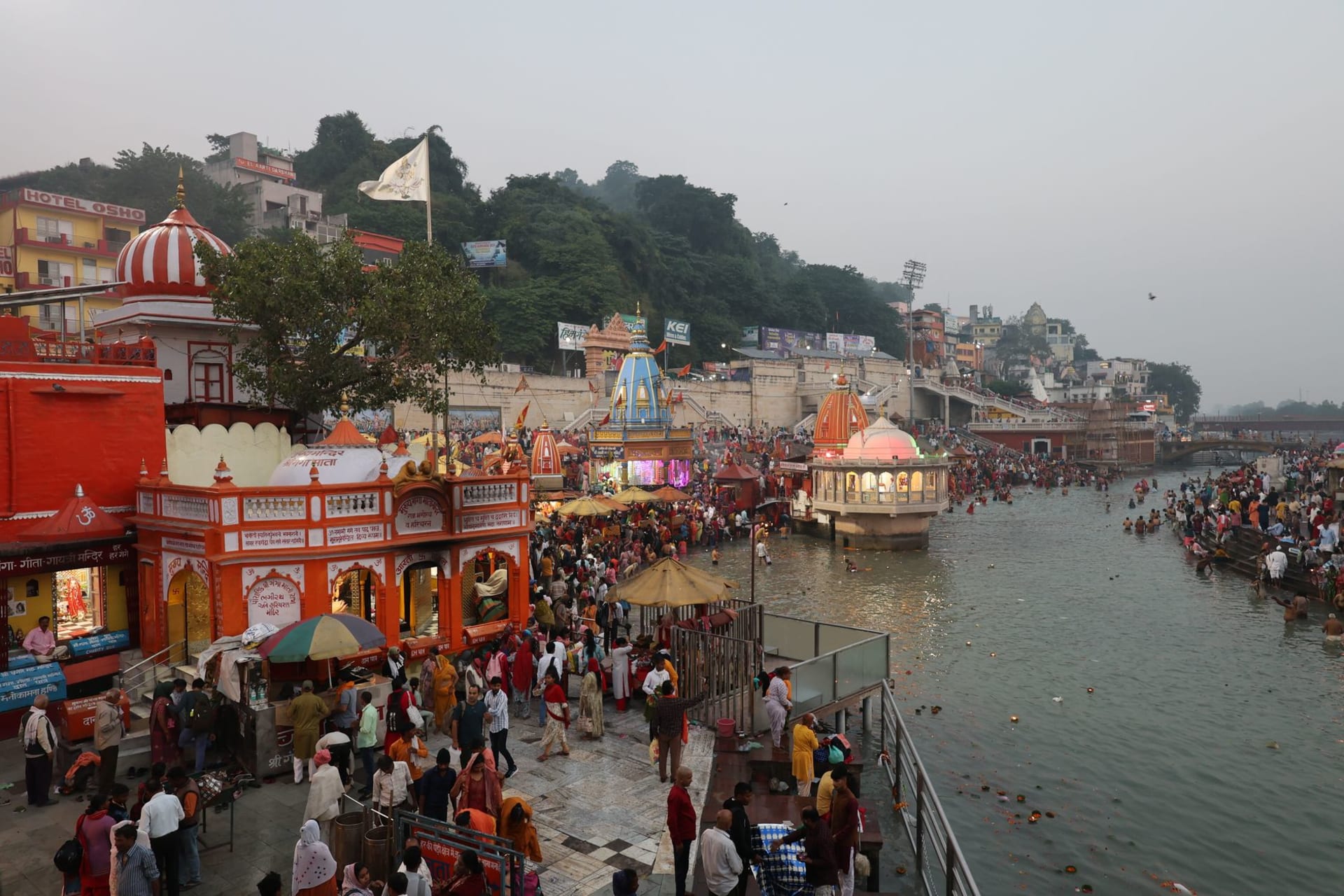
Haridwar is one of Hinduism’s seven sacred cities and has been a pilgrimage site for long enough that the concept of history starts to feel inadequate. The Ganges here is wide, fast, and cold — it has just finished its descent from the Himalayan glaciers and hasn’t yet slowed into the plains. Pilgrims come to bathe at Har Ki Pauri ghat because this is considered the point where the river crosses from the mountains into the mortal world, and the resulting human traffic is extraordinary. I arrived on an ordinary Tuesday in March and the ghats were packed.
I am not Hindu, and I want to be careful about how I describe what I witnessed. What I can say is that the devotion was entirely genuine, layered, unhurried, and completely indifferent to the considerable number of tourists watching it. People came to bathe, to immerse urns of ashes, to float flower offerings, to stand waist-deep in water that was probably close to ten degrees Celsius. A priest sat at a platform above the ghat performing rituals for families who had traveled long distances for this specific purpose.
Ganga Aarti at Har Ki Pauri
The evening ceremony happens every day at sunset, at the bells-chains-and-fire ghat beside the river. Priests lift lamps — large brass constructions that hold dozens of oil flames — and turn them in circles while a crowd of hundreds watches from the stepped banks. The synchronized chanting, the bells from multiple temples, the smoke mixing with the river mist: it builds into something that is genuinely difficult to remain uninvested in. I arrived thirty minutes early to get a position near the water and stayed until the crowd began dispersing and the river surface held only the reflection of the lamps still burning.
The Ghat Architecture
Har Ki Pauri is a chain of ghats connected by bridges, chains, and staircases, and worth walking slowly in the morning before the peak crowds arrive. Metal chains are anchored in the river for bathers to hold against the current. Steps descend at different angles, worn smooth by generations of feet. The temples that line the upper ghat ranges are active, loud, and layered with color — marigold orange, turmeric yellow, the particular red of kumkum powder on stone.
The Markets Behind the Ghats
I didn’t expect to spend much time in Haridwar’s markets, and then I spent two hours. The lanes behind the ghats sell everything from devotional items (brass lamps, mala beads, rudraksha seeds, packets of vibhuti ash) to the aluminum containers pilgrims use to carry Ganga water home. There’s also a surprising variety of street food: kachori stuffed with spiced lentils, jalebi soaking in syrup, aloo puri at tables where the system is to sit down and food arrives without ordering. I ate the kachori twice.
What Haridwar Is Not
It’s not a place to decompress. The energy is dense, sometimes overwhelming, and the commercial apparatus of pilgrimage — touts, guides, vendors — is fully operational. There are no quiet corners at the main ghats. But it is completely, authentically itself, and a few hours here shifts the frame of everything else you see in Uttarakhand.
When to go: October through March for comfortable temperatures and manageable crowds. The Kumbh Mela (held every twelve years, next in 2034) and Ardh Kumbh (every six years) draw tens of millions — extraordinary but logistically challenging. Avoid May–June when heat on the plains is extreme and Haridwar becomes a transit point for hill-bound pilgrims.