Lake Turgoyak
"The Russians call it the younger sibling of Baikal. I thought that was the usual local boosterism. It's not."
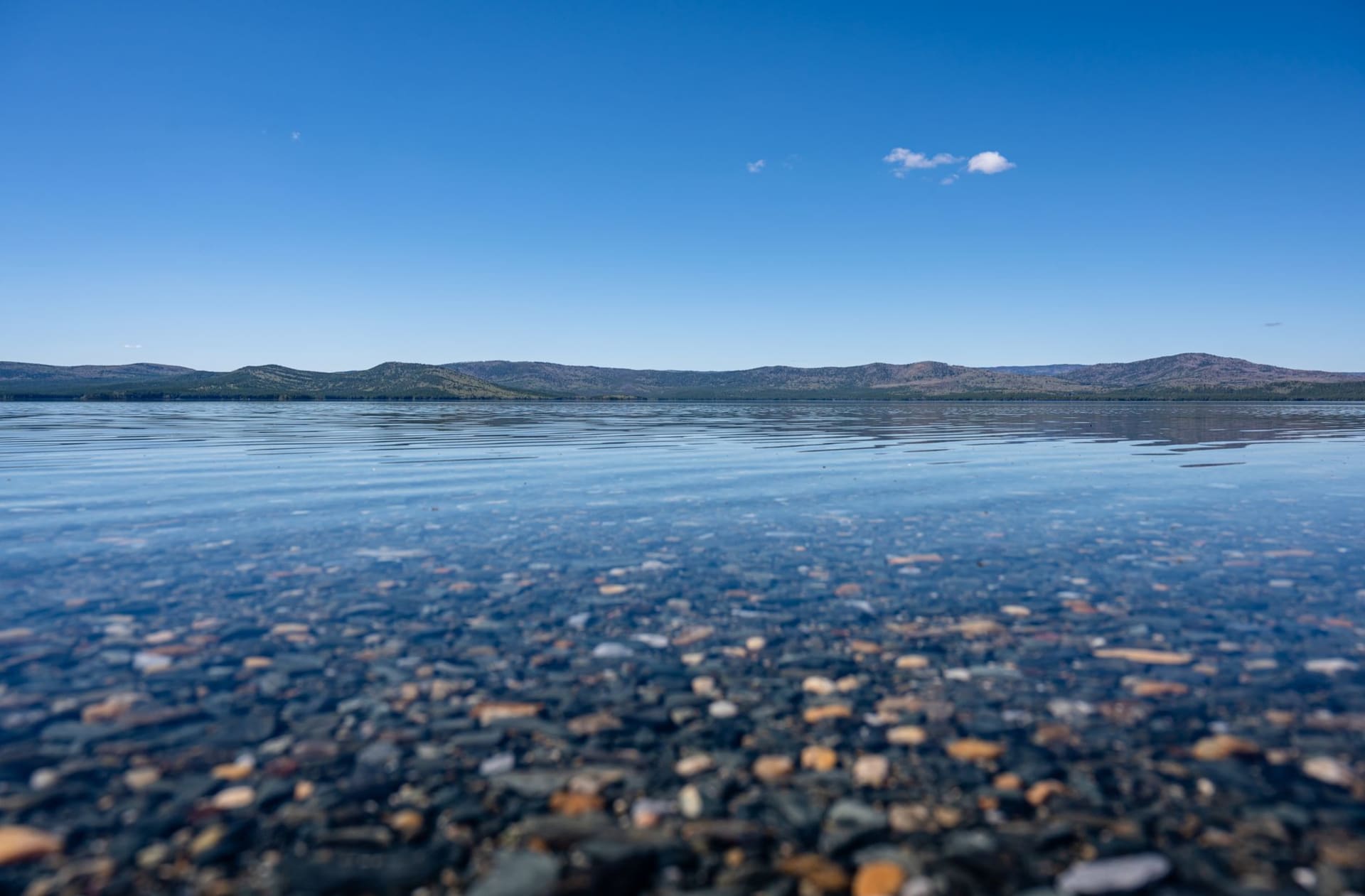
Lake Turgoyak sits forty kilometers west of the industrial city of Miass, which is a dissonance worth noting — you drive through Soviet-era factory districts, swing around a hill, and then the lake opens below you, improbably clear, framed by granite outcrops and Scots pine. The clarity of the water is the first thing and the main thing. You can see the bottom at twelve meters. In the shallows near the boulder beach, you can see individual stones at four meters depth with the same resolution as if they were in your hand.
The Water
Turgoyak has been measured at visibility depths of up to seventeen meters, putting it among the clearest natural lakes in Russia and among the clearest in the world. The clarity comes from the geology — the granite watershed filters water before it reaches the lake, and the lake has no significant river inflow bringing sediment. What comes in comes in clean.
I swam for an hour on a July morning and couldn’t entirely shake the sensation that I was floating in air. The water was cold — about sixteen Celsius at the surface — but the color was so saturated and the visibility so deep that I kept pausing to look down rather than across. Fish were visible at depth, small perch moving through a clarity that seemed unfair to them.
Vera Island
In the center of the lake sits Vera Island, reachable by boat or, in calm weather, by a determined swim from the nearest shore. The island holds the remains of an Early Bronze Age megalithic complex — stone chambers and alignments built by the Sintashta culture around 2000 BCE, the same people who built the circular fortress of Arkaim in the southern steppes. The connection to Arkaim is made by archaeologists who argue this region was a cultural center of the early Indo-European world.
The actual ruins are unspectacular in the way that Bronze Age ruins usually are — low stone walls, grassy depressions, some reconstructed chamber outlines marked with wooden stakes. What makes it worthwhile is the combination: standing on an island in an impossible lake, looking at evidence of people who were here four thousand years ago, surrounded by water so clear you can see the gravel bottom even where the island slopes into the lake.
The Shoreline
The eastern shore is the busiest, with several small sanatoriums and guesthouses built mostly in the Soviet era for workers from the Miass factories. These places are modest, functional, and cheap, and they have the melancholy charm of Soviet leisure infrastructure — concrete changing rooms, a volleyball net on the beach, a food kiosk selling shashlyk and kvas from afternoon until dark.
The northern and western shores are almost entirely undeveloped, accessible by boat or by hiking trails through pine forest. Lia and I took a rented rowboat around the northern tip one morning and found a granite boulder beach with nobody on it. We stayed for three hours. The silence was the particular silence of a windless surface on a still lake — complete, but with texture.
The Light in the Afternoon
The late afternoon light at Turgoyak, when the sun is low enough to come in from the west at an angle, does something to the water color I haven’t been able to fully explain. The blue goes warmer and greener simultaneously. The reflection of the pine-covered hills on the eastern shore sharpens and darkens. It lasts about ninety minutes and it’s worth adjusting your swimming schedule around.
When to go: June through August for swimming, with July being the warmest water (average surface temperature of 18-20°C). The lake is excellent in late May and September for clarity and solitude — fewer visitors, same water, colder air. Winter brings ice fishing and a completely different character: the lake freezes solid and the ice is clear enough to see fish moving below.