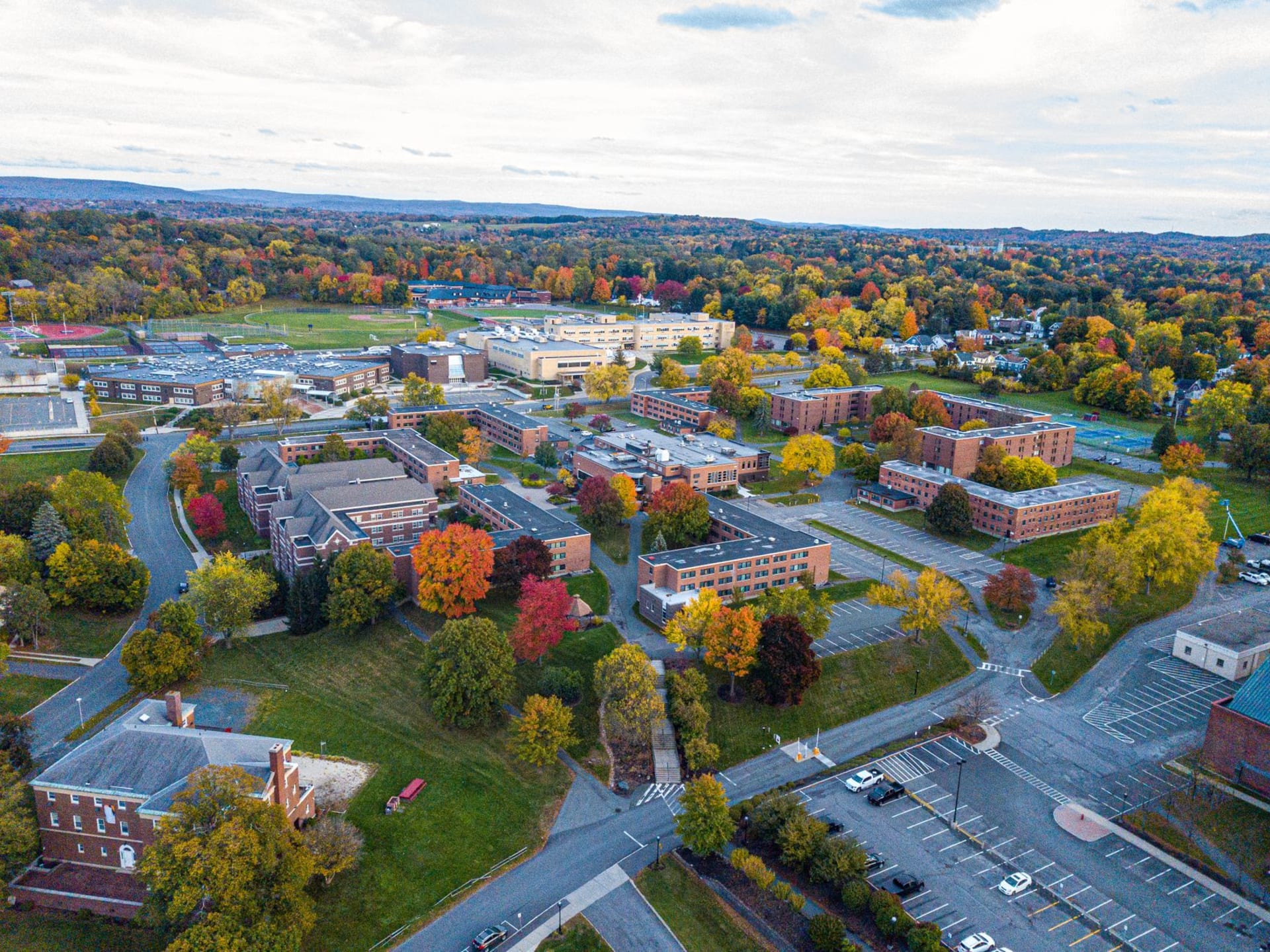
Middlebury
"In Middlebury, the town was built quite literally around a waterfall, and it's still the first thing anyone shows you."
A Green Mountain college town split by a waterfall, where Otter Creek tumbles right through the middle of downtown beneath a historic gristmill turned shop. Lia and I lingered on the falls bridge longer than any single waterfall has ever earned, just watching the water and the students go by.

Middlebury announces itself with a waterfall right in the center of town, where Otter Creek drops over a limestone ledge beside a stone mill building that once ground grain for the whole valley. Lia and I arrived expecting a quiet college town and got that, plus this unexpected drama of falling water framed by brick storefronts and a white-steepled church on the hill above — Middlebury College’s campus climbs that hill, giving the whole town a layered, postcard geometry of falls, Main Street, and ivy.
The falls and the marble works
We spent our first afternoon simply walking the little network of bridges and overlooks around the falls, where the old Frog Hollow mill complex now houses artisan shops and a craft gallery instead of grinding wheels. A short walk uphill, the Vermont Folklife exhibits and a small marble-working display reminded us that Middlebury’s wealth came originally from marble quarried nearby — the same stone that built much of the town’s handsome 19th-century architecture, including the college’s oldest halls.

Cider, cheese, and the college green
Middlebury sits at the heart of Addison County farm country, and we spent a golden afternoon driving a loop of the Vermont Cheese Trail, stopping at a working creamery for samples of clothbound cheddar before finishing at a small orchard for cider donuts eaten standing up in the parking lot. Back in town that evening, the college green filled with students playing frisbee under maples just starting to turn, and we ate dinner at a Main Street bistro that sourced nearly everything on the menu from farms we’d probably just driven past.

Getting There
Burlington International Airport is the closest, about forty minutes north via Route 7, and most visitors fly there before renting a car. From Boston, it’s roughly a three-and-a-half-hour drive northwest through the mountains. Amtrak’s Ethan Allen Express also connects Middlebury to New York’s Penn Station, a scenic if unhurried alternative to driving. Once in town, the compact downtown is entirely walkable, though a car is useful for reaching the surrounding farms and orchards.
Keep exploring
More of Vermont
Keep exploring
More from Vermont
 united-states
Shelburne
Lia and I went for the museum and stayed for the farm, and somewhere between a steamboat parked on dry land and cows grazing above Lake Champlain, we lost an entire day without noticing.
Explore united-states
Waitsfield
The Mad River Valley is where I finally understood the appeal of a Vermont ski town in summer — a red covered bridge, farm stands doubling as restaurants, and Lia insisting we detour to a round barn just because it sounded strange.
Explore united-states
Rutland
Vermont's third-largest city turned out to be exactly the kind of unglamorous, working place I like best — a marble-veined downtown, a Saturday market that's been going since before I was born, and a train platform that still means something.
Explore united-states
Burlington
A small lakefront city on Lake Champlain's eastern shore, its brick downtown built around a pedestrian marketplace and the Green Mountains rising hazy across the water. Lia and I biked the waterfront at sunset and watched the Adirondacks turn purple across a lake wide enough to feel like an inland sea.
Explore united-states
Montpelier
The smallest state capital in America, a walkable town of gold-domed government buildings, co-op groceries, and a river that floods its own streets with regularity. Lia and I spent a rainy afternoon here and left convinced no other capital feels quite this much like a village.
Explore united-states
Stowe
A Vermont village of a white church steeple, covered bridges and the green wall of Mount Mansfield behind it, that turns to fire in October and to powder in January. It is the New England postcard made real, and it earns the cliché. Lia and I arrived at the height of the leaves and understood the fuss.
Explore