Big Bend
"One bank was Texas, the other Mexico, and the river between them didn't seem to know or care."
A remote sweep of desert, river canyons and mountains folds itself around a great bend of the Rio Grande on the Texas–Mexico border. It is one of the emptiest, darkest, most gloriously distant places in the country. You drive for hours to reach it, and then you understand why so few people bother, and are grateful.
You feel Big Bend before you arrive in it — in the emptying of the highway, the widening of the sky, the way the last town falls behind and doesn’t get replaced by another. We drove the final stretch in near silence, the Chisos Mountains rising blue and unlikely out of the flat desert ahead, and Lia said what I was thinking, which was that we had not seen another car in twenty minutes. There is a particular happiness in being genuinely far from things. Big Bend delivers it in bulk. By the time we set up at the Chisos Basin campground, the last light was going lilac on the peaks and a family of javelinas trotted through the sage as if we were the trespassers, which we were.
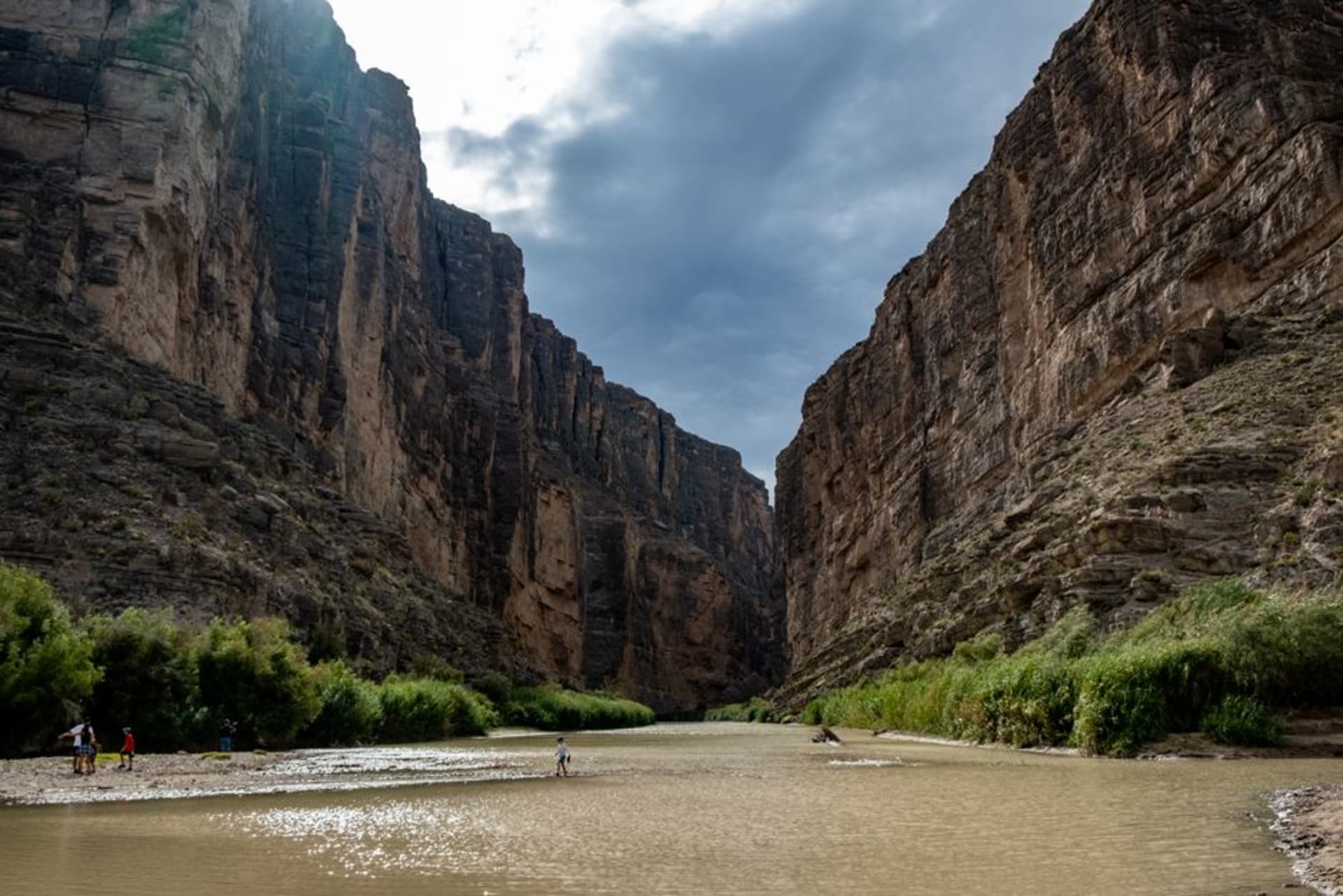
Santa Elena Canyon
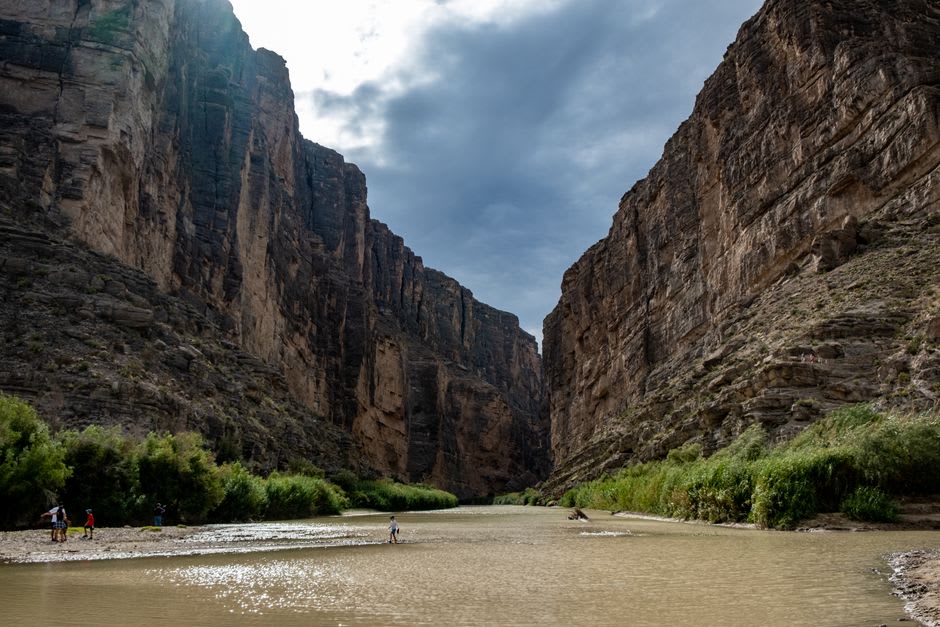
The most astonishing single thing we saw was Santa Elena Canyon, where the Rio Grande has sawed a slot fifteen hundred feet deep straight through a limestone plateau. You walk in along the riverbank, the canyon walls closing overhead until they nearly meet, cool shadow pooling where the sun can’t reach, and the green water sliding past your boots is the actual border — Texas on your side, Mexico an arm’s length across. Lia waded in to her knees and stood there grinning in the echoing cool. A canyon wren sent its falling silver song down the walls. We ate our sandwiches on a gravel bar with a country we’d never set foot in rising sheer on the far bank, close enough to throw a stone into.
Up into the Chisos
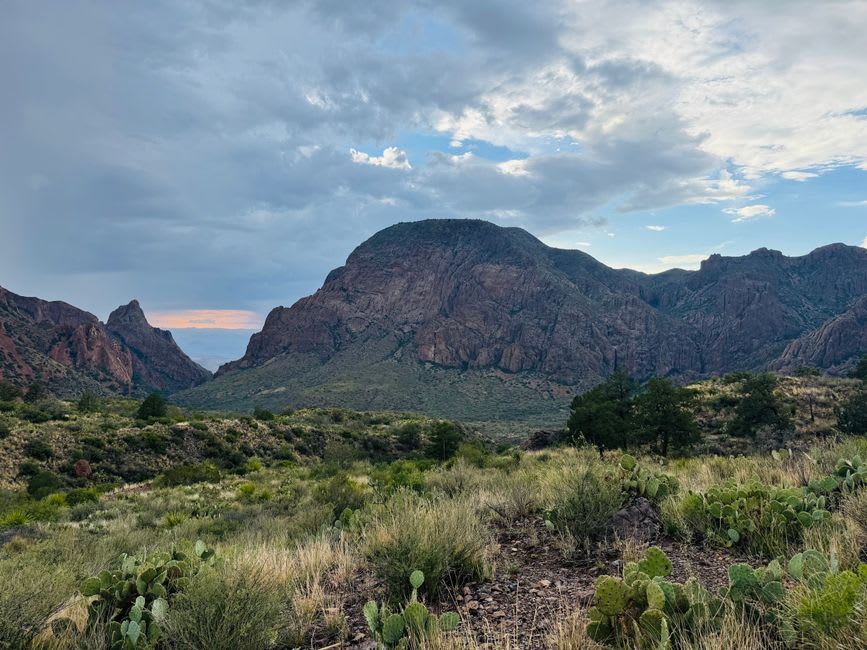
The Chisos Mountains are an island of coolness and pine floating in the surrounding desert, the only mountain range fully contained within a single U.S. national park. We hiked the Window Trail, which drops down through the basin to a pour-off where the whole range funnels its rare rainwater into a V-shaped notch that frames the desert far below like a painting hung in a doorway. The change in the air as you descend is real — juniper and oak, birdsong, the smell of damp stone near the pour-off itself, where the polished rock is slick and you edge forward carefully to look through the Window at a hundred miles of nothing. We sat at the lip with our feet dangling and watched a hawk ride the thermals rising off the hot floor of the world.
The Darkest Sky
We had been told Big Bend has some of the darkest night skies in the lower forty-eight, and I filed that away as the kind of thing brochures say. Then the sun went down over the Chisos and the sky simply filled. Not the scattering of stars you get near any town — a dense, luminous, dust-and-glory band of the Milky Way arching from horizon to horizon, so bright it cast a faint shadow, so crowded it was hard to pick out the constellations we knew. We lay flat on the still-warm hood of the car and didn’t talk. A meteor drew a long chalk line across it. Lia found my hand in the dark. Somewhere down in the desert a pack of coyotes started up, and we listened to them until the cold finally drove us into the tent.
Getting There
Big Bend National Park occupies a far corner of West Texas, and remoteness is the whole point — plan for a long drive. The nearest airports are Midland/Odessa (about three hours north) and El Paso (roughly four to five hours west); from there it’s an empty, beautiful haul on US-90 and US-385. Fuel up before you enter, as services inside and near the park are minimal. A car is mandatory. Late autumn through early spring is the sweet season; summer in the desert lowlands is brutally hot, though the Chisos stay cooler. Reserve campsites or a room at the Chisos Mountains Lodge well ahead — the park is vast but its beds are few.
Keep exploring
More of Texas