
Theodore Roosevelt National Park
"A band of wild horses crested the ridge against a pink sky, and for a moment there was no century attached to what we were looking at."
North Dakota's badlands unfold in banded buttes and eroded coulees along the Little Missouri River, roamed by bison and bands of wild horses. It is the park that shaped a president, and one of the loneliest, most underrated corners of the American West.
We came to Theodore Roosevelt almost by accident, filling a gap on a drive across the northern plains, and it turned out to be the highlight of the whole trip — the kind of place hardly anyone talks about, which is precisely why I want to. On our first evening we pulled off the Scenic Loop Drive in the South Unit as the sun dropped, and a band of wild horses appeared on a ridge above us, manes catching the last light, watching us with more curiosity than fear. They are descendants of ranch stock gone feral generations ago, and the park lets them roam. Lia turned off the engine and we just sat, windows down, listening to them tear at the grass. It was the sort of quiet that has a texture to it.
The Badlands That Made a President
The young Theodore Roosevelt came here in 1883 to hunt bison and, gutted by the deaths of his wife and mother, stayed to ranch and grieve, and he later said he would never have become president without his time in these badlands. You understand the pull immediately. The Little Missouri River has carved the flat prairie into a maze of banded buttes, striped coulees, and eroded slopes streaked with red — the red is scoria, clay baked brick-hard by burning coal seams. It is softer and greener than the badlands of South Dakota, more inhabited, the erosion draped in juniper and grass rather than laid bare. His Maltese Cross Cabin still stands near the visitor center, small and dark and startlingly modest.
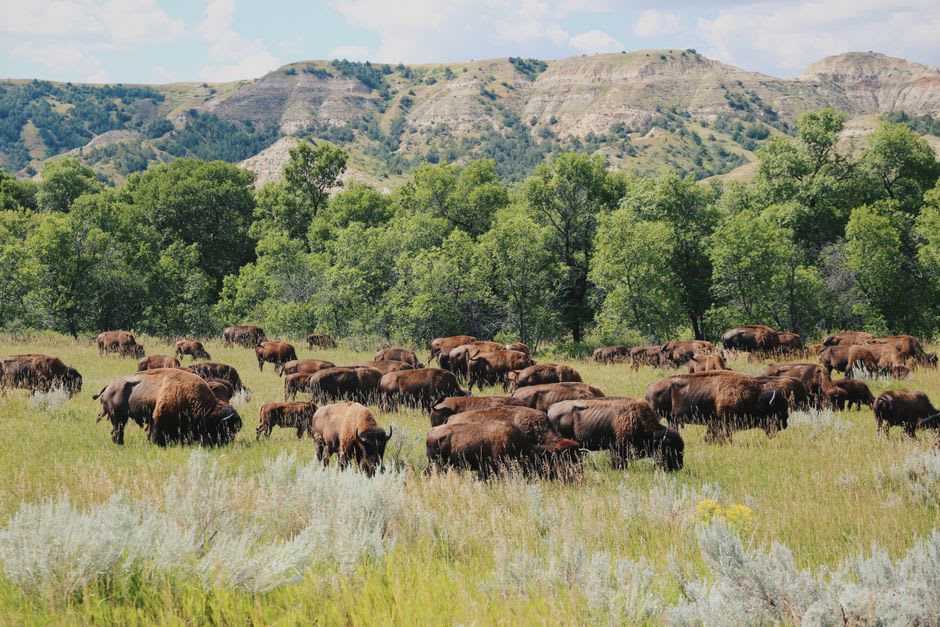
Bison on the Road and Prairie Dog Towns
The wildlife here has a frontier abundance to it. Bison graze right along the loop road and lie in the dust of the pullouts, and more than once we waited, engine off, while a bull the size of a small car decided whether to move. Prairie dog towns pock the flats, hundreds of animals standing at their burrows and chirping alarm in a rolling wave as you pass. We saw pronghorn, mule deer stepping down to the river at dusk, and a lone bull elk in the timber. Wild turkeys crossed in front of us in the grass. It is one of those rare places where the animals clearly outnumber the visitors, and behave as though they know it.
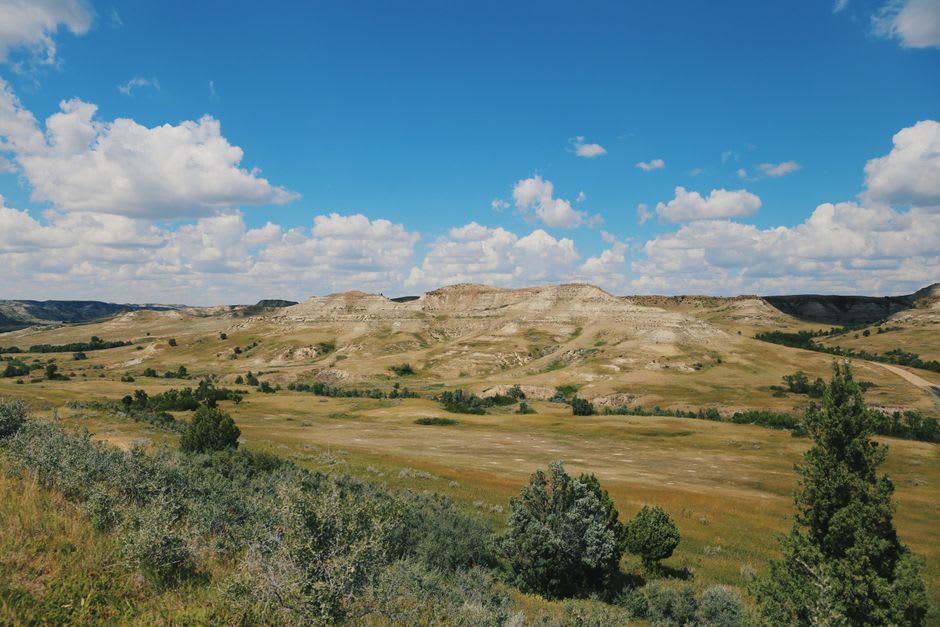
Two Units and a Painted View
The park comes in two main pieces an hour apart, and they feel different enough to warrant both. The South Unit, off Interstate 94 at Medora, has the classic Scenic Loop and the easy overlooks. The North Unit, quieter still, is wilder and more dramatic, its Oxbow Overlook gazing down on a great bend of the Little Missouri and its cannonball concretions — perfect stone spheres eroding out of the cliffs. We hiked a stretch of the Caprock Coulee trail there and saw not another soul for two hours. At sunset we drove back to the Painted Canyon Overlook and watched the whole eroded valley go from ochre to rose to violet, and Lia said, rightly, that we would tell people about this one.
Getting There
The South Unit sits right off I-94 at the tiny cowboy town of Medora in western North Dakota, about two and a half hours west of Bismarck; the more remote North Unit is roughly an hour north near Watford City. The nearest airports are Bismarck and Dickinson. Summer brings warm days, thunderstorms, and the most reliable wildlife viewing; September and early October are glorious, with cottonwoods turning gold along the river and the crowds — such as they ever are — gone home. Drive the loops at dawn or dusk, when the animals move and the buttes catch fire.
Keep exploring
More of North Dakota