Cottonwood Falls
"Cottonwood Falls has fewer than a thousand people and one of the most beautiful courthouses in America."
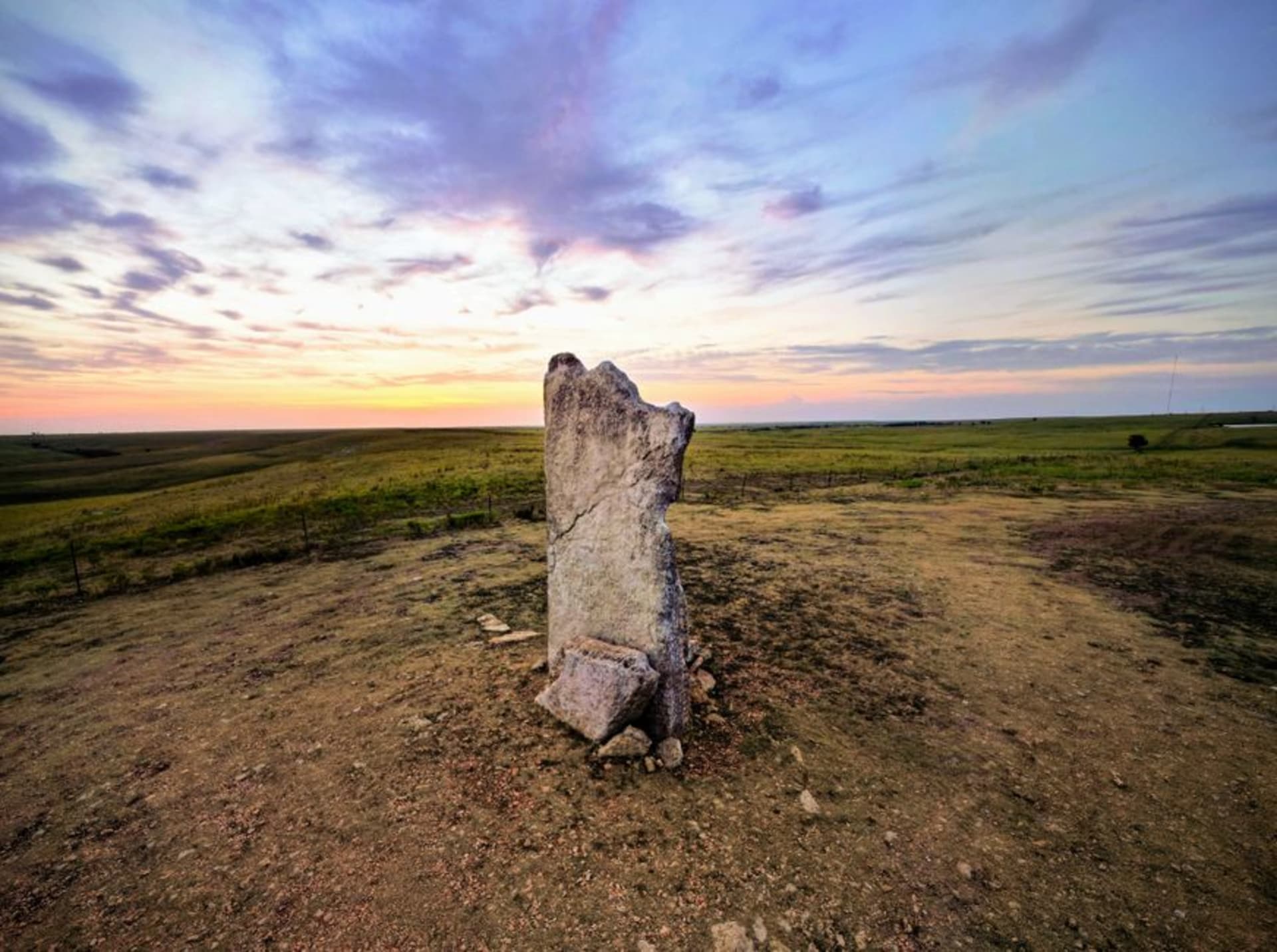
A town of under a thousand people with a French Renaissance courthouse rising absurdly out of the tallgrass prairie around it. Lia and I hiked into the Flint Hills at sunset and didn't see another car for two hours.
Nothing about the drive into Cottonwood Falls prepares you for the Chase County Courthouse, a French Renaissance limestone building with a mansard roof and a clock tower that would look at home in a small European city, sitting in the middle of a Kansas town of barely 800 people. Built in 1873 from local limestone quarried a few miles away, it’s the oldest courthouse still in continuous use west of the Mississippi, and Lia, who grew up around genuinely old European civic architecture, admitted it stopped her in her tracks in a way she hadn’t expected from rural Kansas.
Into the Flint Hills
The real draw for us, though, was what surrounds the town: the Flint Hills, the largest remaining stretch of unplowed tallgrass prairie left in North America, rocky ground that resisted the plow just enough to save it from becoming farmland like almost everywhere else. We hiked a loop trail at the nearby Tallgrass Prairie National Preserve as the sun dropped low, grass up past our knees moving in waves with the wind, bison grazing in the distance, and not another soul in sight for the better part of two hours. It’s a strange, quiet kind of vastness — no mountains, no ocean, just rolling green-gold hills to every horizon.
Broadway Street and the Emma Chase
Back in town, Cottonwood Falls’ Broadway Street runs a short block of well-kept storefronts, several housing art galleries that seem improbable for a town this size but make sense once you learn artists have been quietly drawn here for decades by the light and the emptiness. We had lunch at the Emma Chase Cafe, a local institution known for hosting live music and famously excellent pie, and talked with the owner about ranching families who’ve worked this same prairie for five generations, still burning the hills each spring the way the Osage did long before them.
Getting There
Cottonwood Falls is about 90 minutes from Wichita’s regional airport (ICT) and roughly two hours southwest of Kansas City via I-35 and Highway 177, which runs directly through the Flint Hills and is one of the more scenic drives in the state. A car is essential — there’s no public transit here — and the drive itself, especially along the Flint Hills Scenic Byway, is worth treating as part of the destination.
Keep exploring
More of Kansas