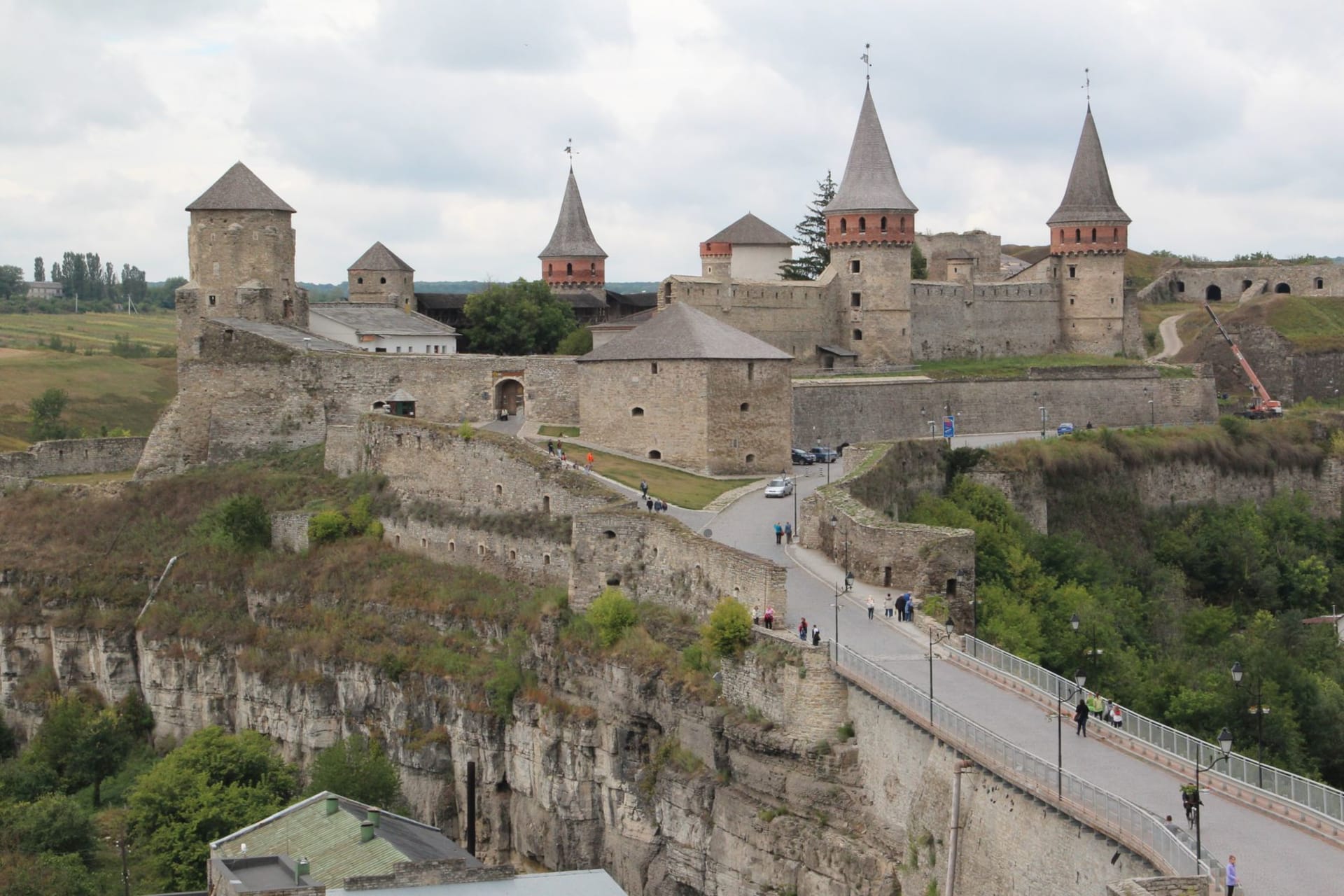
Kamianets-Podilskyi
"The fortress doesn't command the landscape — it argues with it, and it's been winning for six centuries."
The approach to Kamianets-Podilskyi is what stays with me. You’re driving through the flat agricultural plains of Podolia — sunflower fields, grain silos, the unremarkable horizon of inland Ukraine — and then suddenly the earth opens. The Smotrych River has carved a canyon roughly thirty meters deep, and inside that canyon, on a naturally formed peninsula that the river loops around on three sides, sits a medieval city. The fourth side of the peninsula, where it meets the plateau, is where the fortress was built. The whole arrangement looks like something from a fantasy novel that a medieval strategist happened to stumble upon.
The Fortress
The Old Castle is the reason most people come, and it justifies the trip. Eleven towers connected by curtain walls, built by Lithuanian princes and reinforced by Polish kings and contested by Ottoman armies — the fortress has been besieged more times than its records can reliably count. The Turks held it for twenty-seven years in the 17th century and converted the cathedral inside to a mosque, leaving a minaret that the Poles converted back into a bell tower after they reclaimed it. That repurposed minaret, still standing, is one of the most compressed pieces of religious-political history I’ve encountered in any building.
The Old Town Island
The old town on the island is smaller and quieter than the fortress draws, and more interesting for it. Cobblestone streets, Armenian and Dominican churches, the fragmentary remains of multiple cultures that passed through and left their facades. The Trinity Church has an incongruous sculpture of a Madonna installed on top by the Poles, placed there to convert the remaining minaret — it’s the kind of layered improvisation that turns a building into a document. The market square at the center of the island has been there long enough that it’s settled into the stone with a confidence that modern squares never achieve.
The Canyon Paths
Below the old town, trails drop into the canyon alongside the Smotrych. This is where the geology makes itself felt: the river has cut through limestone to expose walls that rise fifty meters on either side in places, moss-covered and theatrical. I walked the canyon path in the late afternoon when the shadows were already halfway up the walls and the light at the top was still golden, and the fortress towers appeared and disappeared above me as the trail curved. It’s one of those hikes that feels cosmically staged but is actually just a river doing what rivers do over a long time.
Practical Pleasures
Kamianets-Podilskyi is a small city of about a hundred thousand people, and it functions like one. There are good cafés near the central square, a few decent hotels in the old town, and the absence of large tourist infrastructure actually helps — the pace is the pace of the place rather than the pace of tour groups. I arrived with a day and a half and found that perfectly calibrated: enough time to walk everything thoroughly, not enough time to exhaust it.
When to go: Late April through October is the viable window; July and August are peak season when the fortress and canyon paths are busiest but most festive. The city hosts a medieval festival in late spring that’s worth timing a visit around if you can. Spring and early autumn combine good weather with significantly fewer visitors — ideal conditions for the canyon paths especially.