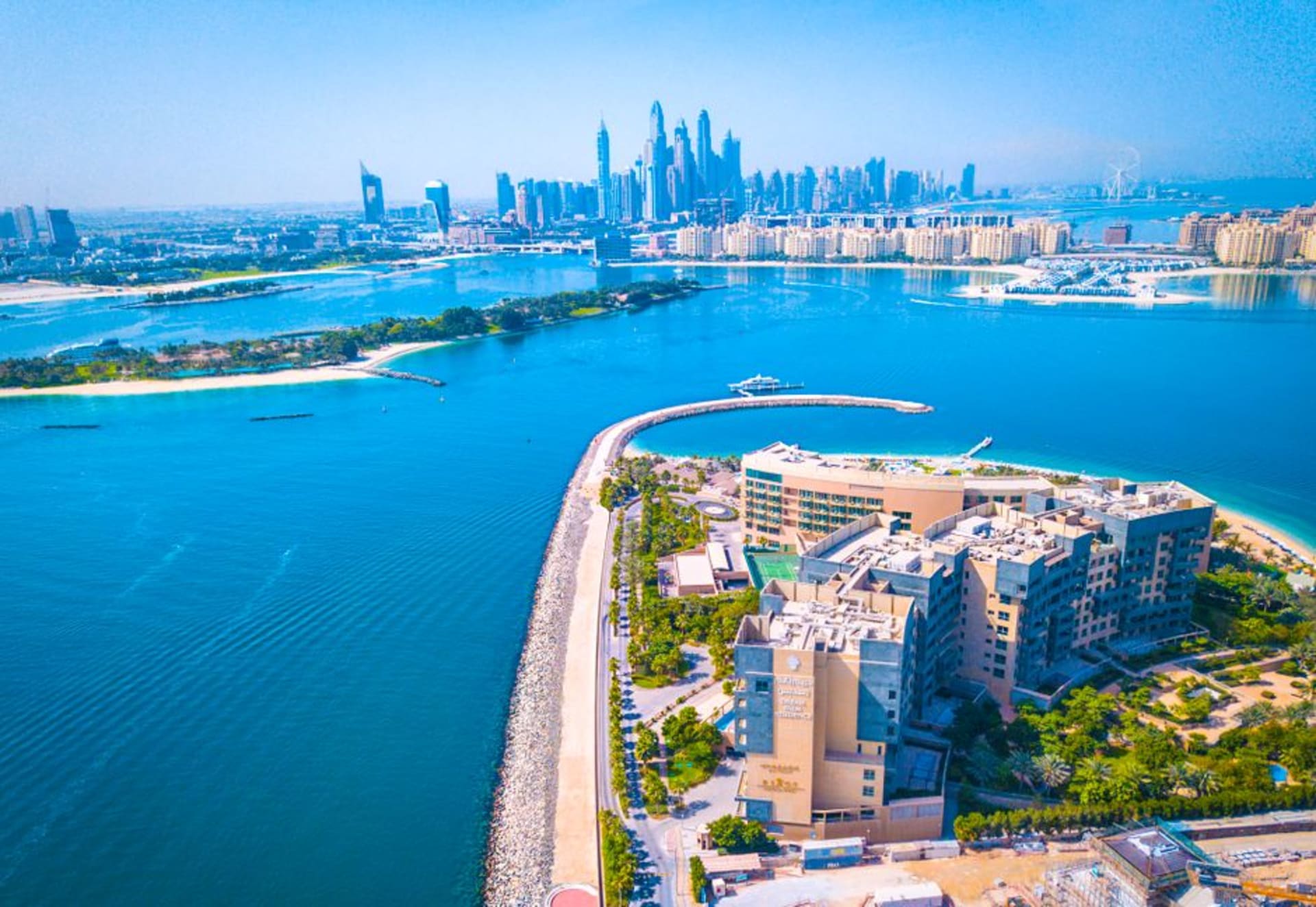
Palm Jumeirah
"You can only really see the shape of it from an airplane window — which tells you everything about how it was designed."
A palm-tree-shaped island built entirely from dredged sand, visible from space and impossible to fully grasp from the ground, with a monorail stitching its fronds together.
The strange thing about Palm Jumeirah is that you cannot actually experience its defining feature while you’re on it. The island’s famous shape — a trunk, sixteen fronds, a surrounding crescent breakwater — only reads as a palm tree from several thousand feet up, which means most of the people who live and holiday there will never see the thing they’re standing on. I only understood this properly on a flight out of Dubai, pressing my face to the window as the wheels came up, watching the whole absurd geometry unfold below like a diagram come to life. From the ground, on the trunk itself, it just feels like a very long, very manicured boulevard.
That trunk-and-frond structure isn’t decorative. Built from millions of cubic metres of sand and rock dredged from the Gulf floor and shaped by GPS-guided reclamation, the fronds were engineered to maximize beachfront property — every villa on every frond backs directly onto private sand, which was the entire commercial logic of the design. It remains one of the largest artificial islands ever constructed, and depending on which stretch of the trunk you’re walking, you can still catch the faint mineral smell of dredged seabed under the landscaping.
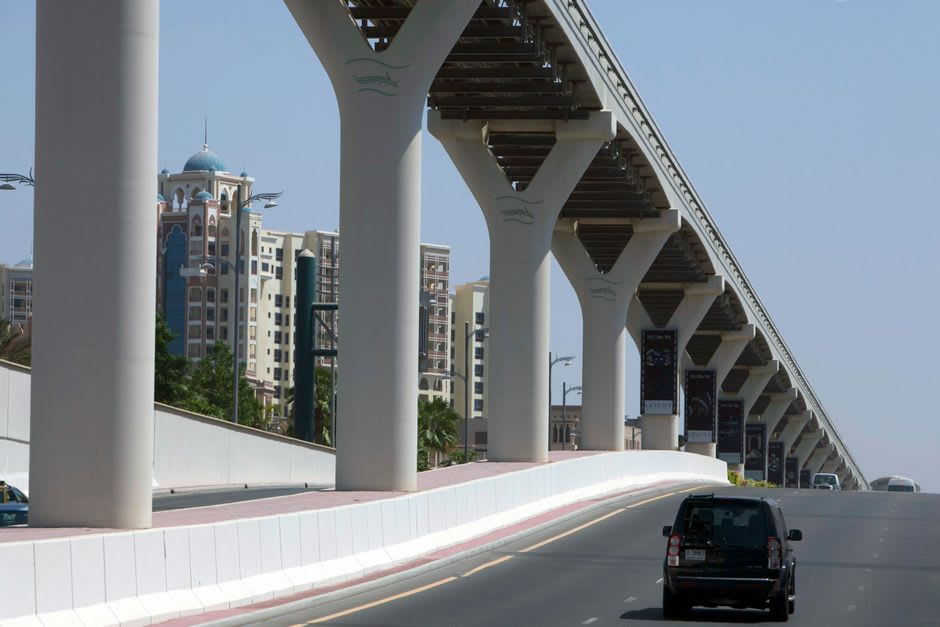
The monorail and the hotel at the tip
Getting around the Palm without a car means using the driverless monorail that runs the length of the trunk, a five-minute ride that gives you the closest thing to an aerial view most visitors will get — glimpses down the fronds toward the water on either side, villas and low-rise apartment blocks flashing past in a rhythm that starts to feel almost hypnotic after a few stops.
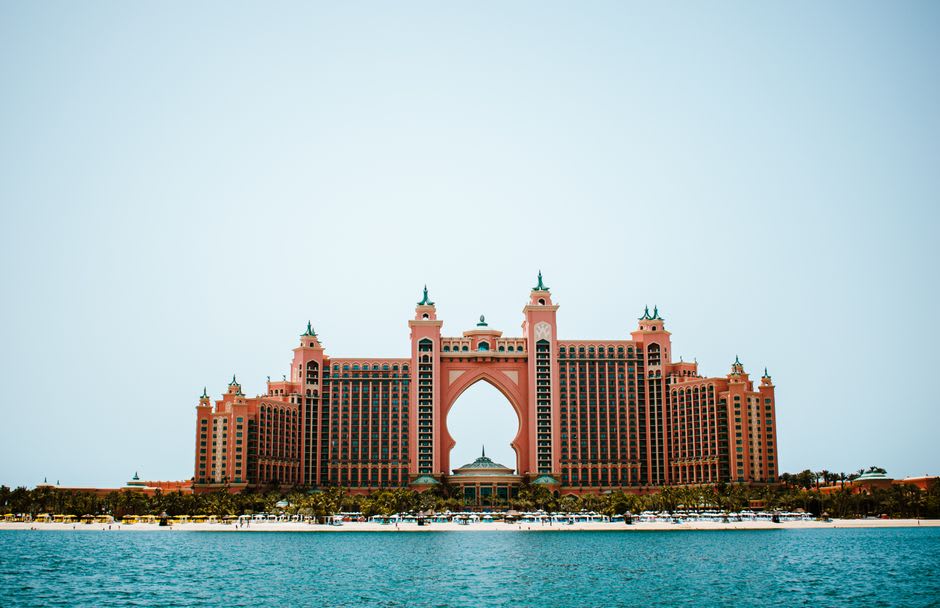
At the trunk’s end sits Atlantis, the resort that anchors the whole development in most people’s minds — pink towers arched over a central gap, water park sprawling around its base, aquarium tunnels running beneath the lobby. I went for a single afternoon, mostly skeptical, and left grudgingly impressed by the sheer commitment to spectacle: a resort built as a destination unto itself, at the far tip of an island built as a destination unto itself. The beach out front, looking back down the length of the trunk toward the mainland skyline, gave me the best sense of scale I got anywhere on the Palm — towers stacking up in the haze, the whole engineered peninsula stretching back toward a city that, from this distance, looked almost modest.
What nobody tells you before you go is how quiet the fronds themselves are. Away from Atlantis and the handful of beach clubs, the residential streets are close to silent — gated, manicured, oddly suburban for something built on reclaimed sand in the middle of the Gulf.
When to go: November to March for the beach and the monorail views; book Atlantis activities for morning, before the day-trip crowds from the mainland arrive after lunch.
Keep exploring
More from UAE
 uae
uae Ras Al Khaimah
The UAE's adventure emirate, where the Hajar Mountains meet desert dunes and the world's longest zipline launches from a 1,680-meter peak.
Explore uae
uae Sharjah
The UAE's cultural capital, a UNESCO-recognized emirate where Islamic art museums and heritage districts preserve the Gulf's intellectual traditions.
Explore uae
uae Sir Bani Yas
A desert island transformed into a wildlife reserve, where Arabian oryx, giraffes, and cheetahs roam a former royal retreat off Abu Dhabi's coast.
Explore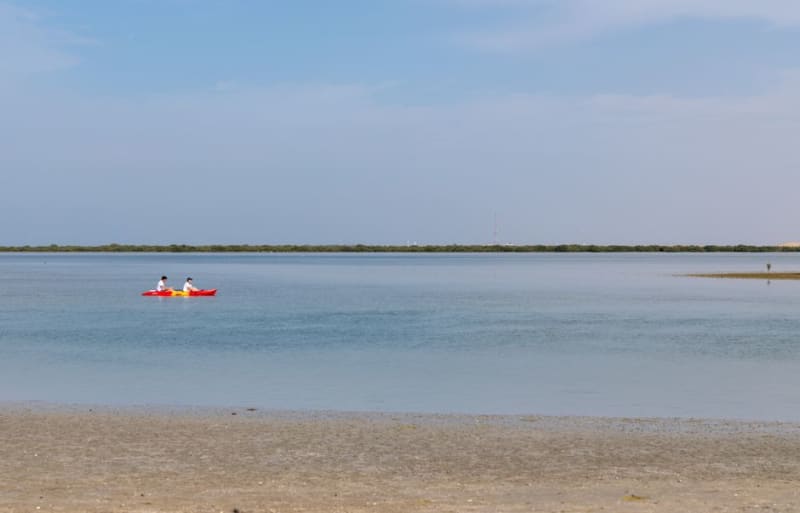 uae
uae Umm Al Quwain
The UAE's quietest emirate, where a mangrove lagoon and a pearling-town past have survived almost entirely untouched by Dubai's skyline energy.
Explore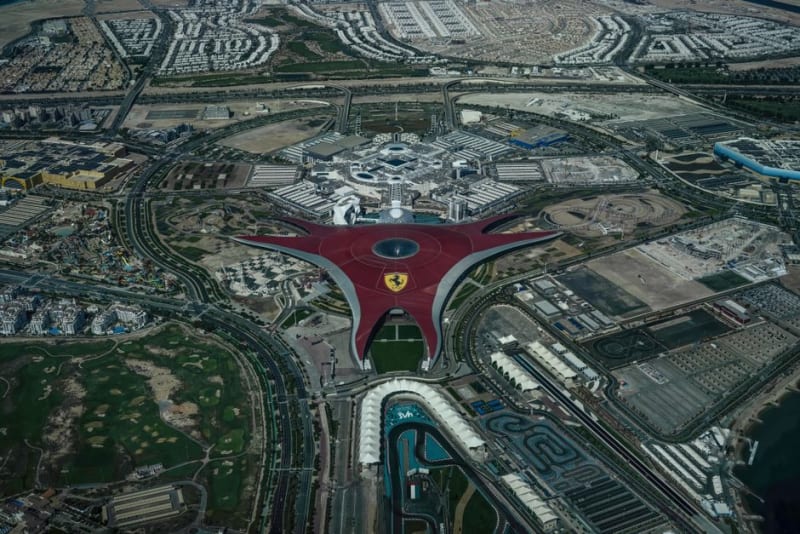 uae
uae Yas Island
Abu Dhabi's purpose-built entertainment island, home to Ferrari World, Yas Waterworld, and the floodlit Formula 1 circuit, unapologetically separate from the capital's formal center.
Explore uae
uae Abu Dhabi
The UAE capital, where the Sheikh Zayed Grand Mosque's white marble meets world-class museums and a more measured pace than its brash neighbor.
Explore