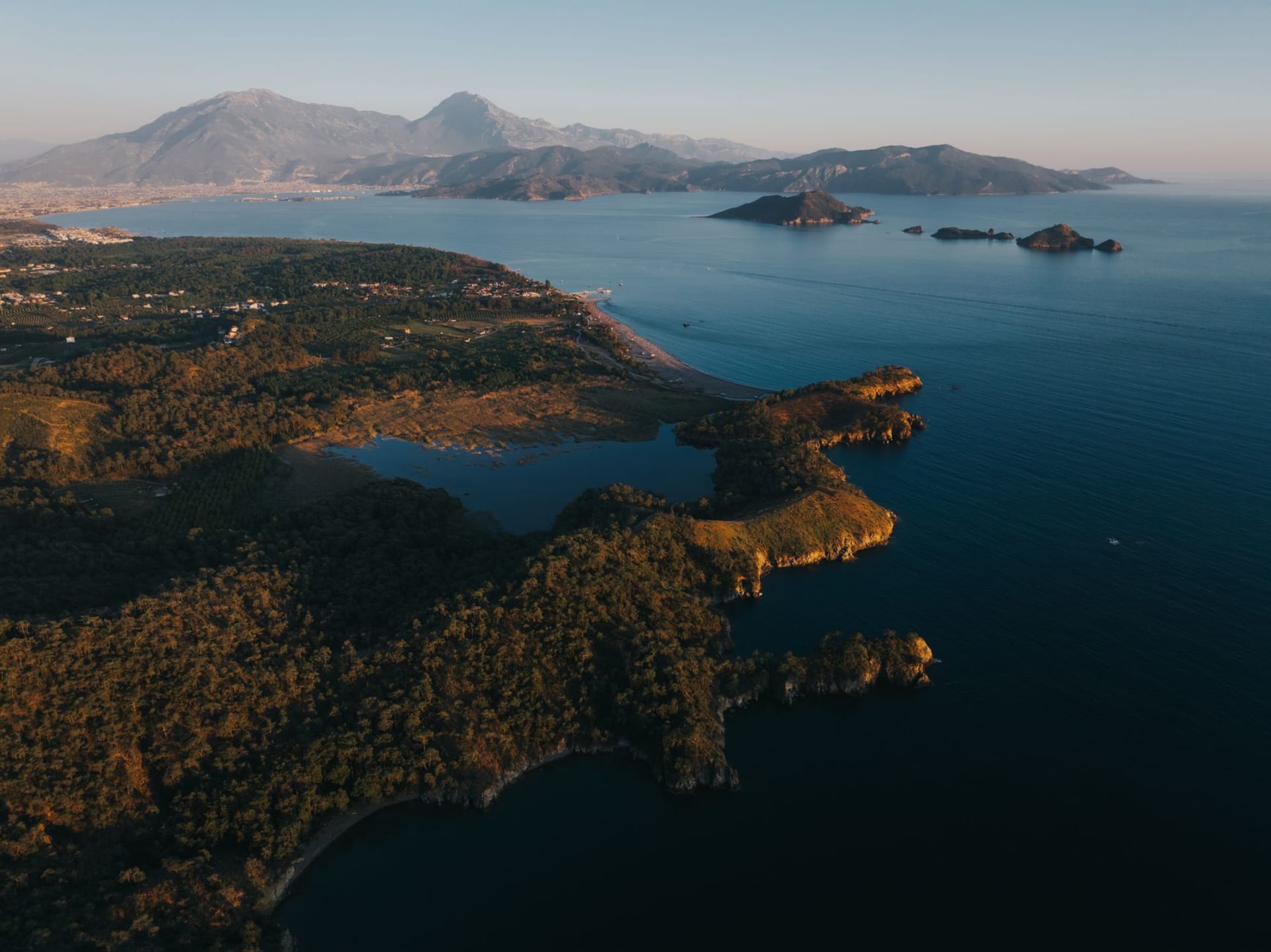
Fethiye
"The tombs in the cliff have been there since the fourth century BC. Below them, someone is selling fresh swordfish out of a bucket."
Fethiye is not trying to charm you, which is partly why it does. It’s a real town — municipal buildings, a produce market that sells to actual residents, traffic roundabouts — that happens to sit at the edge of one of the most beautiful bays on the Turkish coast and to have a set of Lycian rock tombs carved directly into the limestone cliff above the marina. The juxtaposition never quite normalizes.
The Rock Tombs and What Surrounds Them
The Tomb of Amyntas, cut into the cliff face above the town center in the fourth century BC, is the largest and best-preserved of Fethiye’s Lycian tombs — a facade modeled on a Greek temple front, columns and all, hollowed into solid rock. At night the municipality floods it with warm light, and it glows amber above the rooftops in a way that feels less like illumination and more like revelation.
Getting up to it requires a fifteen-minute walk up stepped lanes from the town center, past houses with trellised vines and the smell of wood smoke even in summer. The view from the platform in front of the tomb takes in the full bay, the islands scattered across it, and on a clear day the mountains behind Ölüdeniz. I went twice: once in the late afternoon and once at night, and they are effectively two different experiences.
The Market and the Waterfront
Fethiye’s Tuesday market is a serious affair that takes over the streets behind the waterfront and draws vendors from across the region. I found cured olives in eighteen varieties, pomegranate molasses in unmarked jars, sun-dried peppers strung like garlands, and a stall run by an elderly man selling nothing but different sizes of the same wooden spoon. The fish market operates daily inside a covered hall near the harbor; you select your fish at one counter, pay the market price, and carry it through a connecting door to one of the restaurants surrounding the building, who cook it for a set service fee. It is an excellent system.
Day Trips by Boat
Most visitors use Fethiye as a base, and reasonably so. The twelve-island boat tour is the standard offering: a day on the water stopping at swimming coves, a ghost village, a hot spring, various rocky outcrops. I went on a private gulet charter with a small group, which meant we could linger at the good places and move through the mediocre ones faster. Göcek Bay to the north is quieter and more beautiful; ask your operator to go that direction rather than east toward the crowds.
The Lycian Way on Foot
The long-distance Lycian Way hiking trail passes through or near Fethiye, and even non-hikers can walk the first few kilometers of its coastal section for a sense of the landscape: dry pine forest, limestone paths, views over the bay that keep getting wider as you climb. Lia and I walked about four kilometers one morning before turning back for coffee. It was enough to understand why people do the whole thing.
Fethiye is also the launch point for the Blue Lagoon at Ölüdeniz, thirty minutes east by dolmuş — which means you can enjoy the resort experience and then come back to a town with actual character to sleep in.
When to go: April through June for hiking and sightseeing without the summer heat. September and October for warm water, lower prices, and the best light of the year. The Tuesday market runs year-round. Avoid mid-July through August if you’re sensitive to crowds — the harbor fills to capacity and accommodation prices spike.