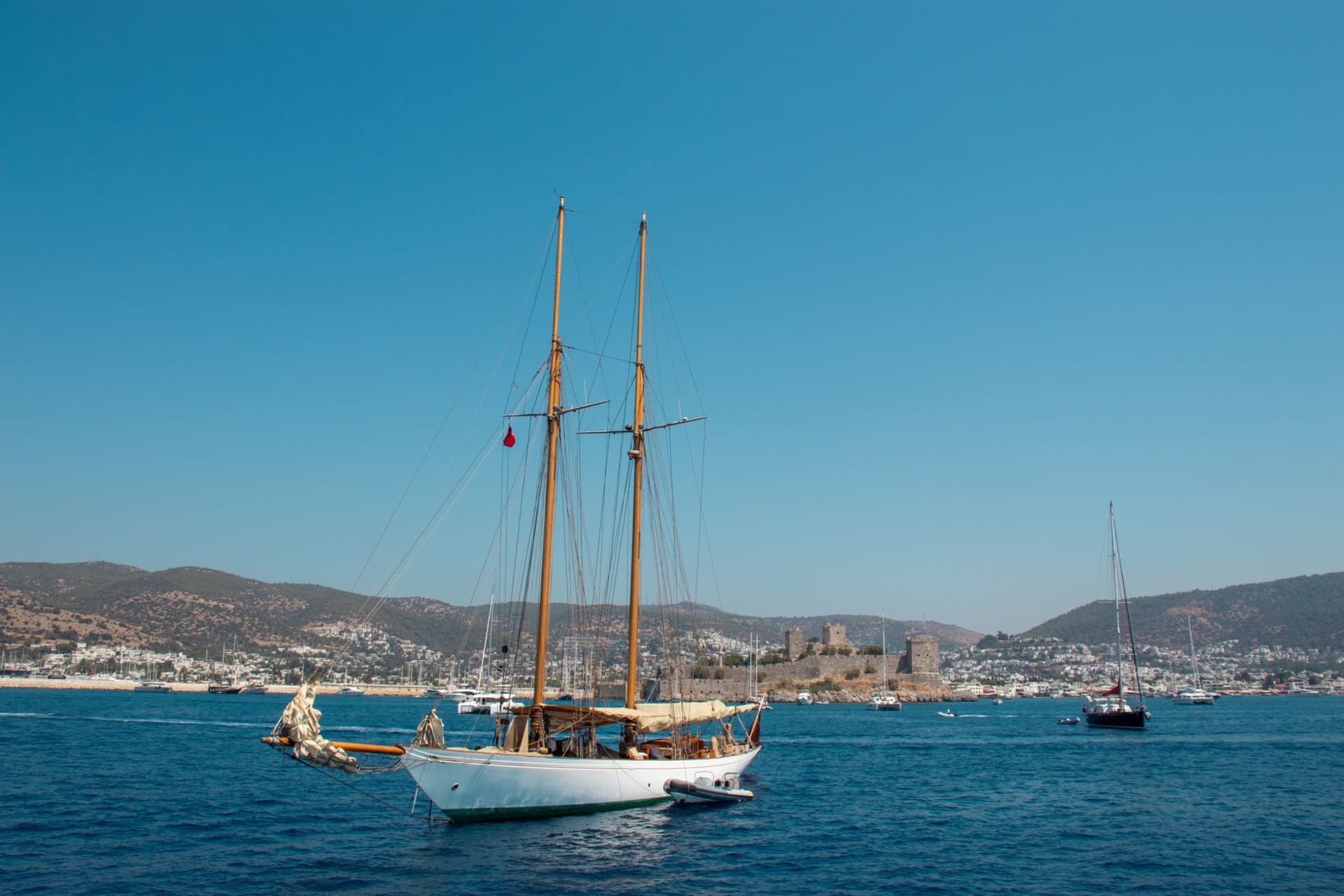
Bodrum
"Bodrum has figured out how to be expensive and genuine at the same time, which is either an achievement or a sleight of hand I haven't identified yet."
Bodrum is the most famous town on the Turkish coast for good reason and in spite of it. It has a Crusader castle, an ancient mausoleum that gave the world the word “mausoleum,” a vibrant nightlife district, serious yacht culture, and a tradition of intellectual and artistic life that stretches back to the writer Cevat Şakir Kabaağaçlı — known as the Fisherman of Halicarnassus — who was exiled here in the 1920s, fell in love with the place, and never left. The combination shouldn’t work. Improbably, it does.
The Castle of St. Peter
The Castle of St. Peter stands at the point separating Bodrum’s two bays, built by the Knights Hospitaller in the fifteenth century from the cut stones of the ancient Mausoleum of Halicarnassus, which makes it an archaeological site consuming an archaeological site. Inside it holds the Museum of Underwater Archaeology — one of the finest such museums in the world — which exhibits artifacts from Bronze Age, Phoenician, Byzantine, and Ottoman shipwrecks recovered from the sea floor off the Turkish coast over decades of excavation.
The Bronze Age Uluburun shipwreck display alone, from a fourteenth-century BC vessel that went down off Kaş carrying Canaanite, Egyptian, Cypriot, and Mycenaean goods, is worth the trip to Bodrum independently of everything else the town offers. The diversity of origins of the cargo on a single ship from 1300 BC tells you something about the Mediterranean that no general history book quite captures in the same way.
The Old Town and the Bazaar
Bodrum’s old town spreads back from the castle through lanes of whitewashed houses, bougainvillea so thick it forms awnings over the street, and a covered bazaar that operates on local rather than tourist time — the merchants here seem genuinely indifferent to whether you buy anything. I like that quality in a market. The produce section sells dried figs, pistachios, and fruit leather in quantities designed for families rather than tourists; the spice stalls have the density of smell that makes you stop and just stand there.
The marina district above the old town is emphatically tourist-facing: boutiques, restaurants, bars, a promenade designed for evening strolling. It’s well done. I spent two evenings there without feeling manipulated, which is about the best you can say for resort infrastructure.
Gumusluk and the Peninsula
The Bodrum Peninsula holds a dozen smaller villages, each with its own character, reachable by dolmuş in twenty to forty minutes. Gumusluk, on the west coast, occupies the site of ancient Myndos and extends its main restaurant strip into the shallow water on a causeway that fords to Rabbit Island. Diners eat at tables that stand literally in the sea, which should be gimmicky and instead is very pleasant, especially with a glass of rakı and a plate of midye dolma — mussels stuffed with rice, pine nuts, and currants.
Türkbükü to the north is the expensive version of this coast — villas, private beach clubs, a crowd that arrives by charter. It’s beautiful in a way that requires money to fully access. Yalıkavak on the northwest tip has a large marina and a quieter character than Bodrum town.
Evenings in Bodrum
Bodrum’s bar street — Cumhuriyet Caddesi, universally called Bar Street — is loud, well-organized hedonism. I went once, understood it, and preferred the harbor-front thereafter. But I don’t fault the logic of Bar Street. It exists because people want it to exist, and it delivers exactly what it promises.
When to go: May and early June for the peninsula at its most manageable. September and October are excellent: the water stays warm well into autumn, the crowds thin after the first week of September, and Bodrum’s intellectual side — readings, art openings, evening concerts in the castle courtyard — becomes more prominent. Mid-July to mid-August is peak at every level; plan accordingly or avoid accordingly.