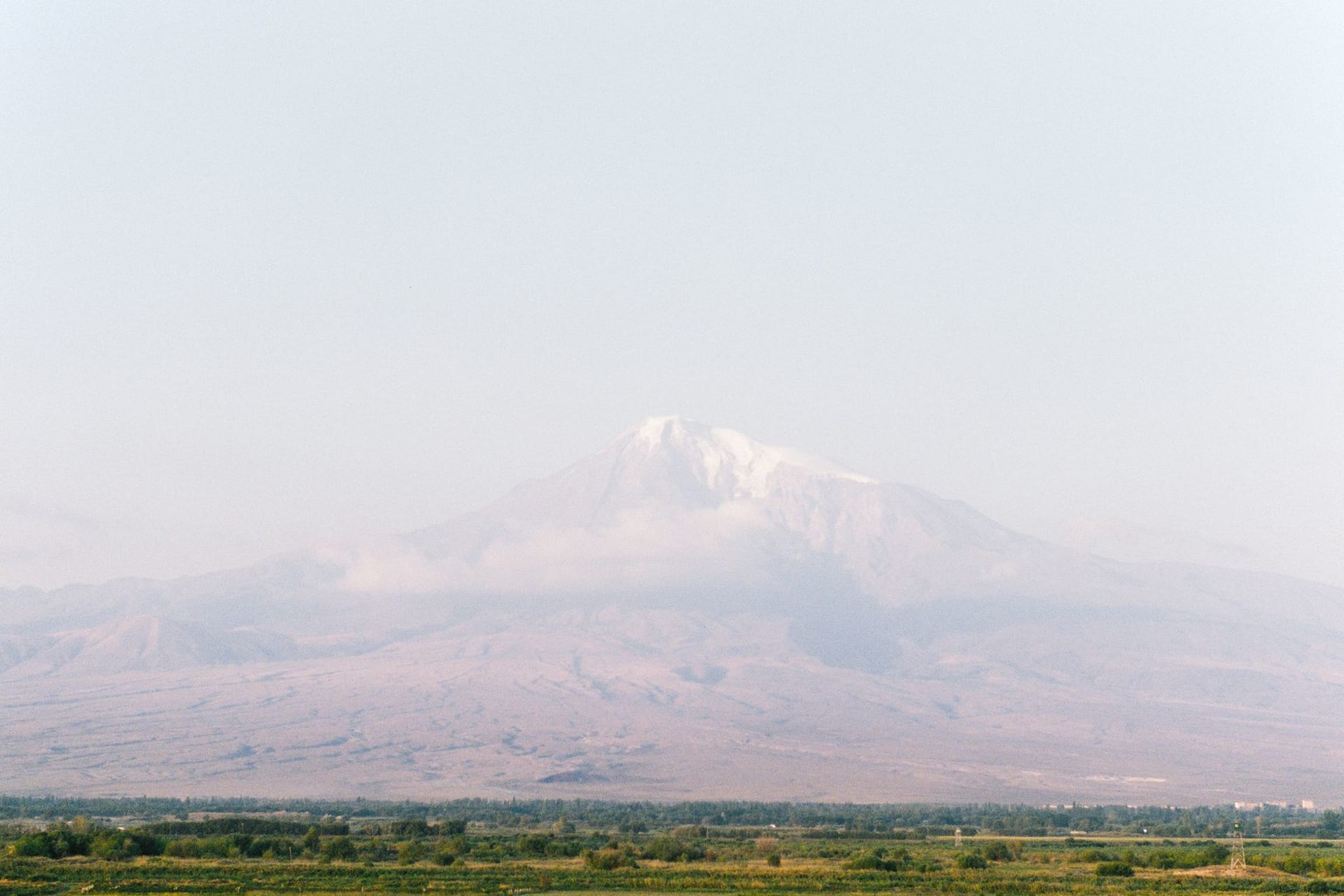
Mount Ararat
"You do not so much arrive at Ararat as notice it has been watching you for the last hundred kilometres."
The far east of Turkey is a long way from anywhere a tourist normally goes, and that is precisely why Ararat had been sitting on my list for years. We flew into Iğdır and then drove, and the mountain announced itself absurdly early — a single enormous white cone floating above flat brown plains, so out of scale with everything around it that my first thought was that it could not be real. It is real, it is 5,137 metres, and it does not get less startling the closer you get.
The Mountain and Its Myth
Ararat is a dormant stratovolcano, snow-capped year-round, and it stands almost entirely alone, which is why it dominates so completely. Beside it sits Little Ararat, a near-perfect smaller cone, and the two together make a silhouette you will recognise from a hundred Armenian paintings and bottles of brandy — because for Armenians, on the other side of the closed border, this is the national symbol they can see but no longer reach.
And then there is Noah. The Book of Genesis grounds the Ark on the “mountains of Ararat,” and ever since, people have come here convinced they will find it. I met one such man at a guesthouse in Doğubayazıt, an American with topographic maps and a fierce certainty, and I did not have the heart to argue. The mountain absorbs that kind of longing without comment. Whatever you believe, there is something about a peak this isolated and this loaded with story that quiets you.

Ishak Pasha and the Best Seat in the House
We did not climb it. Summiting Ararat requires a permit, a guide, and a level of fitness and cold-tolerance I was not pretending to have. What we did instead was drive up to the Ishak Pasha Palace, an extraordinary eighteenth-century Ottoman-Kurdish-Persian fortress-palace perched on a crag above Doğubayazıt, and use its terrace as a viewing platform. The palace itself is worth the trip — honey-coloured stone, a carved gateway, domes and a harem and a mosque, all clinging to the rock.
From there, the whole valley opens out toward the mountain, and we sat against a warm wall in the late afternoon with tea bought from a man with a samovar and a folding table, and watched the light move across Ararat for over an hour. Lia, who had grumbled about the long drive, conceded that it was worth it. From her, in the east of Turkey, that is practically a sonnet.

Practicalities
This is a sensitive border region; check current advice before going, carry your passport, and be relaxed about the occasional military checkpoint. Doğubayazıt is the base town — functional rather than charming, with enough guesthouses and kebab houses to keep you fed.
When to go: Late June to September for the clearest weather and the only realistic climbing window. Spring brings green plains but unstable conditions; winter is fierce and the high passes close. For the views alone, a clear day in July or August is unbeatable.