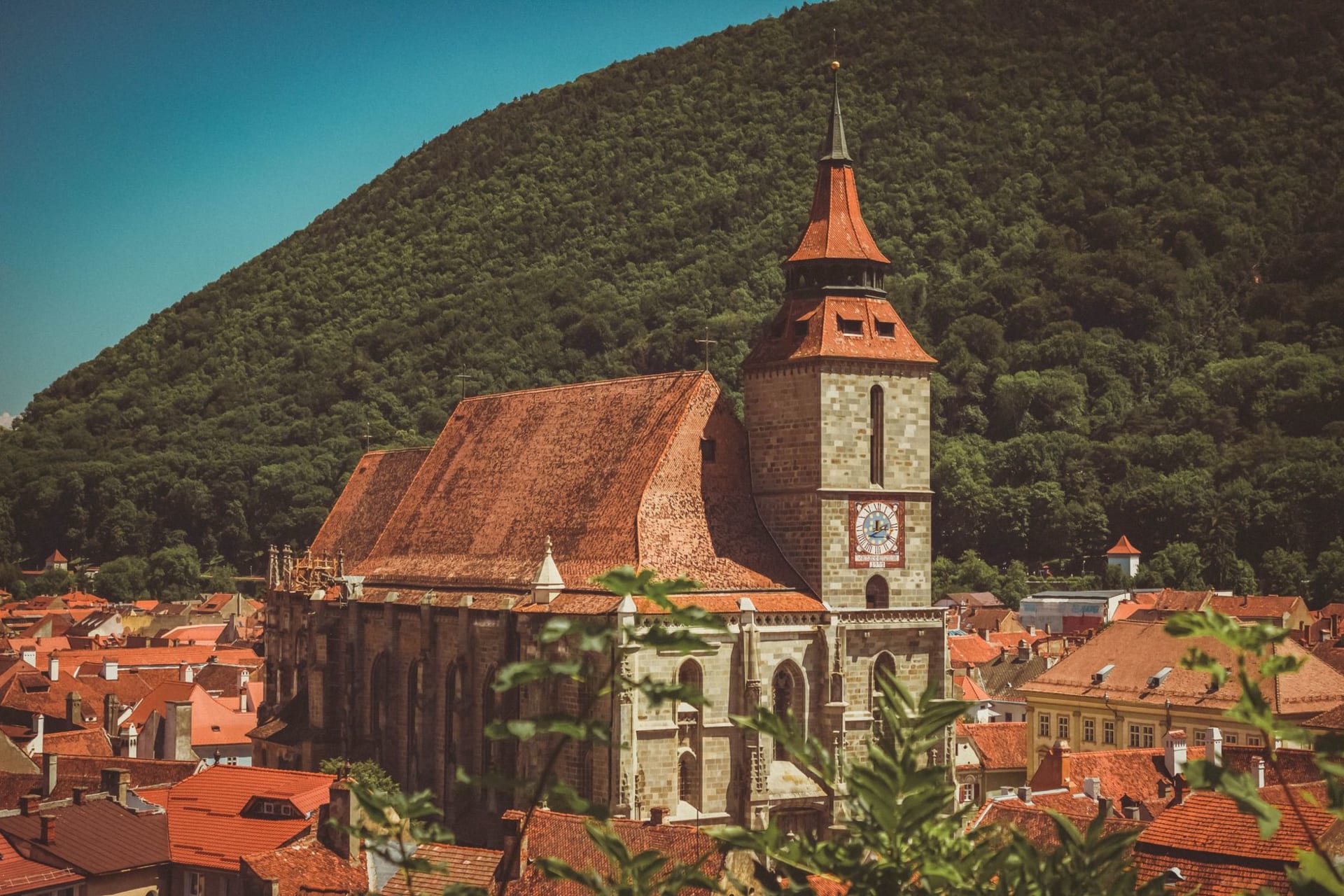
Brasov sneaks up on you. You arrive through an industrial ring of Soviet apartment blocks and then the road bends and suddenly you are in a courtyard city ringed by mountains so close they feel like they’re leaning in to eavesdrop. The scale is almost absurd — Tampa Mountain sits right at the edge of the old town, dark and forested, with the word BRASOV spelled out in white letters near the summit like a Romanian Hollywood sign nobody asked for but which has become, somehow, endearing.
The Black Church and What It Cost
The Schwarze Kirche — the Black Church — is named for the soot that coated its Gothic walls after the 1689 Habsburg burning. Walking around it, I noticed that the blackening isn’t even, that certain stones caught the fire differently, and that the restoration attempts over centuries left strange tonal variations in the masonry. It’s one of the largest Gothic churches in Eastern Europe, and the interior is a strange combination of austere Protestant plainness and one of the finest collections of Anatolian rugs I’ve seen outside of a museum — donated by Transylvanian merchants who traded with the Ottoman world. Wool and incense and cold stone: it stays with you.
Piata Sfatii at the Useful Hours
Council Square is routinely described as “picturesque,” which is code for “you’ll find yourself there with a hundred other tourists.” That’s not wrong, but it’s incomplete. The square works better at eight in the morning, when the cafe chairs are still stacked and the light cuts across the yellow and terracotta facades at an angle that makes the color look applied fresh that morning. I drank a coffee at a table I had entirely to myself and watched a man with a shopping bag argue mildly with a pigeon. The Council Tower, with its clock face and its small history museum of torture instruments, was closed. I felt fine about that.
Up Tampa, Down Through Schei
The cable car to Tampa is cheap and rewards you with views across the Transylvanian plain that keep going longer than seems reasonable, brown farmland and dark forest alternating all the way to where the air thickens into haze. I walked back down through the Schei neighborhood, the old Romanian quarter that sat outside the city walls for centuries — Saxons and Romanians lived in the same city but not quite together, and the spatial memory of that division is still readable in the streets. The Orthodox cathedral here has a small school attached, one of the oldest Romanian-language schools in Transylvania, and the courtyard was quiet in a way the main square never was.
Eating Without Ceremony
Transylvanian food rewards the curious and punishes the squeamish. I ate ciorbă de burtă — tripe soup — at a lunch counter on a side street, and it was one of those dishes where the flavor is so clean and specific that you understand immediately why people have been making it for centuries. The sour cream stirred in at the table, a squeeze of vinegar, a torn piece of bread. Lia found a place near the old walls that did a cucumber salad dressed with dill and walnut oil that she ordered twice in the same afternoon.
When to go: May and June for soft light and manageable crowds, or September into October when the beech forests above the city turn copper. Avoid August, when Brasov becomes a chokepoint for Romanian summer tourism and the square loses whatever quiet it had. Winter has its own logic — cold, yes, but the Christmas market on Council Square is genuinely pretty rather than cynically so.