Mount Ramelau
"We climbed in the dark with a line of pilgrims and reached the top of a country just as it caught fire with light."
At 2,986 metres, Mount Ramelau — known locally as Tatamailau, “grandfather of all” — is the highest point in Timor-Leste, and reaching its summit for sunrise is something close to a national rite. Both Catholic pilgrims and ordinary hikers make the climb, and on the morning we went the trail was a slow-moving constellation of headtorches winding up the dark mountain, families and teenagers and one very determined old man with a walking stick, everyone breathing hard in the thin cold air and nobody complaining.
We based ourselves the night before in Hato Builico, the small highland village that serves as the trailhead. It is genuinely cold up there — Timor sits a few degrees off the equator, but altitude does what altitude does, and Lia and I were grateful for the extra blanket the guesthouse owner pressed on us with a knowing look. We set our alarm for 3am, which is an hour at which I question all my life decisions, and stumbled out into a sky absolutely riveted with stars.
The climb in the dark
The trail from Hato Builico to the summit is not technically difficult — a steady switchbacking path of perhaps three hours — but the dark, the cold and the altitude conspire to make it feel like an undertaking. We climbed mostly in silence, our world reduced to the bobbing pool of the headtorch and the crunch of feet on the stony path. Every so often the line of pilgrims ahead would pause, and you’d look up and see their lights strung out above you against the black bulk of the mountain, and it was genuinely beautiful in a way I wasn’t expecting at four in the morning.

Near the top the vegetation thins to scrubby alpine grass, and the white statue of the Virgin Mary that crowns the summit emerges out of the dark — installed in 1997, it has become the symbolic heart of the climb. People gathered around its base, some praying, most just turning east and waiting, hands wrapped around cups of coffee sold by an enterprising soul who had carried a thermos up the mountain. I bought one. It was terrible and perfect.
Sunrise over two seas
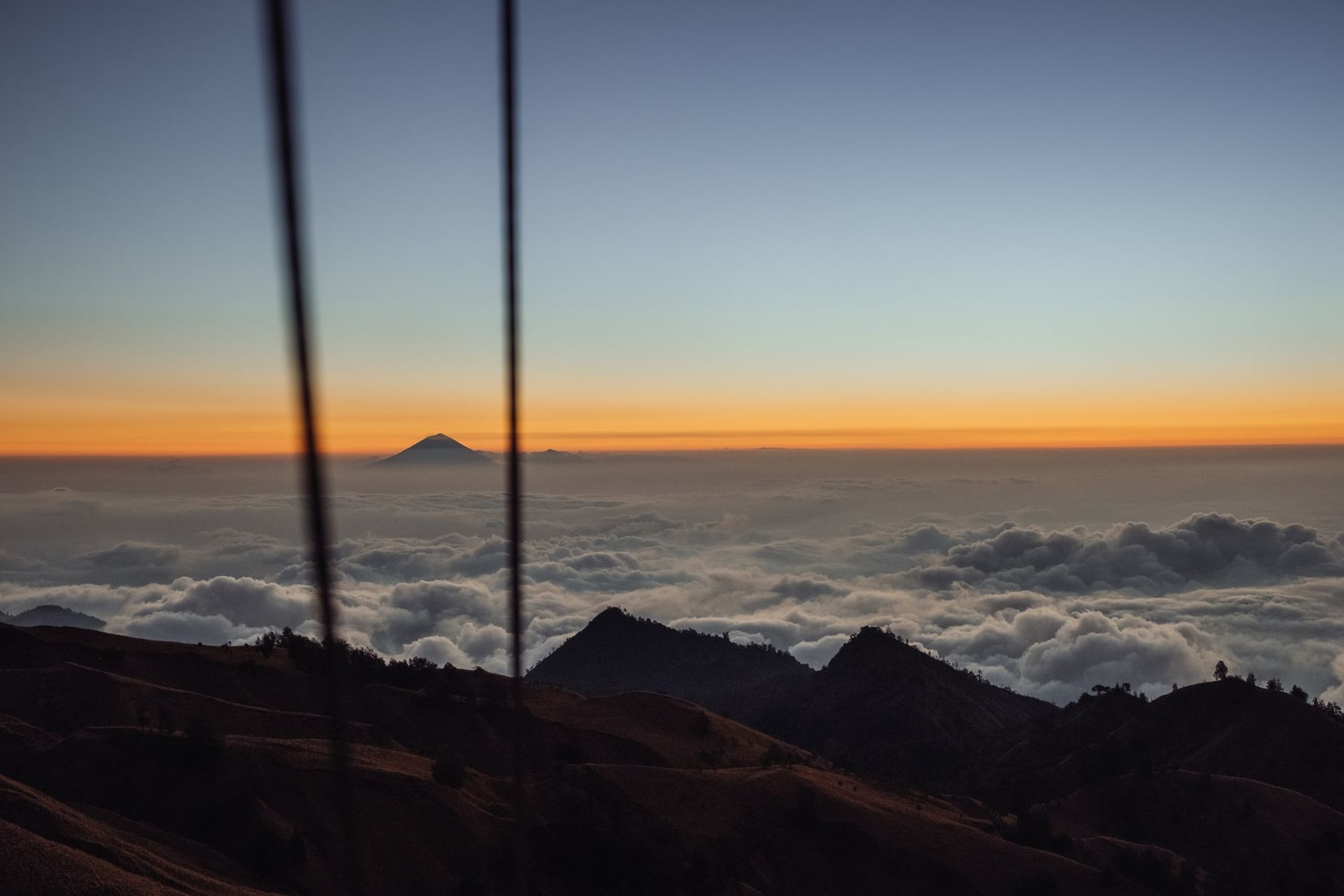
Then the light came. Because Timor is a long, narrow island and Ramelau sits roughly on its spine, the summit gives you both coasts at once — the sun rising over the sea to the east while, behind you, the cloud-filled valleys to the south and west catch the first colour. We stood above a complete sea of cloud, the lower peaks poking through it like islands, and the sun came up the colour of a struck match and lit the whole white statue gold.

A group of Timorese students near us started singing — a hymn, I think, though I didn’t know it — and the sound carried out over the cloud and disappeared. Lia, who is not given to grand statements, just said quietly that she was glad we’d come. So was I. There is a particular satisfaction in standing on the literal highest point of an entire nation, especially one as young and hard-won as this one, and watching it wake up beneath you.
The way down
The descent in daylight is a different mountain entirely. The trail you climbed blind reveals itself as a corridor through coffee plantations and stands of eucalyptus, with villages tucked into the folds below. We passed pilgrims still heading up — late risers who would miss the sunrise but climb anyway — and reached Hato Builico ravenous, where the guesthouse fed us eggs and impossibly strong local coffee grown on the very slopes we’d just descended. I’ve climbed bigger mountains. I’m not sure I’ve climbed a more meaningful one.
When to go: May to November, the dry season, when the trail is firm and the summit views are clear. Climbs cluster around major Catholic feast days, when the pilgrim crowds — and the atmosphere — peak. Bring far more warm clothing than the word “tropical” suggests.