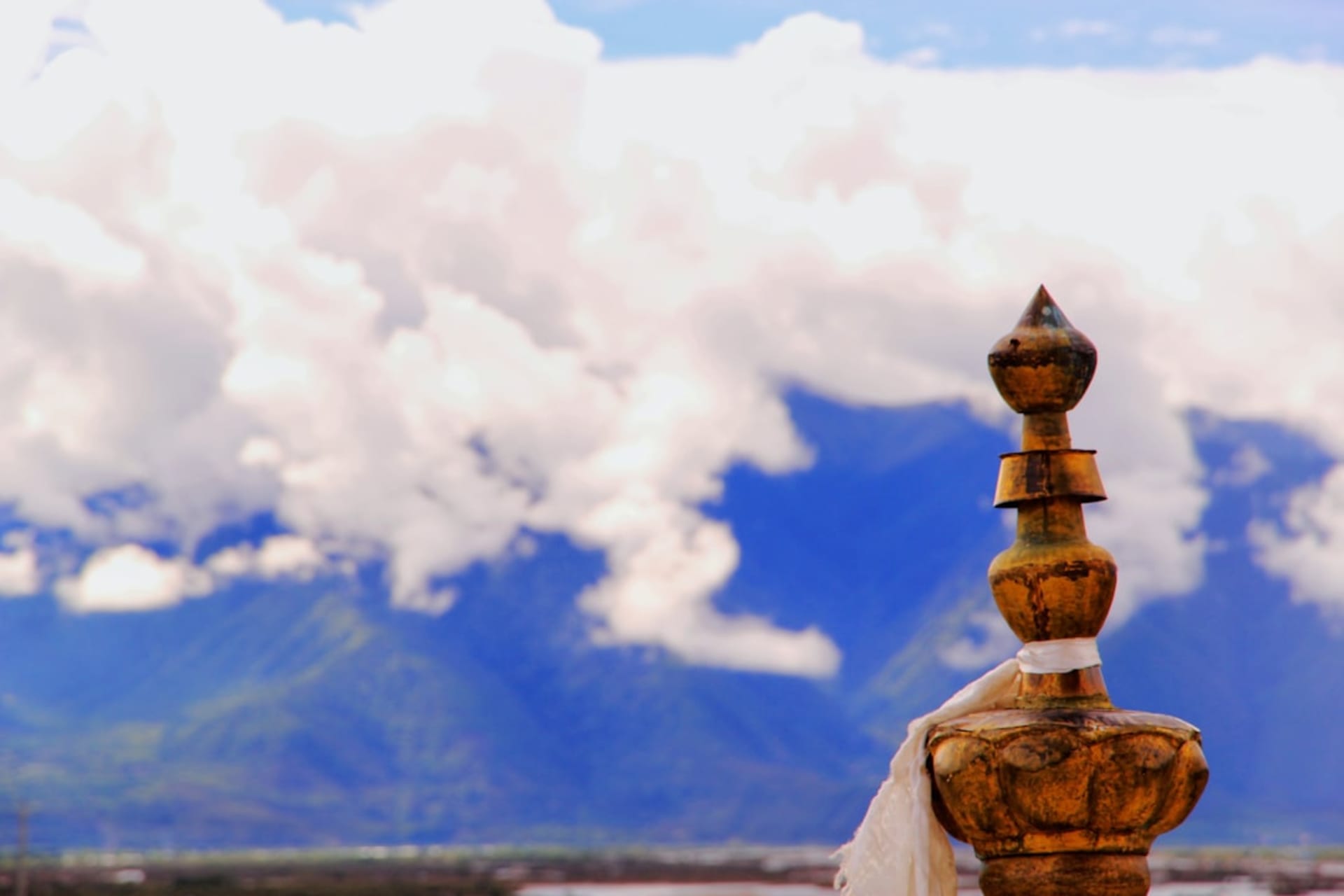
Samye Monastery
"Samye is a Buddhist cosmology made into a building. The dunes around it are a complete non-sequitur."
Nobody tells you about the sand dunes. You research Samye Monastery — Tibet’s oldest, founded in 775 CE, a mandala of temples representing the Buddhist cosmos — and the photographs show ochre walls and prayer flags and a remarkable circular outer wall containing the whole complex. What the photographs somehow fail to communicate is that the monastery sits in the middle of a wide sandbar on the Yarlung Tsangpo, and that the prevailing winds have deposited significant sand dunes on the surrounding plain. I arrived by ferry across the river and stepped off onto a beach. The monks were visible in the distance, crossing sand.
This is Tibet’s capacity for surprise: the oldest monastery in the country surrounded by desert dunes beside a major river, two hours south of Lhasa.
The Mandala in Architecture
Samye was designed by the Indian master Shantarakshita and the Tibetan king Trisong Detsen as a three-dimensional mandala — a representation of the Buddhist universe made inhabitable. The central temple, Utse, represents Mount Meru at the centre of the cosmos. The surrounding temples represent the continents and sub-continents of Buddhist cosmology. The circular outer wall is the iron mountain range at the universe’s edge. Walking the kora around the outer wall, you’re completing one revolution of the cosmos.
The concept is beautiful and the execution, across thirteen centuries of maintenance and occasional destruction and reconstruction, remains legible. You can read the plan from the central rooftop: the satellite temples in their positions, the cardinal directions marked by different architectural styles mixed into a single complex.
Inside the Utse
The central temple rises three storeys in three different architectural styles — Tibetan, Chinese, and Indian — stacked on top of each other, which reflects both the eclectic ambitions of the founding period and the various reconstructions over the centuries. The interior is dim and thick with the smell of incense and butter. Ancient thangkas hang in the assembly hall. A monk with a clipboard was cataloguing objects in one corner with the air of someone engaged in an impossibly long task who had made peace with it.
The basement level houses older murals — some dating to the original foundation — depicting the monastery’s founding and the legendary subduing of local spirits by Padmasambhava, who performed the ritual to consecrate the site. The faces in the oldest paintings have the same archaic quality I noticed in Gyantse: a different visual grammar, pre-Mughal, distinctly local.
The Sand Dunes at Sunset
The dunes west of the monastery complex aren’t enormous — nothing comparable to the Sahara or the Gobi — but they’re real and they’re genuinely disorienting in context. I walked out to them in late afternoon with no particular plan. The sand was fine and pale gold and still warm from the day’s sun. The monastery was visible behind me, its white outer wall catching the last light. The Yarlung Tsangpo glinted in the middle distance. A cold wind was coming down the valley.
I sat on a dune for a while. This is what Tibet does when it’s not doing the austere plateau thing: it produces juxtapositions so unlikely that your pattern-matching equipment gives up and you’re left simply looking.
Getting There
Samye requires a short ferry crossing from the north bank of the Yarlung Tsangpo at Samye Ferry Crossing, south of the town of Zedang. The ferry runs on variable schedules. There is a small guesthouse inside the monastery complex for overnighters. Most visitors come as a day trip from Tsedang.
When to go: May through October, when the ferry runs reliably and the sandbar approach is not subject to high water. The Samye festival (Droma Lhakang Festival) takes place in late spring or early summer on the Tibetan calendar and is worth timing a visit around if possible. Avoid the monsoon peak in July–August when river crossings can become unpredictable.