Mahabalipuram
"The oldest stones face the sea, and the sea has been trying to answer them ever since."
Stone and Shore
The Shore Temple sits at the edge of the Bay of Bengal like a question addressed to the ocean — two towers of dark granite rising directly from a strip of sand, waves running in around the outer walls. It’s been here since the early eighth century, which means it’s been exposed to monsoon swells and salt spray for over a millennium and still holds its shape. Some of the carved details have blurred, softened, dissolved back into the rock. That’s not decay so much as dialogue.
I arrived just before sunrise and had the outer grounds mostly to myself for about twenty minutes before the first tour buses appeared. That window was enough. The light came in low and orange across the water, catching the tiered towers from the east, and the sound was pure coast — gulls, surf, distant fishing boat engines. The stone turns from black to gold in that light in a way no photograph I’ve taken has ever adequately captured.
The Five Rathas
A short walk inland from the Shore Temple, the Pancha Rathas are a different kind of monument: five freestanding temple chariots carved from single granite boulders, never finished, never used for worship, just left in the field where they were made. Thirteenth-century architectural prototypes, essentially, built to test out design ideas that would later be applied elsewhere.
What’s strange about them is their scale — modest, almost intimate compared to the massive temple complexes at Madurai or Kanchipuram. I spent more time here than anywhere else in Mahabalipuram, partly because the crowds were lighter and partly because I couldn’t stop looking at the elephant sculpture standing calmly beside them, life-sized and extraordinarily precise, carved by someone who evidently spent a lot of time observing elephants closely.
The Cave Temples and Arjuna’s Penance
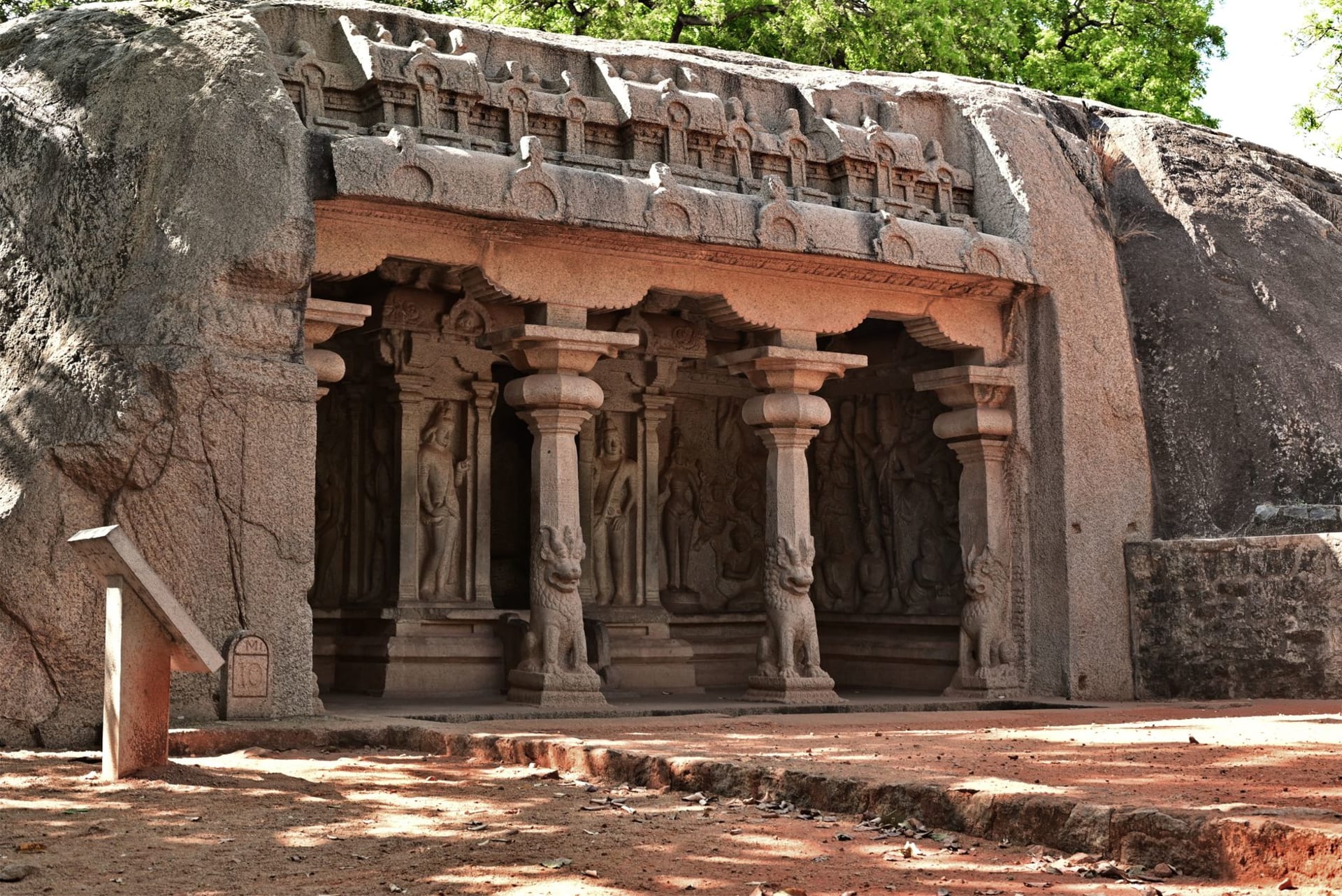
The rest of the UNESCO heritage zone is spread across rocky hillocks in the center of town: cave temples with intricate relief sculptures, open-air panels, mandapas carved directly into the granite face. The craftsmen worked with the natural shape of the rock rather than against it, and the results feel embedded in the landscape rather than imposed on it.
Arjuna’s Penance is the standout — a massive bas-relief panel, one of the largest in the world, depicting the cosmic descent of the Ganges from heaven to earth. Celestial beings, animals, humans, serpent gods, and a single thin man standing on one leg in ascetic meditation: the whole scene animated in stone, a crowd still moving thirty meters wide. I stood in front of it for longer than I’d planned and still left feeling I’d missed things.
The Town Itself
Mahabalipuram is a small town with a big beach, a busy sculpture school (the sound of chisels on granite follows you through the workshops along the main road), cheap guesthouses, and a seafood strip that starts ramping up at dusk. The fish here is cooked on open grills outside the restaurants and the smell pulls you in before you’ve made any decisions. After a full day in the heat among ancient stones, a grilled pomfret and a cold drink at a plastic table ten meters from the surf felt approximately perfect.
When to go: November through February is ideal — dry, breezy, 26–30°C. The sea is calmer, which matters if you want to swim or take a boat out. The northeast monsoon passes through October–November and can bring heavy rain; the shore temple area floods at high tide after serious storms. Avoid March through June when the coast heats up quickly.