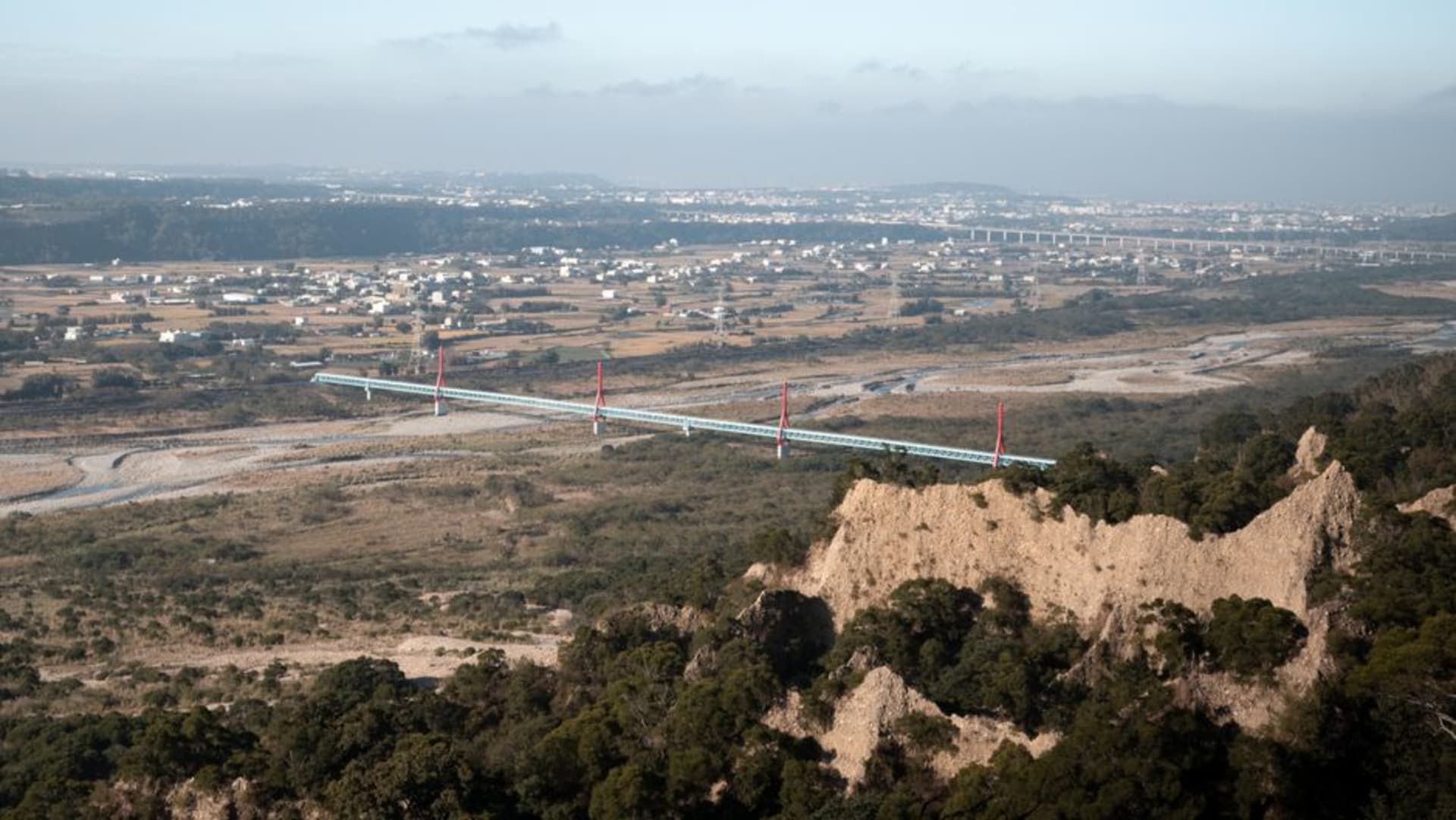
Miaoli
"Miaoli has no interest in convincing you to come. I think that's exactly why I liked it."
An unglamorous farming county that turns out to hold Taiwan's best-kept Hakka food, hot springs, and hillside tea terraces.
Miaoli doesn’t show up on most first-timer itineraries, and having now spent four days there, I understand why and also think it’s a mistake. It’s a county built on farming and small industry, not tourism infrastructure, and that absence of performance is precisely what made it stick with me longer than plenty of more photogenic stops.
Shengxing and the Trains That Stopped Coming
The Shengxing Station, once a stop on the old Neiwan-Jhunan rail line, sits abandoned in a bamboo grove after a 1999 earthquake shifted the land beneath the tracks and the trains simply never came back. What’s left is an eerily peaceful wooden platform overtaken by ferns and moss, a single rusted bell still hanging by the ticket window, bamboo creaking overhead in the wind. We had it almost entirely to ourselves on a grey Tuesday, and it felt less like a tourist site than like accidentally trespassing on somebody’s abandoned memory.
Tea Country Without the Crowds
Miaoli’s hills produce some of Taiwan’s most respected Oriental Beauty oolong, grown at altitudes lower and gentler than the famous high-mountain teas further south, but arguably more distinctive for it — a honeyed, slightly fruity character that comes specifically from small leafhoppers biting the leaves, which sounds like a flaw and turns out to be the entire point. We stopped at a family-run tea farm outside Toufen where the owner, a woman probably in her seventies, walked us through the withering and rolling process by hand before pouring us a cup so different from typical oolong that Lia asked twice if it was actually the same plant.
Hot Springs Without the Resort Price Tag
Taian Hot Springs, tucked into a valley near the Dawu mountain range, has none of the polish or price tag of the bigger spring towns up north, just a scatter of modest, slightly worn inns built around genuinely excellent mildly alkaline water. We soaked in an outdoor pool at dusk with mist rolling off the surrounding peaks and paid roughly a third of what an equivalent Beitou soak would cost in Taipei.
When to go: Autumn through spring, October to April, for cool hiking weather at Shengxing and the hot springs at their most appealing — Miaoli’s summers get genuinely humid and the tea harvest crowds the farms in late spring, so early autumn hits the sweet spot for both quiet and comfort.