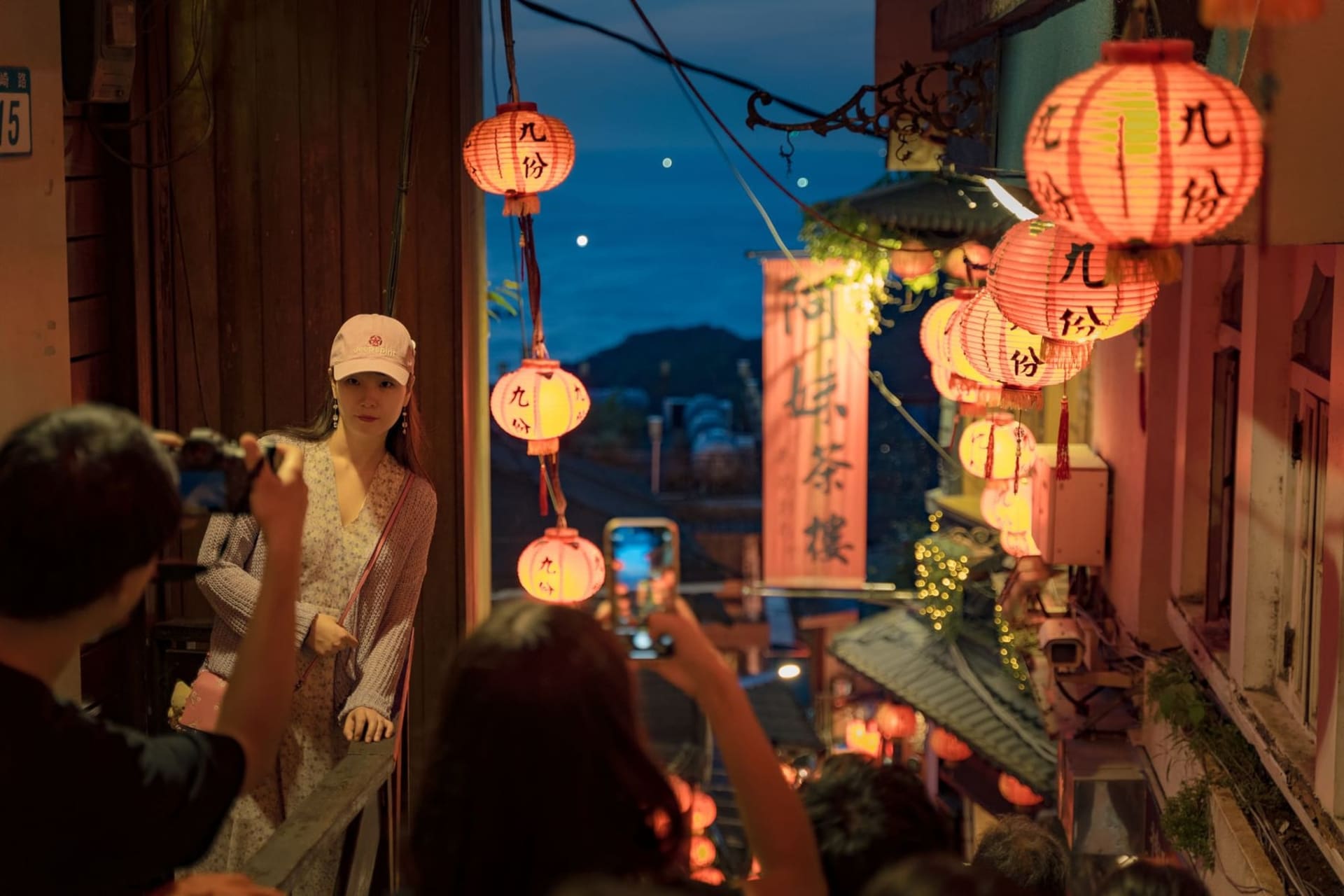
Jiufen
"Jiufen at dusk, rain on the lanterns, tea in both hands — it's exactly what the film poster promised."
A gold-rush hillside town of red lanterns and fog, inspiration for the spirit world of a Miyazaki film.
I had watched the film enough times to half-convince myself that no real place could hold up to it. Then I climbed the Shu Qi Road steps at dusk with rain just starting, looked up at the paper lanterns bleeding red into the mist, and understood that the debt might actually run the other way — the film had borrowed from here, not invented it.
The Old Street and What It Smells Like
Jiufen Old Street is narrower than photographs suggest. It is a single corridor of wooden storefronts running up the mountain, and in the early evening it smells of taro balls frying in hot oil, of wet stone, of sandalwood drifting from a small temple tucked between a tea shop and a stall selling fish balls on sticks. The vendors work fast and the crowds move slowly, and the friction between those two rhythms gives the street its particular nervous energy. I ate the taro and sweet potato balls from a paper cup outside A-Zhu Peanut Ice Cream, standing against the railing with the harbor of Keelung visible far below through breaks in the cloud. The sweetness was subtle, almost reluctant — nothing like the aggressively sugared street food I had expected.
Tea Above the Fog
Lia found the teahouse before I did. She had ducked off the main drag down one of the side alleys — the ones that descend toward the cliff face on uneven steps slicked with rain — and came back to find me to say there was a place with a wooden deck hanging over nothing. That place was A-Mei Tea House, red lanterns along every beam, the Pacific somewhere far below and entirely invisible. We ordered a pot of high-mountain oolong and sat for nearly two hours. The tea arrived in a clay pot the color of old brick. Outside, fog moved through the lanterns like something alive.
The unexpected thing: the silence. For a place so photographed, so referenced, so thoroughly mythologized, the interior of that teahouse at around six in the evening was genuinely quiet. The rain kept the tour groups moving. We had the railing to ourselves.
Getting There and Getting Lost
The bus from Taipei’s Zhongxiao Fuxing station takes about an hour and deposits you at the bottom of the hill — from there it is a walk up through residential lanes that smell of garlic and laundry before the tourist corridor begins. I recommend arriving later than feels sensible. The light after five, when the lanterns come on and the natural light hasn’t quite left, is the whole point of the place.
When to go: Autumn and early winter — October through December — bring the low cloud and drizzle that make Jiufen cinematic rather than merely pretty. Summer is crowded and clear; go for the mist, not the sunshine.