Mürren
"You're on a ledge. The mountains are directly across from you, at eye level. There is no reasonable explanation for why a village is here."
The Impossible Position
Mürren is on a ledge. Not metaphorically — literally on a terrace carved into the western cliff of the Lauterbrunnen valley, accessible only by cable car from Grütschalp and then a narrow-gauge railway along the cliff face, or by gondola from Stechelberg far below. There are no cars. There is no road. The village has about 450 permanent residents who, when they need to bring anything large to their homes, use the cable car.
The result of this inaccessibility is a village that feels like it was preserved in a particular moment and then left alone. The chalets are wood-dark and low and heavy with window boxes. The lanes between them are wide enough for two people and a wheelbarrow. At one end is the Schilthorn cable car, going up to 2,970 meters. At the other end is a footpath toward Gimmelwald, which is quieter still.
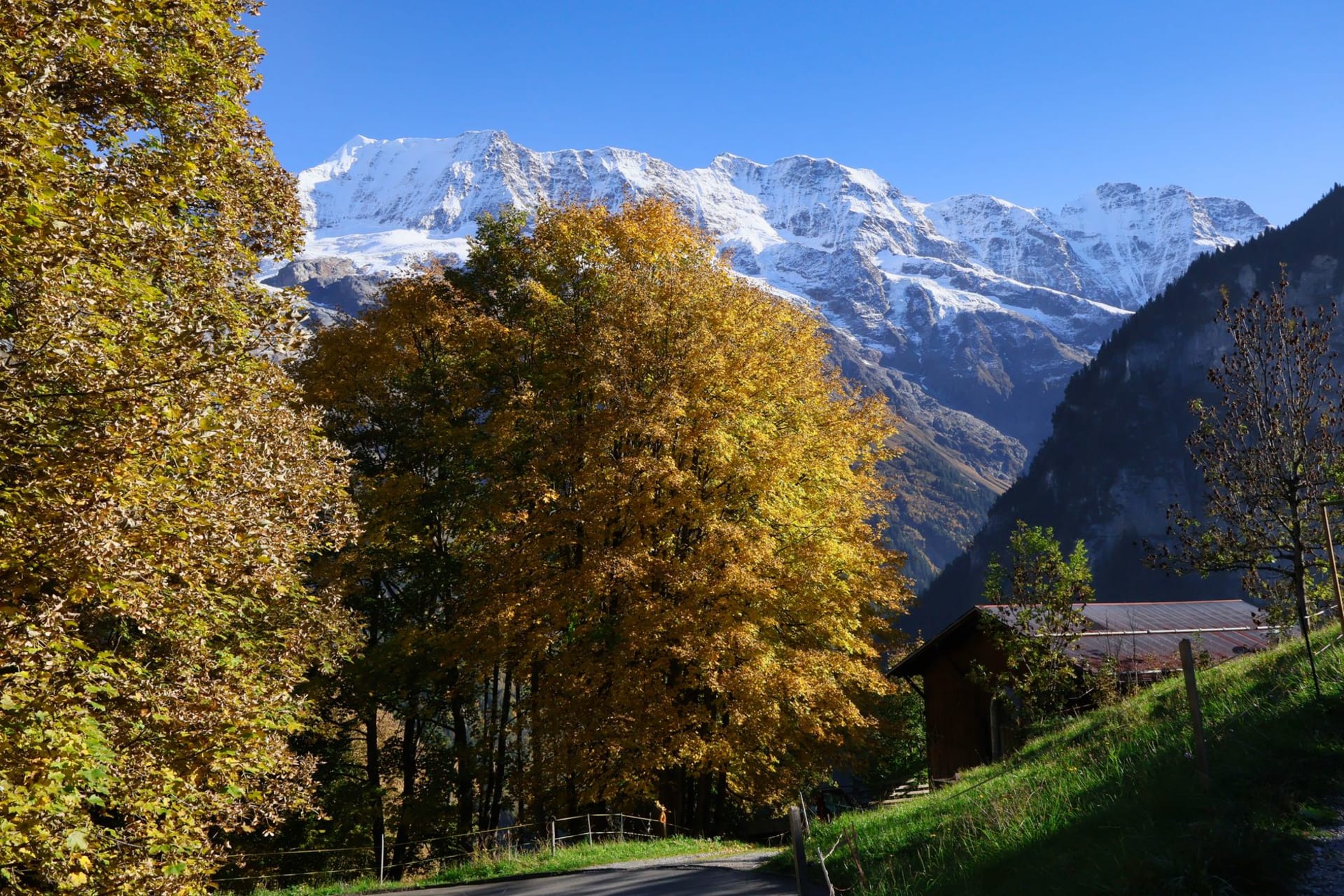
The view from the terrace — and almost every surface in Mürren is a terrace — is directly at the Eiger, Mönch, and Jungfrau across the valley gap. Not below you, not above you: across from you. They are at eye level. This is an extremely specific visual experience and it takes a day before you stop stopping to stare.
Schilthorn and the Bond Connection
The cable car above Mürren climbs to the Schilthorn at 2,970 meters, where a revolving restaurant called Piz Gloria sits on the summit ridge. It rotates once per hour. In 1969, part of the James Bond film On Her Majesty’s Secret Service was filmed here — specifically the sequences set at Blofeld’s mountaintop research facility. The restaurant has committed fully to this heritage. There is a 007 museum section, Bond-themed cocktails, and a model of the original film location that you can look at while the Alps rotate outside the windows.
I watched the restaurant complete a full rotation while eating a Rösti that was fine, not exceptional, and thought about the fact that this building has been gently spinning on a mountaintop for over fifty years while below it civilizations have done various things. That is a sustainable form of confidence.
The sunrise cable car runs on certain mornings in summer, departing at 5:25am to catch the light on the Bernese peaks. I did this once, half-asleep, and arrived at the summit in time for the Jungfrau to turn pink and then orange and then gold while I stood in total silence with four other people who all looked similarly unprepared for 5:25am. It was the best thing I did in the Jungfrau region.
The Village at Walking Speed
Mürren is very small. The walk from the railway station to the Schilthorn cable car is about eight minutes. The walk from the station to Gimmelwald, the hamlet downvalley, is about forty minutes on a path through Alpine meadows with the valley dropping away and the peaks of the Bernese Oberland visible in most directions.
There are enough restaurants and hotels for the population that visits — the Eiger Guesthouse, long a favorite of budget travelers who want the position without the price; the Hotel Jungfrau with its direct view terrace; the Stäger-Stübli in the village center for Älplermagronen, the Swiss Alpine version of mac and cheese that I find impossible to criticize.
Lia and I stayed three nights in October, the mountains across the valley alternating between being fully clear and being completely inside cloud, which meant every meal on the terrace was either extraordinary or blank white. We ate well either way.
When to go: December through March for skiing — Mürren sits at the top of the Schilthorn ski domain and the runs from Piz Gloria are excellent. July through September for hiking, particularly the Northface Trail below the cliff. October for near-empty trails and the chance of that specific golden light on the Lauterbrunnen waterfalls at dusk. The village is less crowded than anywhere comparable in the Jungfrau region because access requires a cable car and train.