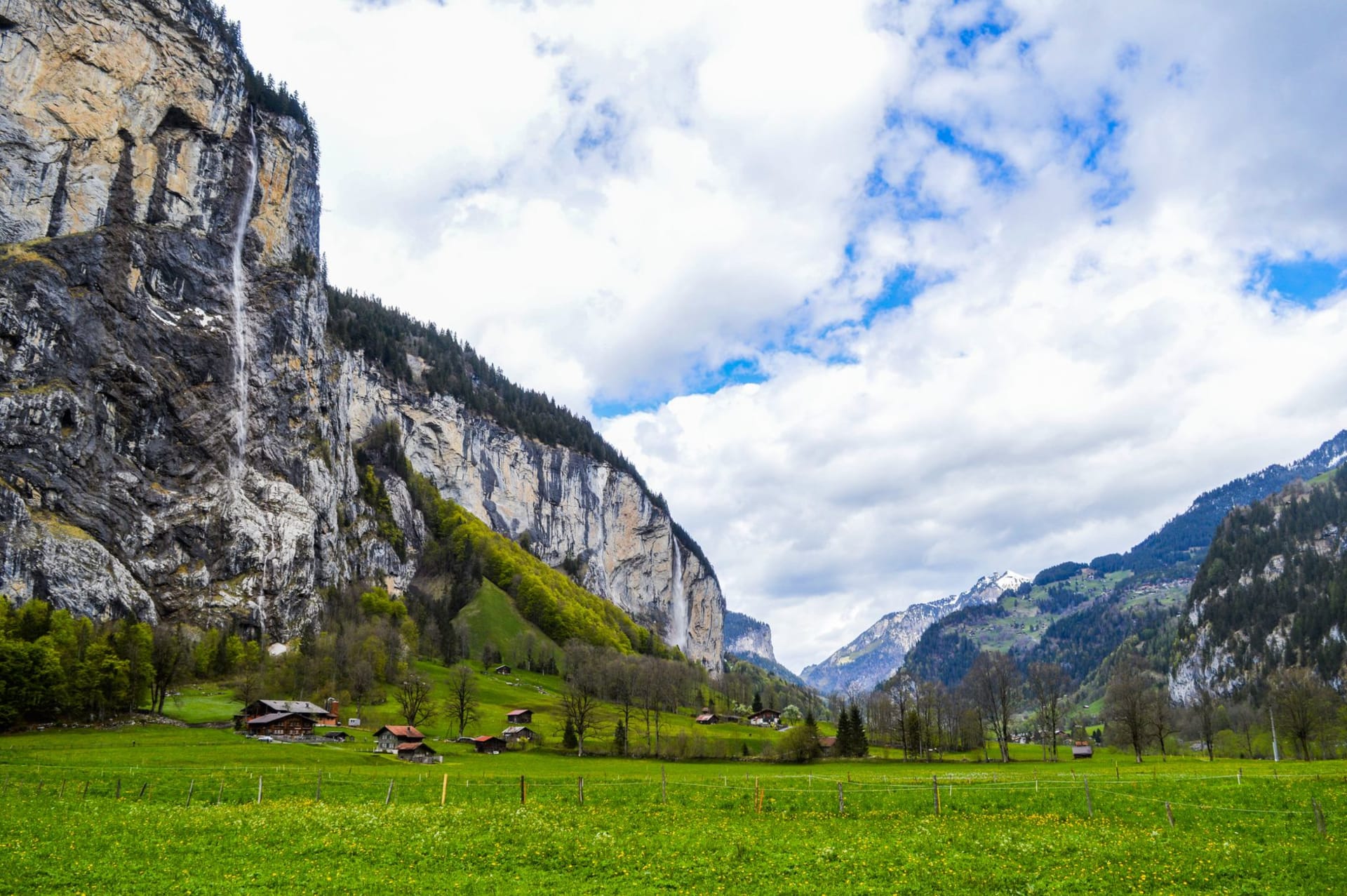
Lauterbrunnen
"The water comes off the cliffs like something being poured from an enormous height and doesn't stop all day."
The Valley That Tolkien Noticed
J.R.R. Tolkien visited Lauterbrunnen in 1911 and sketched the valley. Rivendell, the hidden elven valley in his books, is said to have come partly from this place. I thought about that while standing on the valley floor watching the Staubbachfall — the main waterfall, 297 meters of continuous white thread dropping off the cliff above town — and decided that it was a reasonable creative transaction. The valley really does feel like somewhere that shouldn’t be accessible. The walls are too vertical, the sky above too thin, the floor too flat and green. It looks assembled rather than geological.
The sound inside the valley is particular: a constant low hiss and roar from multiple waterfalls running simultaneously, varying with wind direction. You stop noticing it after an hour, and then you walk out of the valley into silence and notice it again by its absence.
Seventy-Two Waterfalls, Which Is Too Many
The valley claims seventy-two waterfalls, which I haven’t verified personally but believe. They range from the Staubbachfall’s theatrical plunge to thin silver threads you only see when afternoon light catches them at the right angle. The Trümmelbach Falls, a series of glacier meltwater falls inside a mountain reached by a tunnel and a tilt-lift, are the strangest. You go inside rock and stand in chambers while the water from the Jungfrau glaciers thunders through carved channels at volumes of up to 20,000 liters per second. It is loud in a way that vibrates your sternum.
I went with Lia on a wet July afternoon when other attractions seemed uninviting, and it turned out to be exactly the right choice for rain — you’re inside, the drama is unchanged by weather, and the mist inside the gorge chambers has nowhere to go.
The Station for Everywhere
Lauterbrunnen is also a transportation node. From here, cogwheel trains climb to Mürren and Wengen — the two car-free villages on opposite cliffs — and cable cars launch toward Grindelwald and the Männlichen ridge. The village itself is small, has a proper grocery store and a few restaurants, and is considerably cheaper to sleep in than the car-free villages above.
The Staubbachfall is a five-minute walk from the train station. There’s a path that winds up close enough to feel the spray. I walked it at 7am before the coaches arrived from Interlaken and had the waterfall essentially to myself. The light that early is cool and bluish, and the spray catches it in shifting curtains. I stayed for forty minutes and was mildly damp and happy.
Wengen and Mürren Above
The two villages above the valley walls deserve mention because they’re reached from Lauterbrunnen and because they’re good in different ways. Wengen, above the east wall, is larger and more resort-like, with skiing in winter and a long Eiger-facing promenade. Mürren, above the west wall, is smaller, quieter, and looks directly at the Eiger-Mönch-Jungfrau trinity across the valley. The walk from Mürren to Gimmelwald, the smaller hamlet downvalley, takes about forty minutes and involves meadows, cowbells, and views that I will not attempt to describe adequately.
When to go: June through September for hiking and waterfall volume at peak — the falls run strongest when glacier melt is maximum in July. December through March for ski access to the Jungfrau region above. The valley itself is accessible year-round. Rain actually helps the falls; don’t let grey skies discourage you. Avoid arriving at Lauterbrunnen station on a weekend in August — the coach groups make the narrow valley floor feel very small.