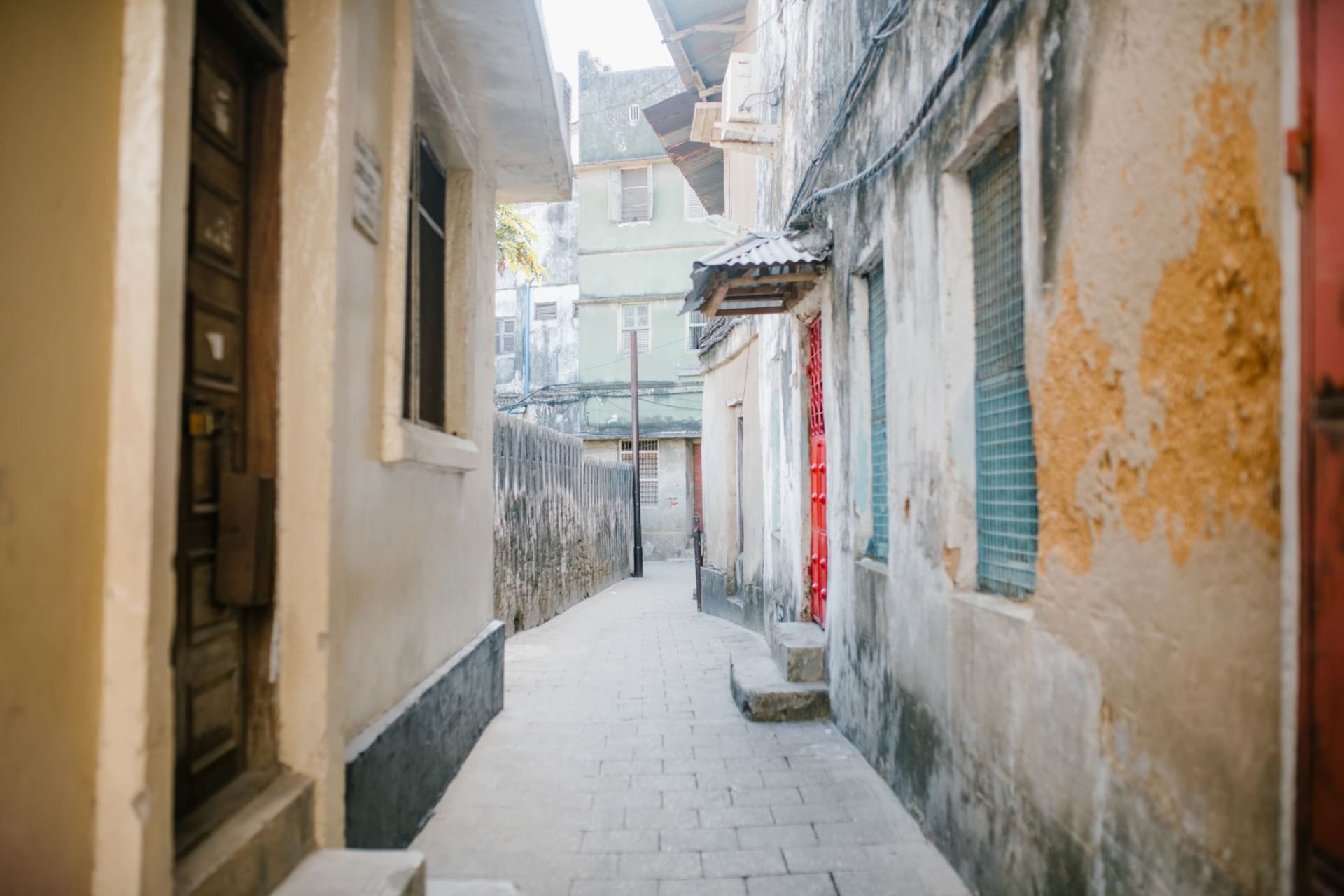
Stone Town has a smell. It arrives before the harbor does — a complicated mix of drying fish, clove oil, cardamom from the spice stalls, salt off the channel, and something else I’ve never been able to name, something resinous and old that seems to come from the coral stone buildings themselves. I’ve tried to identify it for years. My best theory is that it’s the accumulated exhale of every civilization that decided this harbor was worth fighting over.
Zanzibar’s Stone Town is the old city at the western tip of Unguja island, and it is genuinely one of the more disorienting places I’ve spent time. The alleyways are narrow enough that laundry strung between upper floors blocks the sky. Streets that feel like they should lead somewhere loop back into themselves. The architecture is a physical argument between Arab, Persian, Indian, Portuguese, and British colonial sensibilities, all crammed into the same five-hundred-meter radius and somehow producing something that looks entirely like nowhere else.
The Doors
Everyone tells you about the doors, and the doors deserve it. There are reckoned to be over five hundred historically significant carved wooden doors in Stone Town, and the debate between Indian-influenced chain-carved borders and Arab-style pointed-arch frames plays out in almost every block. The Indian doors typically have central brass bosses — originally designed to stop elephants from battering through, a precaution that feels slightly overprecautionary for an island, but there it is. I spent two hours photographing just the stretch between the Old Fort and the Darajani market before I had to admit I was avoiding making an actual decision about lunch.
The Palaces and the Dark History
The Old Fort, built by Omani Arabs in 1698 on the foundations of a Portuguese church, is the kind of layered ruin that makes you sit still for a while. The Palace Museum next door — once the sultan’s residence — holds a collection of Omani carved furniture and British colonial artifacts that are awkwardly wonderful together. The real confrontation, though, is the Anglican Cathedral, built in 1873 on the site of Zanzibar’s slave market. The altar stands where the flogging post stood. There is a small underground chamber where enslaved people were held before auction. It’s quiet in there and the quiet does exactly what it should.
Forodhani Gardens at Dusk
Every evening, the seafront gardens in front of the Old Fort transform into Zanzibar’s most democratic restaurant. Charcoal grills appear, and with them: Zanzibar pizza (a doughy stuffed crepe situation that is addictive in ways I don’t feel good about), grilled octopus, sugar cane juice, Urojo — the coconut and tamarind soup that is somehow the most underrated thing on the island. Lia and I ate here three nights running. The harbor fills with dhow silhouettes as the sky goes purple. The lights of the ferry terminal blink on. It costs almost nothing and is one of the more satisfying meals you can have on this coast.
Mercury’s Town
Freddie Mercury was born in Stone Town in 1946, when it was still Zanzibar City under British colonial rule. There’s a small museum in the house on Kenyatta Road where he was born, more interesting for the photographs than for the artifacts. What strikes me more is the ongoing argument between his local legacy and Zanzibari conservatism — a man of considerable contradictions claims this complicated place as home. That feels right somehow.
When to go: June through October is the best window — dry southeast monsoon, clear snorkeling visibility, and manageable humidity. Avoid April and May (long rains). The Zanzibar International Film Festival in July fills Stone Town with street screenings and music and is worth planning around if you can.