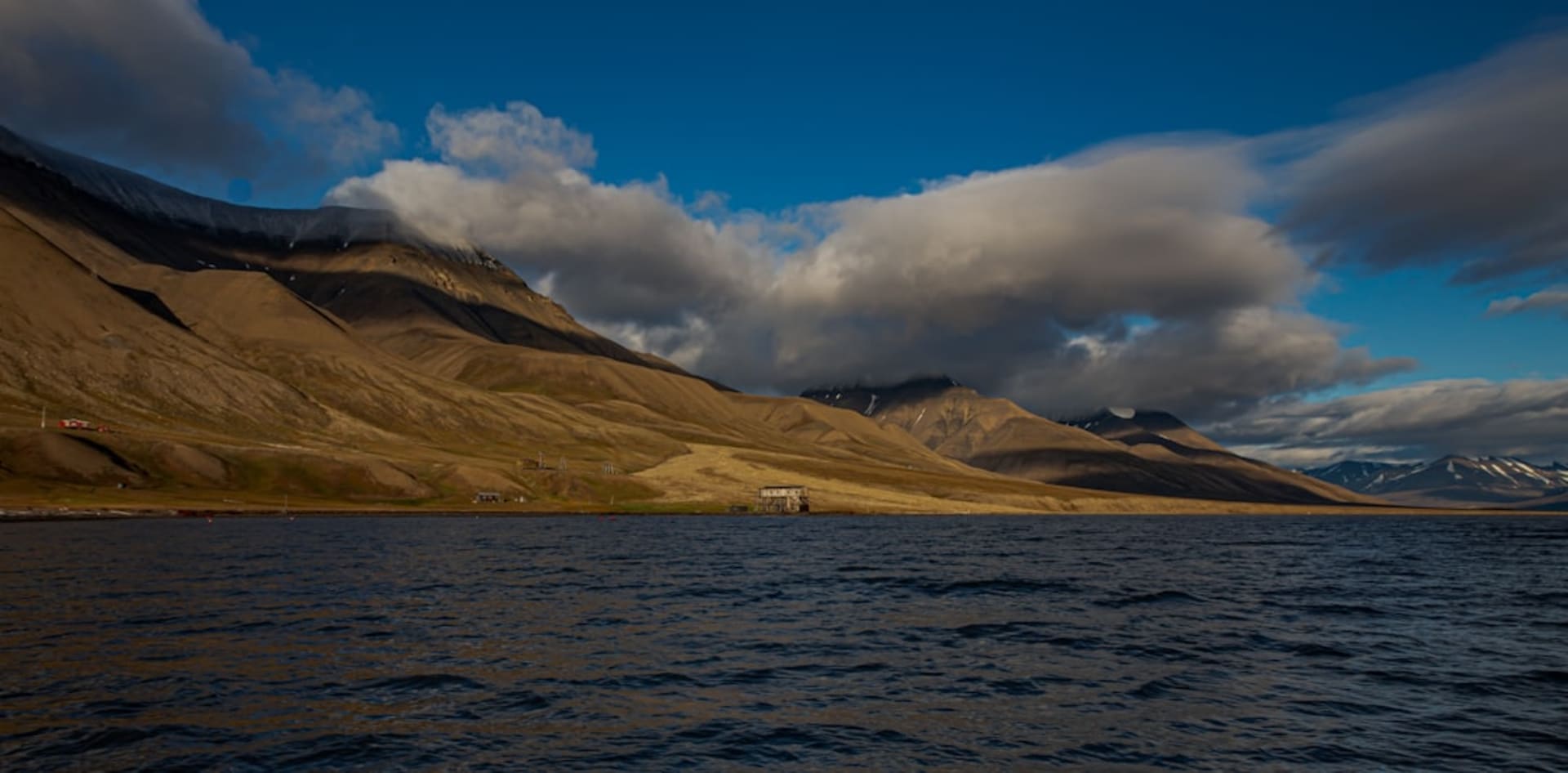
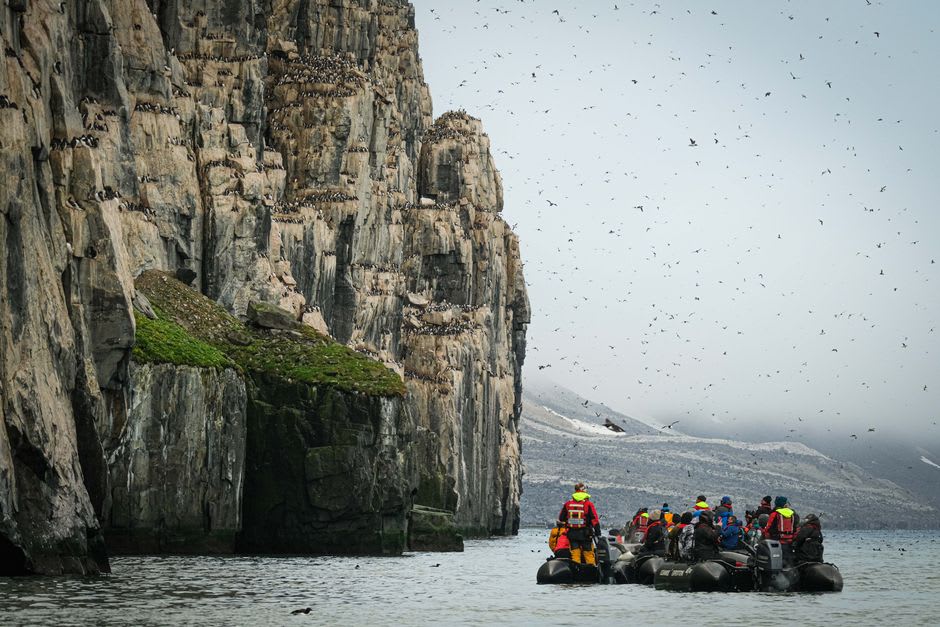
A basalt wall of screaming seabirds rising straight from the Hinlopen Strait, seen only from the deck of a Zodiac.
Nobody tells you how loud a mountain of birds actually is. We were still a few hundred meters out, the Zodiac slapping over small chop in the Hinlopen Strait, when the noise reached us before the cliffs did — this constant, ragged roar, like static with wings. Then Alkefjellet came into view: a wall of dark basalt columns rising a hundred meters straight out of the water, and every ledge on it moving. Our guide cut the engine back and just let us drift. Lia grabbed my arm without saying anything. There was nothing really to say yet.
The name means “mountain of the guillemots,” and once you’re close enough you understand why nobody bothered getting more creative. Something like 60,000 pairs of Brünnich’s guillemots nest on those ledges, packed shoulder to shoulder along a pale band running through the rock — a dolerite intrusion cutting across the dark basalt, and the birds seem to know exactly which stripe belongs to them. Kittiwakes and fulmars fill in everywhere else, and glaucous gulls patrol low along the base, working the edges for anything that falls. Because that’s the other thing about Alkefjellet — chicks do fall, and the gulls know it.
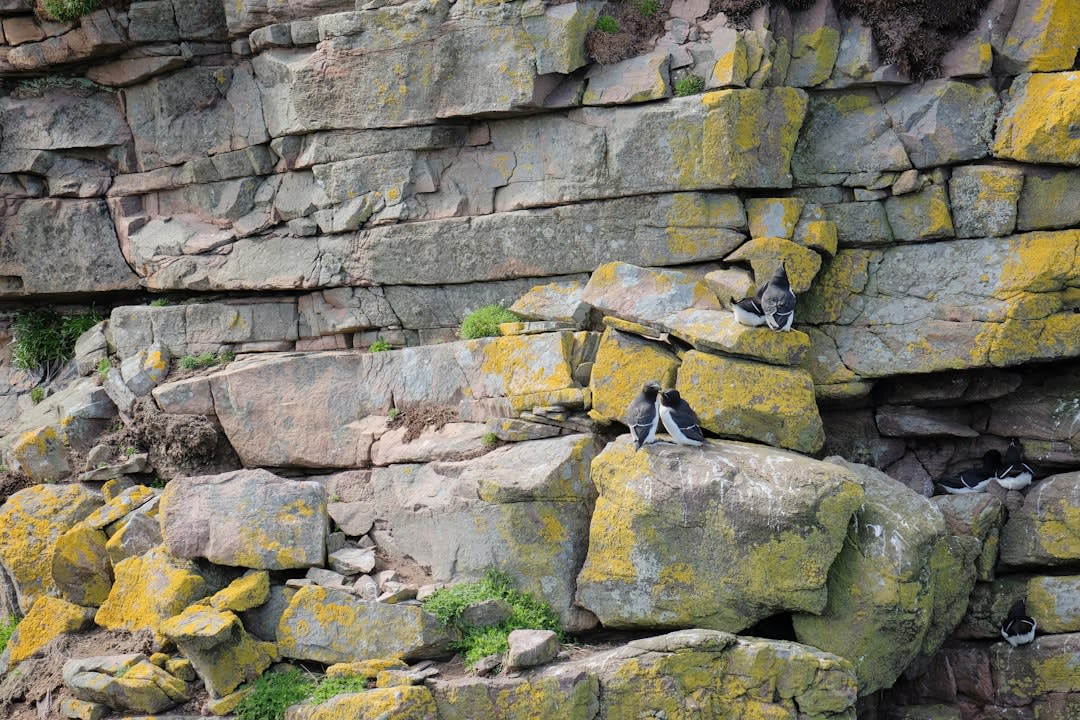
There’s no landing here, no trail, not even a rocky beach to pull the Zodiac onto — the only way to see Alkefjellet is from the water, hugging the base of the cliffs at whatever distance the ice and the swell allow. I liked that about it. It forces you to just look up for an hour, neck sore, camera forgotten in your lap half the time, while thousands of birds wheel overhead against columns of rock that look like something poured and cooled on purpose. Our guide killed the engine again near a deep crack in the basalt where the noise doubled back on itself, and for a minute none of us in the boat said anything at all.
What stayed with me afterward wasn’t even the scale of it, though the scale is real — it was how briefly this all exists. Alkefjellet is only this alive for a handful of weeks a year, and we happened to catch it at its loudest. Lia said later it was the closest she’d ever felt to standing inside something wild instead of just visiting it.
When to go: June and July are the window — that’s the height of the breeding season, when the ledges are packed with nesting guillemots and the noise, frankly, never really stops.
Keep exploring
More from Svalbard
 svalbard
 Barentsburg
Russia's active coal-mining settlement on Norwegian soil — an unlikely Arctic outpost where Soviet murals face the fjord and the bar pours vodka to anyone who makes the journey.
Explore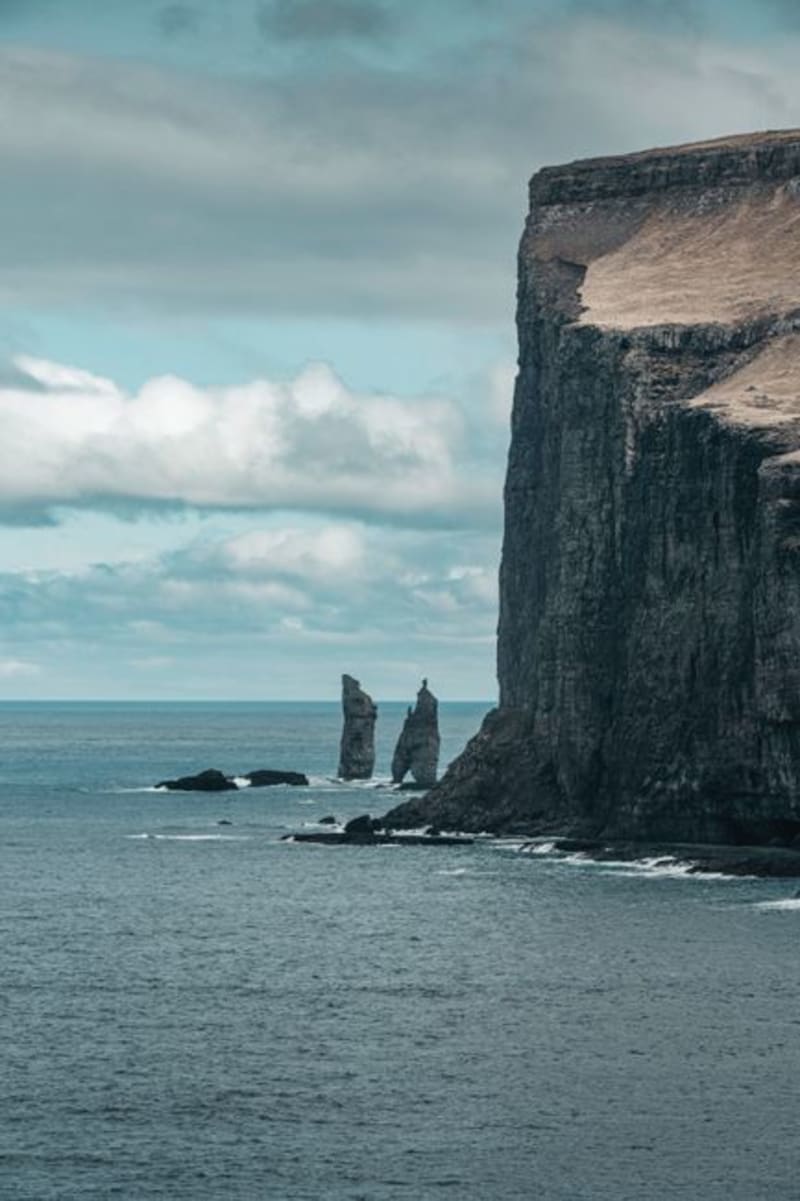 svalbard
 Bear Island (Bjørnøya)
A fog-bound outpost in the Barents Sea where seabirds outnumber people by the hundred thousand and history hides in a driftwood cabin.
Explore svalbard
 Edgeøya
Svalbard's third-largest island, a place so genuinely remote that even the polar bears seem surprised to encounter people — flat tundra and braided rivers running to a coast where walruses haul out by the hundred.
Explore svalbard
 Hornsund
Svalbard's wildest southern fjord — a cathedral of calving glaciers and jagged peaks where polar bear sightings are common enough that you stop being surprised, and then start again.
Explore svalbard
 Isfjorden
Svalbard's great central fjord — 107 kilometers of geological theater that contains four smaller fjords, three settlements, and enough birdlife to keep an ornithologist busy for a month.
Explore svalbard
 Kongsfjorden
King's Fjord on the northwest coast — a glaciologist's field site and a photographer's obsession, where four glaciers merge into a single ice front and the light at midnight in June does things I can't fully explain.
Explore