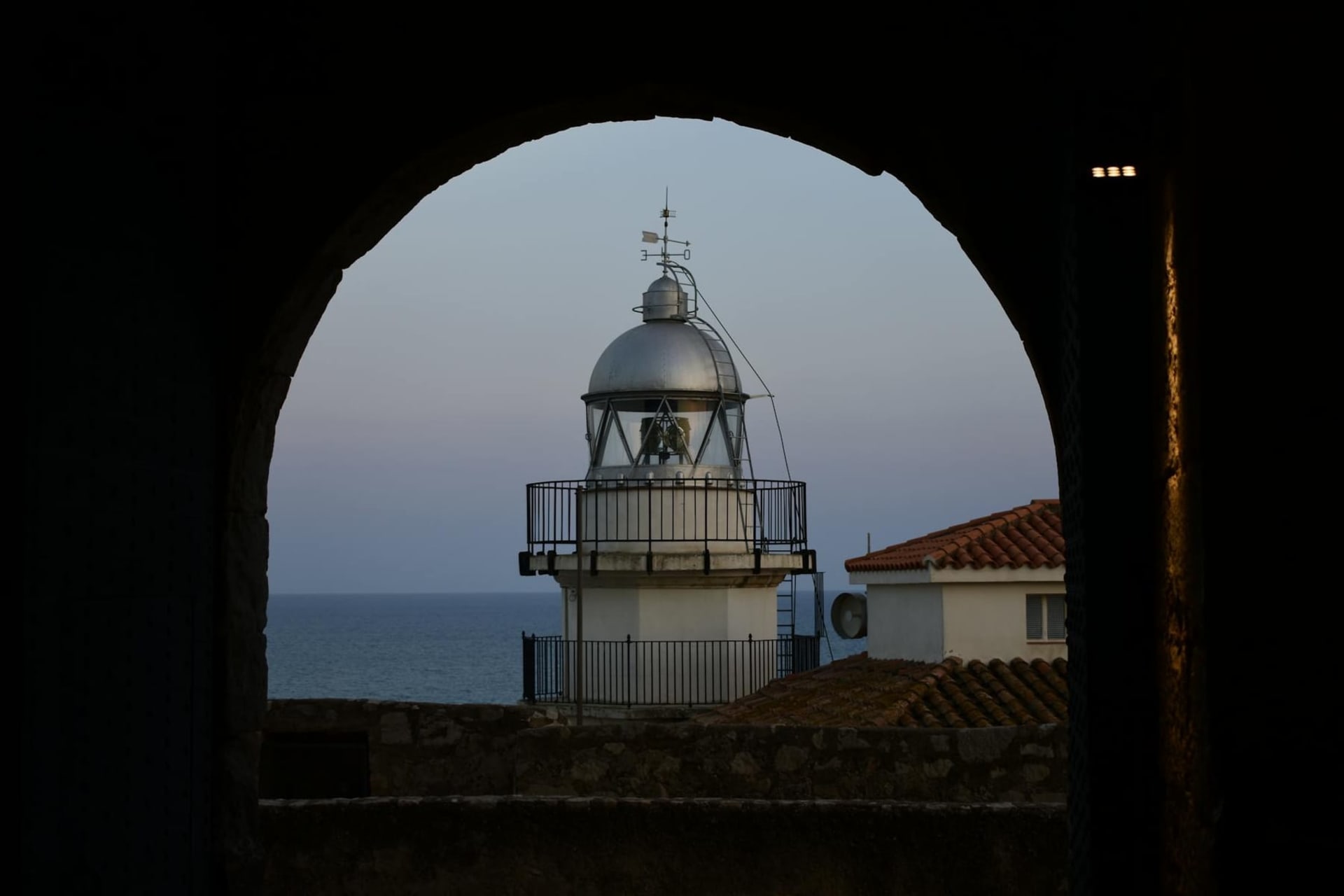
A walled papal city rising from a rocky promontory into the Mediterranean, overshadowed by its own beach resort sprawl.
The approach is disorienting. You drive up the Valencian coast past a corridor of hotel blocks and souvenir shops, the kind of beach resort infrastructure that could belong to any Mediterranean country, and then the rock appears — a volcanic fist punching out of the sea, crowned with medieval walls and the unmistakable silhouette of a Templar castle. Whatever the surrounding town is doing, that promontory wants nothing to do with it.
Inside the Walls
We parked below and walked up through the Puerta Falsa, the smaller of the old town’s two gates, in the early morning before the tour groups arrived. The Carrer Major is barely wide enough for two people to pass without turning sideways. The stone underfoot is worn smooth and bright, almost luminous in the way limestone gets when it has been walked on for eight centuries. The walls on either side hold the cool of the night long into the morning, and the smell is salt and old mortar and, from somewhere above, someone frying garlic.
The castle at the top was the refuge of the Avignon antipope Benedict XIII — Pedro de Luna — who retreated here in 1415 after the Council of Constance deposed him, and then simply refused to leave. He died here in 1423, still insisting he was the legitimate pope. The Spanish title “Papa Luna” has a melancholy comedy to it. The castle’s interior is modest, almost austere, but the views from the ramparts stop conversation.
The Surprise at the Northern Wall
What I hadn’t expected was the fishing quarter pressed against the northern curtain wall. Lia found it first, ducking through an arch while I was photographing a doorway. A handful of boats dragged up onto a sliver of shingle, nets drying on iron hooks hammered into the medieval stone, a plastic chair outside a building with no visible function. It felt genuinely separate from both the castle tourism above and the resort below — a third thing, unglamorous and unconcerned.
We ate at a table outside a small restaurant on the Plaça de les Armes: arroz a banda, the rice cooked in fish stock and served with alioli, the kind of dish that tastes like it was invented exactly here and nowhere else. A cat sat on the wall behind us and ignored us comprehensively.
Getting the Timing Right
When to go: Late September or October, after the summer crowds have left and before the old town closes up for winter — the light is softer, the streets are quiet enough to hear your own footsteps, and the restaurants still have fresh fish worth eating.