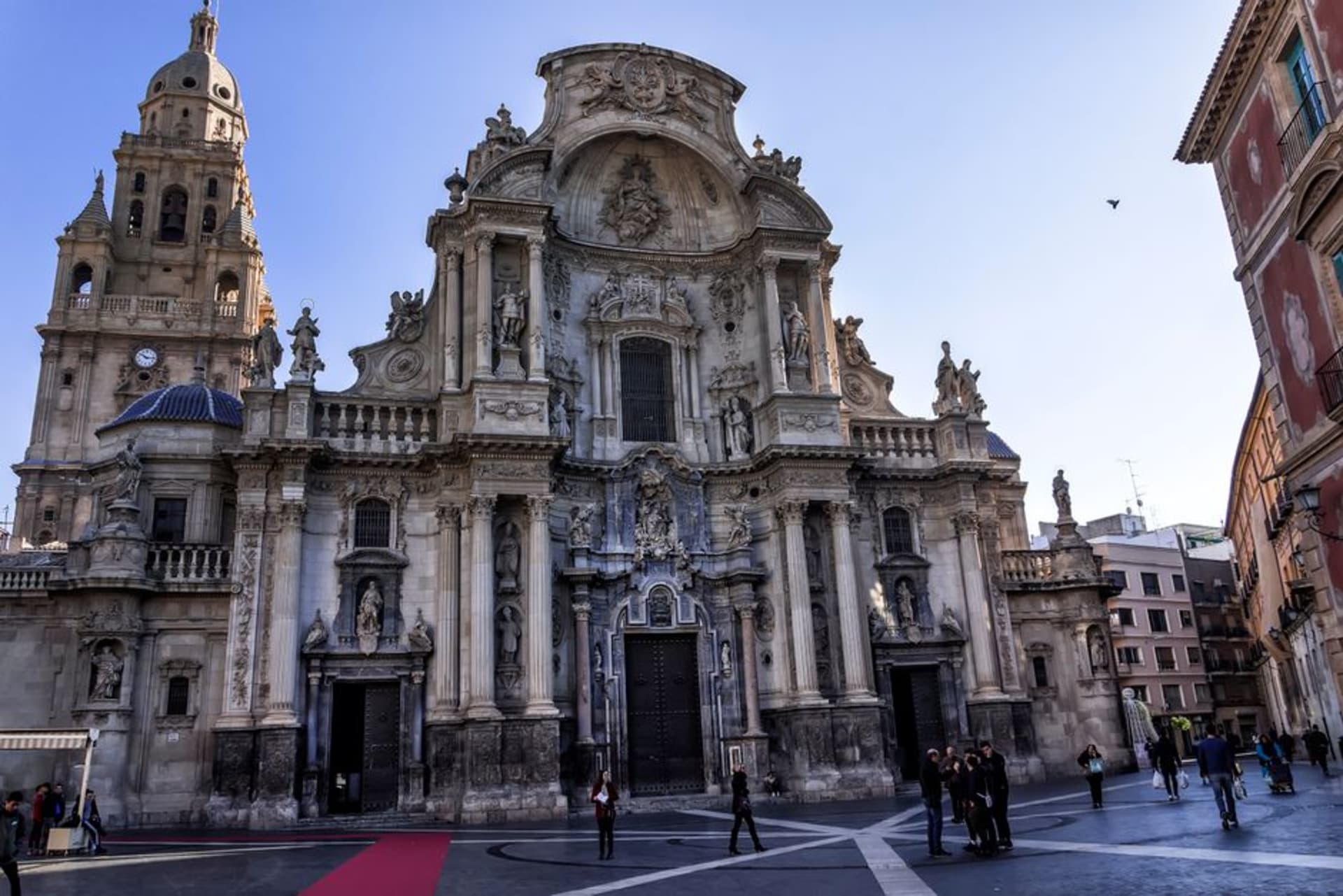
A baroque cathedral, an orchard the Moors called the Huerta, and a city that never quite bothered to become famous for either — Murcia rewards the traveler who stops asking why they came.
I’ll admit it: I came to Murcia because Cartagena was fully booked and I needed somewhere to sleep. What I found instead was a city that seems almost embarrassed by its own beauty, tucking a baroque cathedral facade behind an unassuming plaza as if it didn’t want to make a scene. The Segura river runs through the middle of it, slow and unhurried, and the whole place moves at the same pace — which after Madrid and Barcelona felt less like a letdown and more like being let in on something.
A Cathedral Built by Committee, Across Centuries
Murcia Cathedral took nearly four hundred years to finish, and you can read every decade of indecision in its stonework. The main facade is Baroque, added in the 1740s by Jaime Bort, all convex curves and stacked columns that seem to be climbing over each other to reach the sky. But walk around to the Puerta de los Apóstoles and you’re suddenly in the Gothic original from the 1390s, austere and pointed where the front is theatrical and round. Inside, the Capilla de los Vélez is a fifteenth-century fantasy of star-vaulted stone so intricate it looks woven rather than carved — Isabelline Gothic at its most obsessive. I climbed the Torre de Santa María, one of the tallest bell towers in Spain, mostly for the burn in my legs, and stayed twenty minutes longer than planned once I saw the Huerta spreading green and geometric toward the mountains.

The Huerta, and What the Moors Left Behind
What surprised me most wasn’t the cathedral — it was the orchard. The Huerta de Murcia is a network of irrigation channels, some tracing back to the ninth-century Muslim taifa of Murcia, that turned this dry Mediterranean basin into one of the most productive farmland systems in Europe. You can still see the norias, the old waterwheels, and the acequias threading between citrus groves on the city’s edges. It’s easy to forget, wandering the tapas bars around Plaza de las Flores, that the entire reason Murcia exists where it does is hydraulic engineering a thousand years old. I ate marinated tiger nuts and a plate of zarangollo — courgette and egg, unglamorous and completely right — at a bar barely wide enough for four stools, and the owner told me his grandfather had irrigated fields with water rights that predated the Reconquista by centuries.

Murcia doesn’t perform for tourists the way its coastal neighbors do. The Real Casino de Murcia, an eclectic nineteenth-century gentleman’s club with a Moorish-revival patio and a ballroom modeled loosely on Versailles, still functions as a private club upstairs while letting visitors wander the ground floor for a couple of euros — an odd, wonderful hybrid of exclusivity and openness that felt very Murcian by the end of my stay. I never did make it to Cartagena that trip. I’m not sorry.
When to go: April and May bring mild days and the Bando de la Huerta festival, a riot of traditional dress and orchard produce during Murcia’s spring fiestas; September and October offer similar warmth without the crowds.