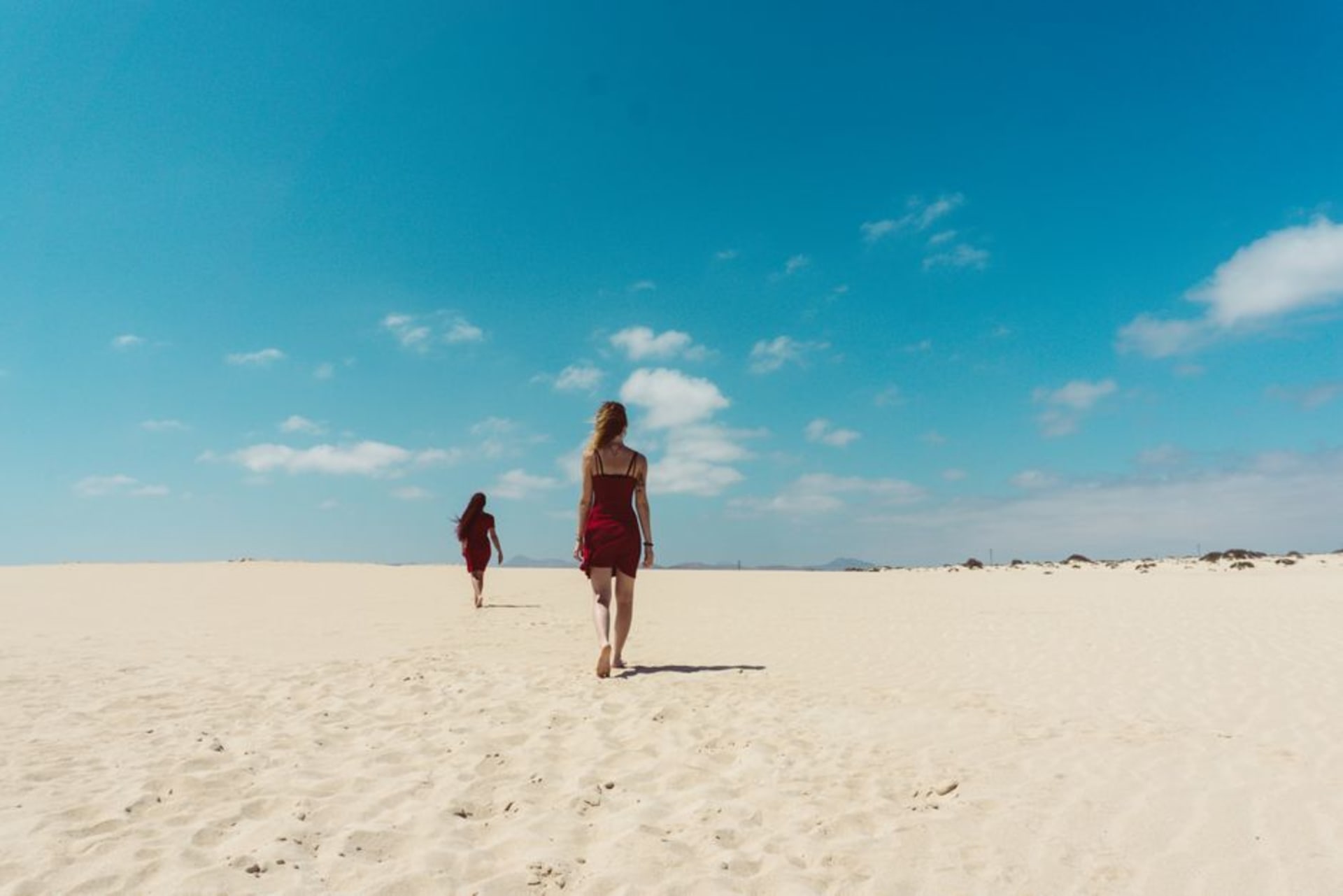
Fuerteventura
"Fuerteventura doesn't perform for you. It just keeps being a desert that happens to have the best water in Spain."
The oldest of the Canary Islands is also the emptiest — a wind-scoured slab of ochre desert dropped into the Atlantic, where the beaches outnumber the people.
I landed in Fuerteventura expecting an island and found a desert with a coastline stapled around it. That’s the thing nobody tells you: this is the closest the Canaries get to the Sahara, geologically and visually — flat, biscuit-colored, scrubby with tabaiba and aulaga, ringed by peaks worn down over twenty million years into blunt, patient shapes. It’s the oldest island in the archipelago, and it looks like it’s spent that extra time sanding off anything unnecessary.
Corralejo and the Dunes
The Parque Natural de Corralejo, in the north, is where the desert idea makes the most sense. Dunes the color of raw sugar roll for kilometers between the town and the sea, blown across from the Sahara over millennia — you can feel the geological kinship in the sand itself, finer and paler than anything volcanic. I walked out at golden hour with the wind doing that constant low hiss it does here, sculpting new ridges while erasing yesterday’s footprints, and the water beyond the dunes had that improbable Canarian turquoise that looks photoshopped even when you’re standing in it. Just offshore sits Isla de Lobos, a tiny nature reserve you can reach by a short ferry from the harbor, named for the monk seals that used to haul out on its rocks before sailors hunted them to local extinction centuries ago.

Wind, Waves, and Goat Cheese
Fuerteventura is a windsurfing and kitesurfing pilgrimage site — the trade winds hit this stretch of the Atlantic with a reliability that surfers elsewhere would kill for, and the beach at Sotavento, on the southeast coast, hosts a world championship every year on a lagoon that shifts shape with the tides. I’m not a windsurfer, but I sat on the sand at Sotavento for an entire afternoon just watching the kites carve patterns against the sky, dozens of them, silent from that distance, like a flock trained to formation-fly. The island is also, oddly, goat country: there are more goats than people here, and the local cheese, queso majorero, has its own denomination of origin. I bought a wedge of the aged, paprika-rubbed version at a market in Antigua and ate it with figs on a wall overlooking nothing but scrubland and heat-shimmer, which felt correct.

Inland, the town of Betancuria — founded in the early 15th century by the Norman conquistador Jean de Béthencourt and briefly the island’s capital — sits tucked in a valley that’s noticeably greener than the coast, a reminder that this desert has folds where water still collects. Its stone church and small museum are modest, but the drive there, through the Vega de Río Palmas with its scattered palms, is one of the better ways to understand how much variety this “flat island” actually holds.
When to go: March through May and September through October give you the trade winds without peak-summer crowds or heat; if you’re chasing the windsurf championships specifically, aim for late July or August at Sotavento.