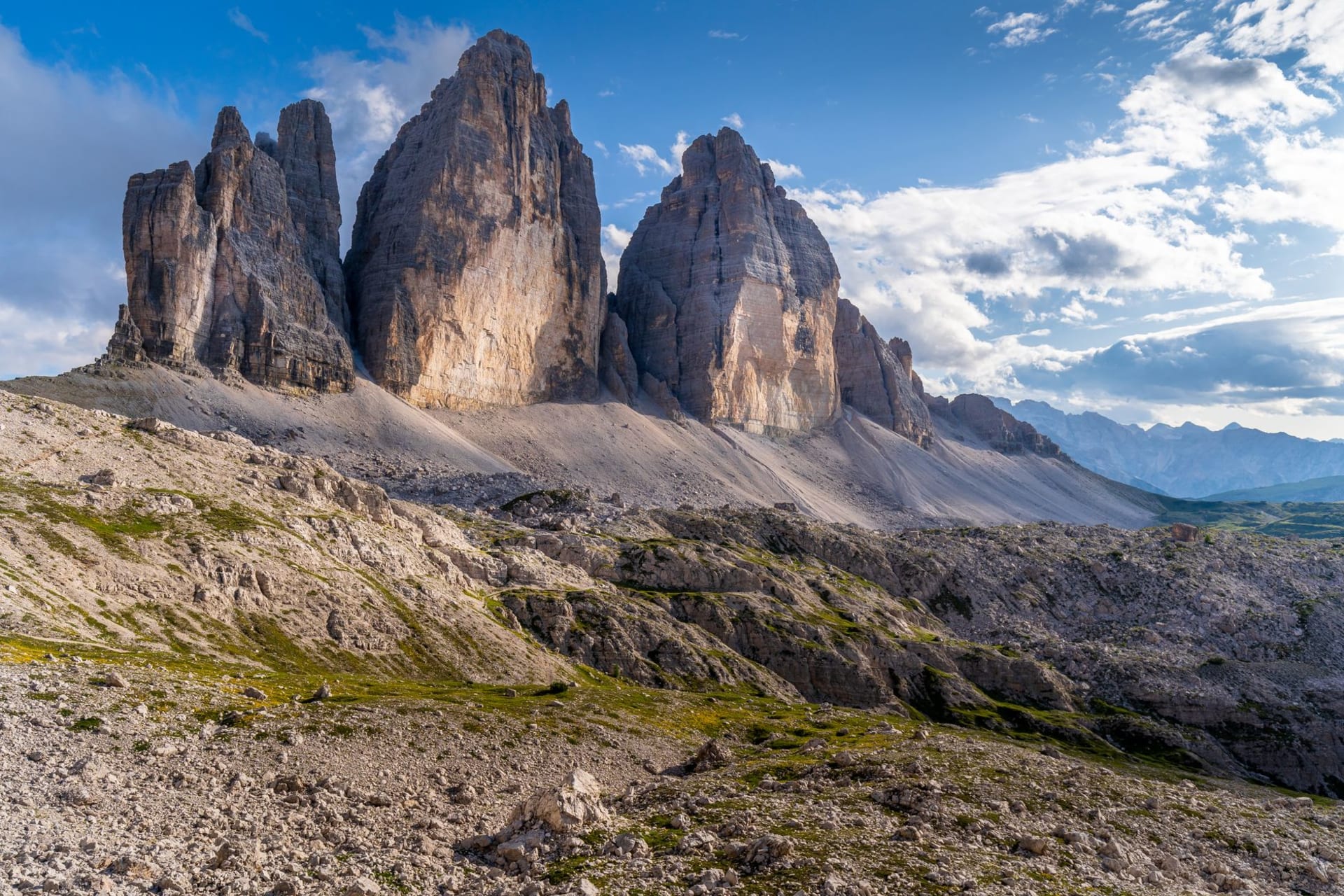
Tre Cime di Lavaredo
"Every landscape has its definitive angle. This one has several, and they're all correct."
Getting There
There are two approaches. From the south via Misurina and a toll road that climbs to the Rifugio Auronzo at 2,333 meters — the easier route, twelve euros to drive up, and the road quality makes it feasible without a 4x4. From the north via the Val Fiscalina, longer and wilder, starting from Sesto. I’ve done both; the southern approach delivers you closer to the peaks, the northern gives you a longer morning with the towers growing from a distance.
The toll road runs roughly from late May to late October, snow permitting. I drove it on a clear July morning at 7am and found the upper parking lot at Rifugio Auronzo perhaps a quarter full. By 9:30, when I was well into the circuit, cars were queued back down the road. The math of early starts applies here with particular force.
The Towers Themselves
The Tre Cime — Cima Grande (2,999 m), Cima Occidentale (2,973 m), and Cima Piccola (2,857 m) — are the defining image of the Dolomites and have been since the first Romantic-era engravings. They are vertical in a way that most mountain terrain isn’t: the north faces drop nearly 500 meters almost without interruption, overhanging in sections, the grey-white limestone striated with orange and the specific dark staining of lichen that gives the rock its surface complexity from distance.
From below, walking on the circuit path, they change constantly. The relationship between them — which one appears largest, how the gaps between them open and close — shifts at every bend. Lia, who grew up near the Massif Central and is not usually susceptible to mountain awe, stopped talking for about twenty minutes somewhere on the west side and took photographs she already knew she wouldn’t use because the three-dimensional reality wasn’t transferable.
The Circuit Walk
The standard loop around the three peaks covers roughly 10 kilometers and takes three to four hours at a moderate pace, gaining and losing about 400 meters of elevation. The path is well-marked and packed gravel for much of it — not technical, but at altitude and exposed in sections to mountain weather that can change within the hour.
The view from the Forcella Lavaredo — the saddle between the peaks and the Cadini di Misurina group — stops most people for a while. The Cadini are a jagged secondary group to the south, and at the saddle you see both ranges simultaneously at close range: the Tre Cime dominant and blunt behind you, the Cadini spiky and complex ahead.
The Rifugio Locatelli, on the north side of the loop, serves Wienersch nitzel and Lagrein wine at 2,405 meters. The queue at lunch is long but moves quickly; the terrace faces north toward the Austrian border and Austria’s Sexten Dolomites. The food is unremarkable and exactly right.
Misurina and Below
The village of Misurina, eight kilometers south of the toll road junction, sits above a lake of the same name — smaller, quieter, and far less visited than Lago di Braies. A walking path circles it in forty minutes. In the morning before the Tre Cime traffic begins, it holds a particular stillness: mist coming off the water, no wind, the reflections of the surrounding pine forest on the surface.
I stopped there on the way down for a coffee and sat by the lake for twenty minutes doing nothing specific, which the morning seemed to require.
When to go: Late June through September for the circuit walk. The toll road typically opens by late May and closes in October, but snow can block it at any time. Mid-July and August are the peak crowds; aim for weekdays and early starts. October, when the larches turn gold, is undervalued and the light changes what you see.