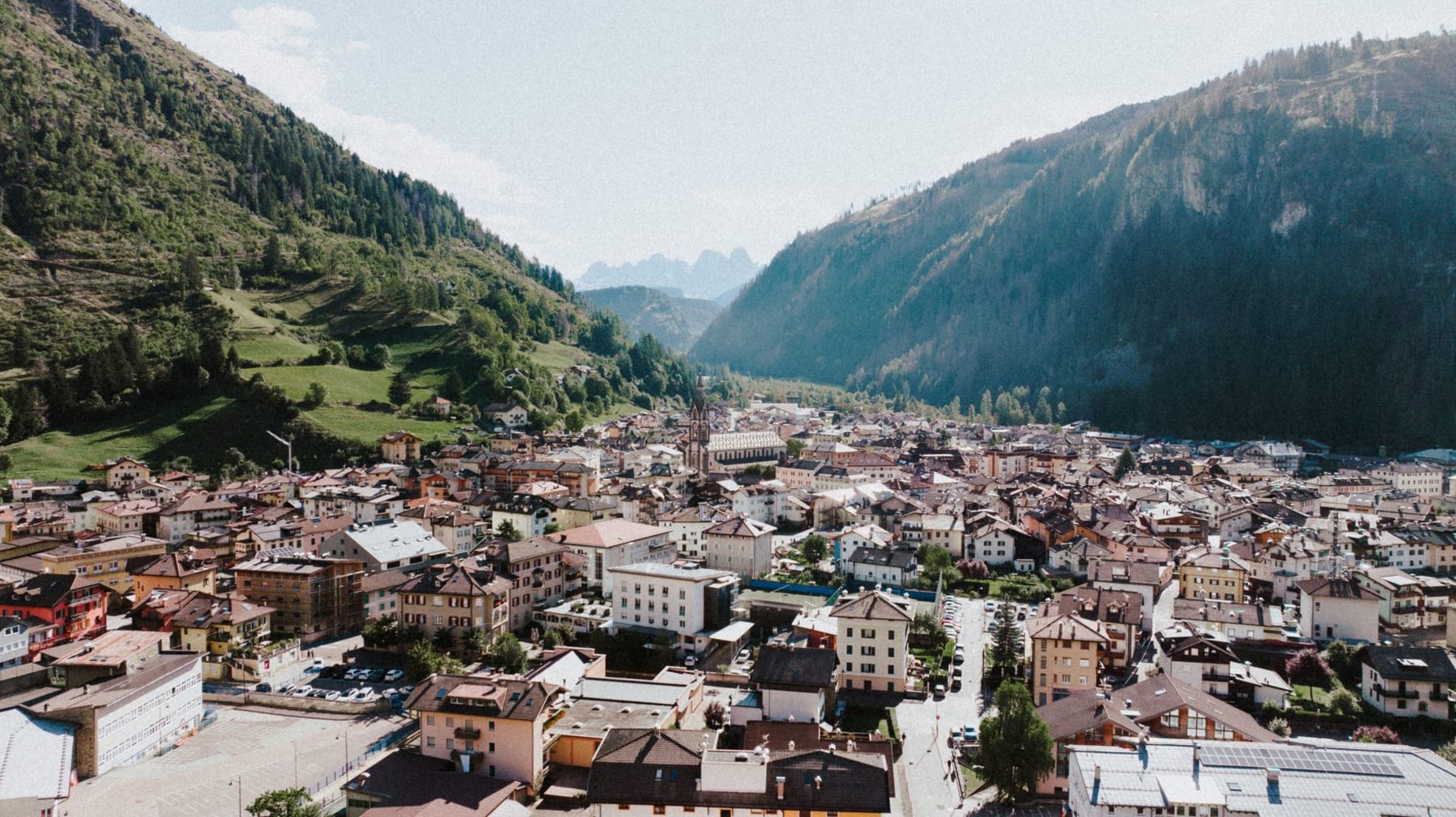
Brunico
"Reinhold Messner climbed Everest without oxygen and then built five museums. I respect the ambition."
The Town Itself
Brunico is the kind of place that doesn’t lead with its appeal. The ring road around it is functional and graceless; the approach from the main highway passes industrial buildings and a supermarket. Then you park, walk two minutes, and find yourself on Via Centrale — a traffic-free medieval street that climbs straight toward a 13th-century castle, lined with painted guild houses, shops selling Speck and mountain cheese and hiking equipment with the confidence of a town that knows what its visitors are there for.
The castle at the top of the hill belongs to the bishops of Bressanone and dates from 1248. It’s not open for interior tours but the walk up the lane beneath it, through the old quarter with its narrow stepped alleys and window boxes, takes fifteen minutes of the best kind of aimless walking.
I arrived on a Wednesday market day in October. The square held vegetable stalls, two honey vendors, a man selling dried herbs in brown paper bags, and a bread baker who’d brought a hundred loaves and had forty left when I arrived at 10am. I bought a sourdough rye — the standard bread in this part of South Tyrol, dense and slightly sour — and ate it over the course of the day.
The Messner Connection
Reinhold Messner — first person to climb all fourteen eight-thousanders, first to climb Everest without supplemental oxygen, general overachiever — is from the Puster Valley, and he has spent his post-climbing decades building the Messner Mountain Museum: a network of six sites across South Tyrol, each occupying a different mountain or castle. Ripa, in Brunico’s castle, covers mountain peoples of the world: their cultures, their relationship to altitude, their tools and clothing and belief systems.
I spent three hours there. The permanent collection is organized around vertical geography rather than nationality, which produces unexpected juxtapositions — Tibetan prayer flags beside Andean textiles beside Scandinavian Sami gear. Messner’s own mountaineering artifacts show up throughout, including the boots from Everest 1978, which look insufficient for a cold day in the Alps let alone 8,848 meters.
Puster Valley Food
The Puster Valley (Pustertal) has its own culinary emphases, even within a region already serious about food. Gerstlsuppe — barley soup with smoked pork — is the standard first course. Schlutzkrapfen appear on every menu. Kaminwurzen — thin smoked sausages dried over weeks until they’re firm and intensely flavored — come with drinks at most bars.
At a restaurant on Via Centrale, I ordered the Gröstl — a pan-fried hash of potatoes, onions, and beef — and it arrived in a cast-iron skillet still sizzling. The beer was a local dark from the brewery at Monguelfo, fifteen minutes east. It was a very practical lunch.
As a Base for the Valley
Brunico’s position in the center of the Puster Valley makes it the logical base for exploring in both directions: west toward the Dolomites and the Val Pusteria ski area (Kronplatz), east toward Lago di Braies and the Sesto Dolomites. The train connects it to Fortezza (for Bolzano connections) and east to San Candido at the Austrian border.
When to go: December for the Christmas market, which occupies the central streets without the excess of larger cities. January and February for Kronplatz skiing (the mountain is directly above the town). July through September for valley hiking and access to Lago di Braies and the Sesto Dolomites.