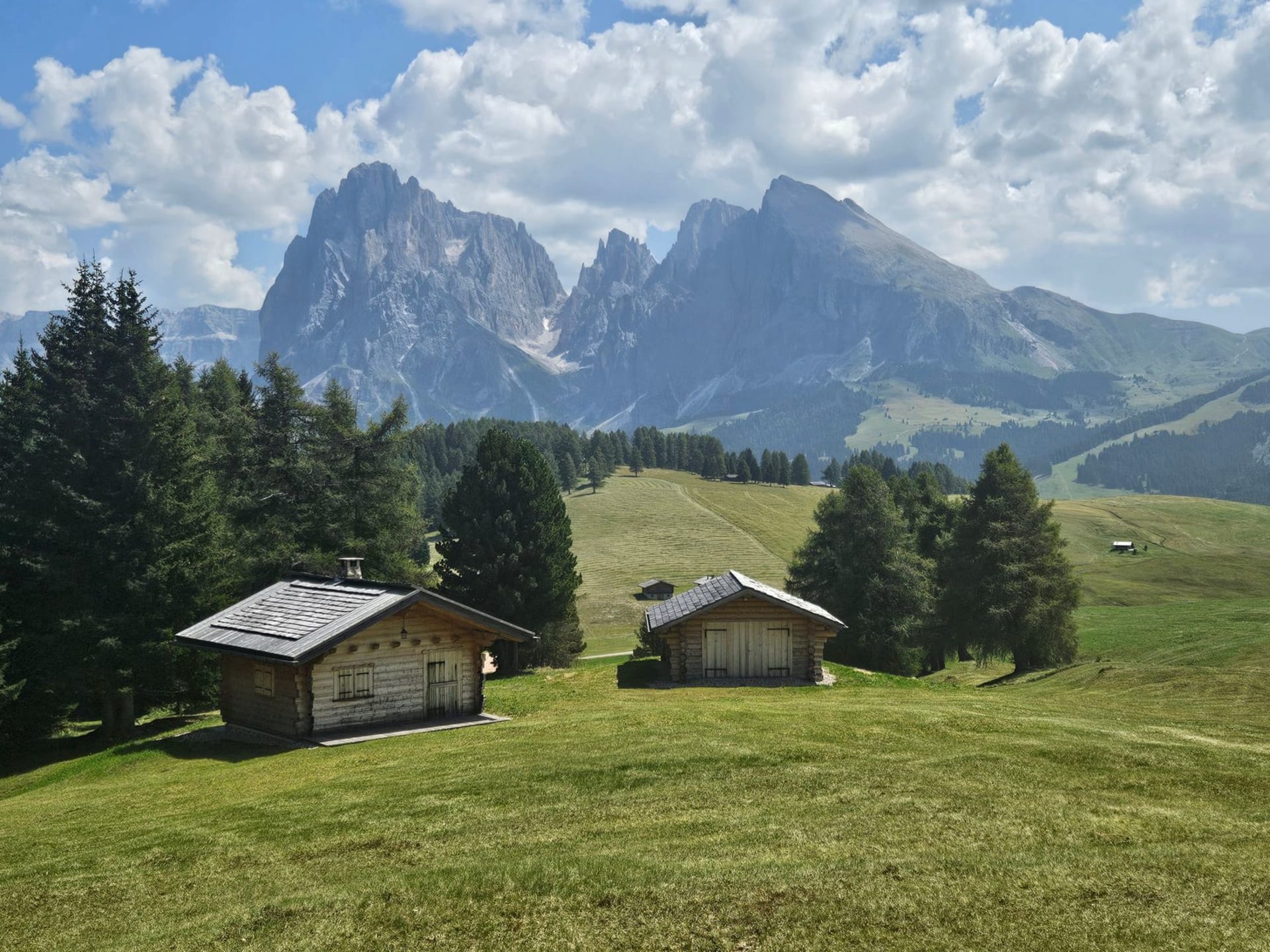
Alpe di Siusi
"At 2,000 meters you stop justifying why you're just sitting in the grass."
Getting Up There
Cars are banned from the plateau between 9am and 5pm in summer, which means you take the cable car from Siusi or drive up in the early morning and commit to the day. I drove at 7:30, found the upper parking lot nearly empty, and walked out into the alp before the first tour groups had arrived. For a full hour I had something close to solitude on a plateau that in peak season holds thousands of people.
The Seiser Alm — the German name, used interchangeably — covers 56 square kilometers at elevations between 1,800 and 2,350 meters. In summer it’s wildflower meadows: gentian, arnica, alpine clover in colors that feel overcranked until you accept that the thin air and the angle of the sun actually do that to color up here. In winter it’s a Nordic skiing paradise with 80 kilometers of groomed trails. Both versions are real; both feel slightly unbelievable.
The Sassolungo Effect
The Sassolungo (Langkofel) massif rises from the western edge of the plateau in a series of near-vertical towers that top out around 3,181 meters. At sunrise the rock goes through a sequence — grey, pink, amber, finally the hard white-grey of full daylight — that the locals call Alpenglow and that I would have assumed was a tourism board invention if I hadn’t seen it myself at 6:15am with no one else around.
The effect is partially geological: these Dolomite peaks are composed of ancient coral reefs, calcium carbonate in a form that absorbs and reflects certain wavelengths in ways that sedimentary rock elsewhere doesn’t. Knowing this doesn’t diminish it.
Walking the Plateau
The trail network up here is genuinely extensive and genuinely flat by Alpine standards — long traverses across open meadow rather than technical climbing. The most popular circuit runs from the Compatsch cable car station east toward Saltria and back, roughly 12 kilometers with minimal elevation change. I did it in four hours including a stop at a Berghütte where the Schlutzkrapfen — Tyrolean pasta filled with spinach and ricotta, served with browned butter and poppy seeds — cost eight euros and tasted like it cost more.
The unmapped pleasure is simply wandering off the main trail onto cow paths, following the sound of cowbells until you find a small herd in a hollow you wouldn’t have found otherwise.
Where to Stay
There are a handful of farms and guesthouses directly on the plateau — staying up here overnight means the early morning light and late evening quiet are yours without a cable car schedule. The guesthouses are rustic in the original sense: wooden floors, duvets that smell faintly of hay, breakfast that arrives in quantities appropriate to people who’ve been walking since dawn.
I booked two nights at a farmhouse near Saltria and ate dinner both evenings on a terrace facing west, watching the Sassolungo go through its colors in reverse.
When to go: Mid-June through September for wildflowers and walking. January through March for Nordic skiing on groomed trails. Avoid the last two weeks of August — the plateau reaches its maximum crowd density and parking becomes a competitive sport.