Suwon
"I came for a UNESCO wall and stayed for the ribs. Suwon does not let you leave hungry, in any sense."
A Wall With a Backstory
Most fortress walls are about keeping people out. Suwon’s Hwaseong is about something stranger and more human. King Jeongjo built it in the 1790s when he moved his father’s tomb here — a father who had been sealed inside a rice chest and left to die by his own father, the king before him, in one of the more operatic episodes of Joseon court history. Jeongjo built the fortress partly as a military stronghold, partly as a new power base away from the capital’s politics, and partly, you sense, as an act of devotion. It is a wall built out of grief, and once you know that, walking it feels different.
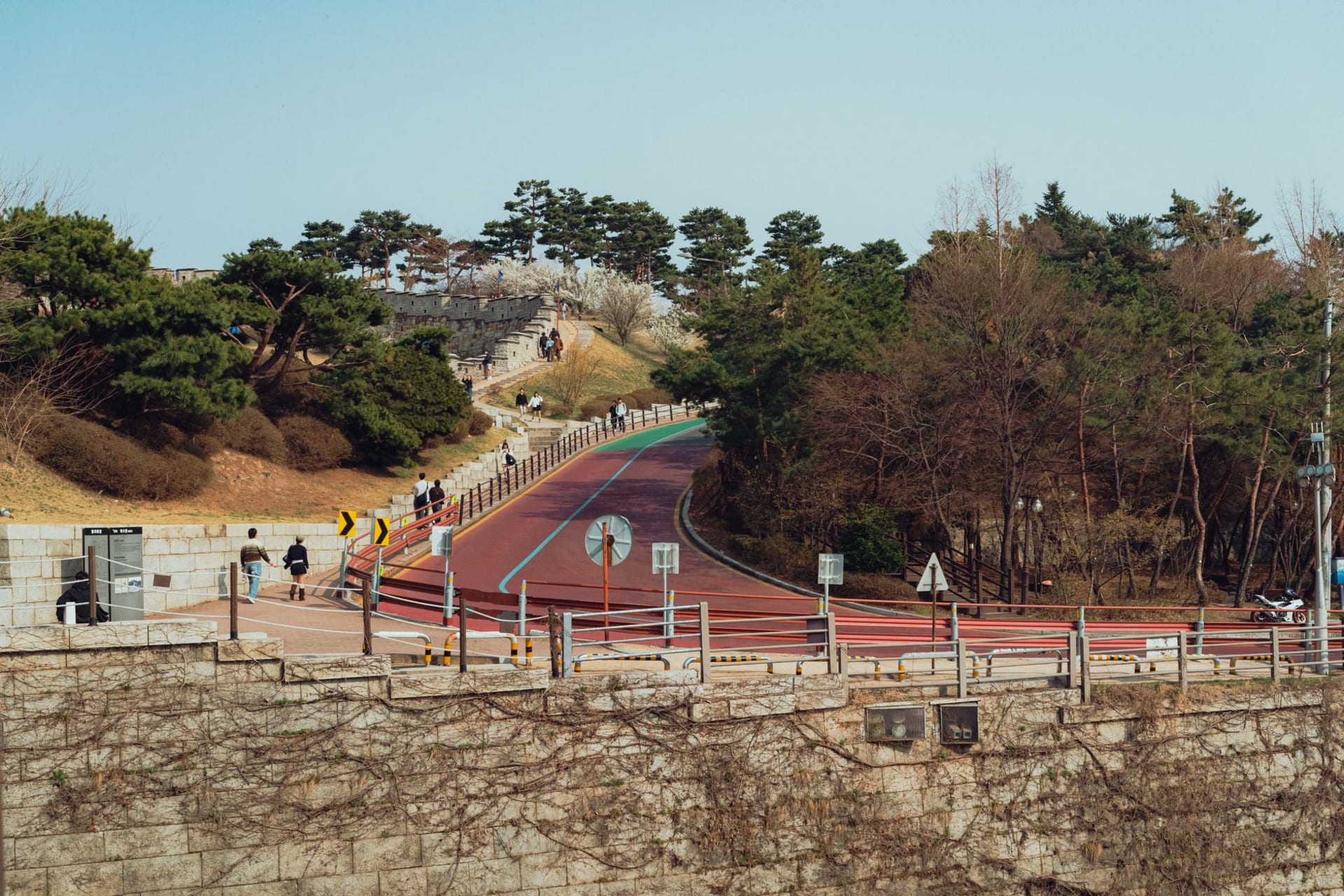
The whole circuit runs about five and a half kilometres over the hills that ring the old city. I walked it counterclockwise from Paldalmun, the great southern gate, which sits stranded now in the middle of a roundabout like a king at a bus station. The climb up Paldalsan behind it is the only real effort, and the reward at the top is the whole city laid out below, the wall snaking away in both directions.

Cleverness in Stone
What makes Hwaseong remarkable is not just that it survived — it was badly damaged in the Korean War and meticulously rebuilt using the original construction records, which Jeongjo’s engineers had written down in obsessive detail. That documentation is part of why UNESCO listed it. The wall is full of clever military features: artillery towers, floodgates where a stream passes through the wall under a beautiful seven-arched sluice, secret sally ports, and command posts with views in every direction.
Lia, who has a low tolerance for me reading information panels aloud, nonetheless got drawn into the floodgate — Hwahongmun — where the water runs under the wall in a small architectural drama of stone arches and a pavilion balanced on top. We sat there a while, and I understood why the locals treat the wall as a public park rather than a monument. They jog it, walk dogs along it, court on it. It is alive in a way ruins rarely are.
The Palace and the Ribs
Inside the walls, Hwaseong Haenggung is the palace where Jeongjo stayed on his visits to his father’s tomb — a low, elegant complex of courtyards that hosts changing-of-the-guard performances and the occasional historical drama film crew. It is worth an hour, especially the throne hall and the old zelkova tree in the courtyard that people tie wishes to.
But let me be honest about what fixed Suwon in my memory: the galbi. Suwon is famous across Korea for its beef short ribs, served in cavernous old restaurants where the meat arrives in slabs and is grilled at the table over real charcoal. We went to one of the old institutions near the wall, ordered more than two people should, and worked through it methodically with scissors, tongs, and lettuce wraps until we could not continue. The bill was alarming and entirely worth it. I rolled back to the guesthouse along the floodlit wall, full of beef and quiet admiration for a king who built all this for his dead father.

Worth the Short Hop
Suwon is forty minutes from Seoul on the metro, which makes it an easy day trip, but I would argue for staying the night. The wall is at its best at dusk and after dark, when it is floodlit and nearly empty, and the day-trippers have all gone back to the capital. Walk it twice: once in daylight for the views and the engineering, once at night for the atmosphere.
When to go: Spring (April–May) for mild weather and cherry blossom along the wall, or autumn (October) for crisp air and colour on Paldalsan. Summer is hot and humid; winter is cold but the floodlit wall in clear cold air is genuinely beautiful. Wear proper shoes for the full circuit — the hill sections are steeper than the photos suggest.