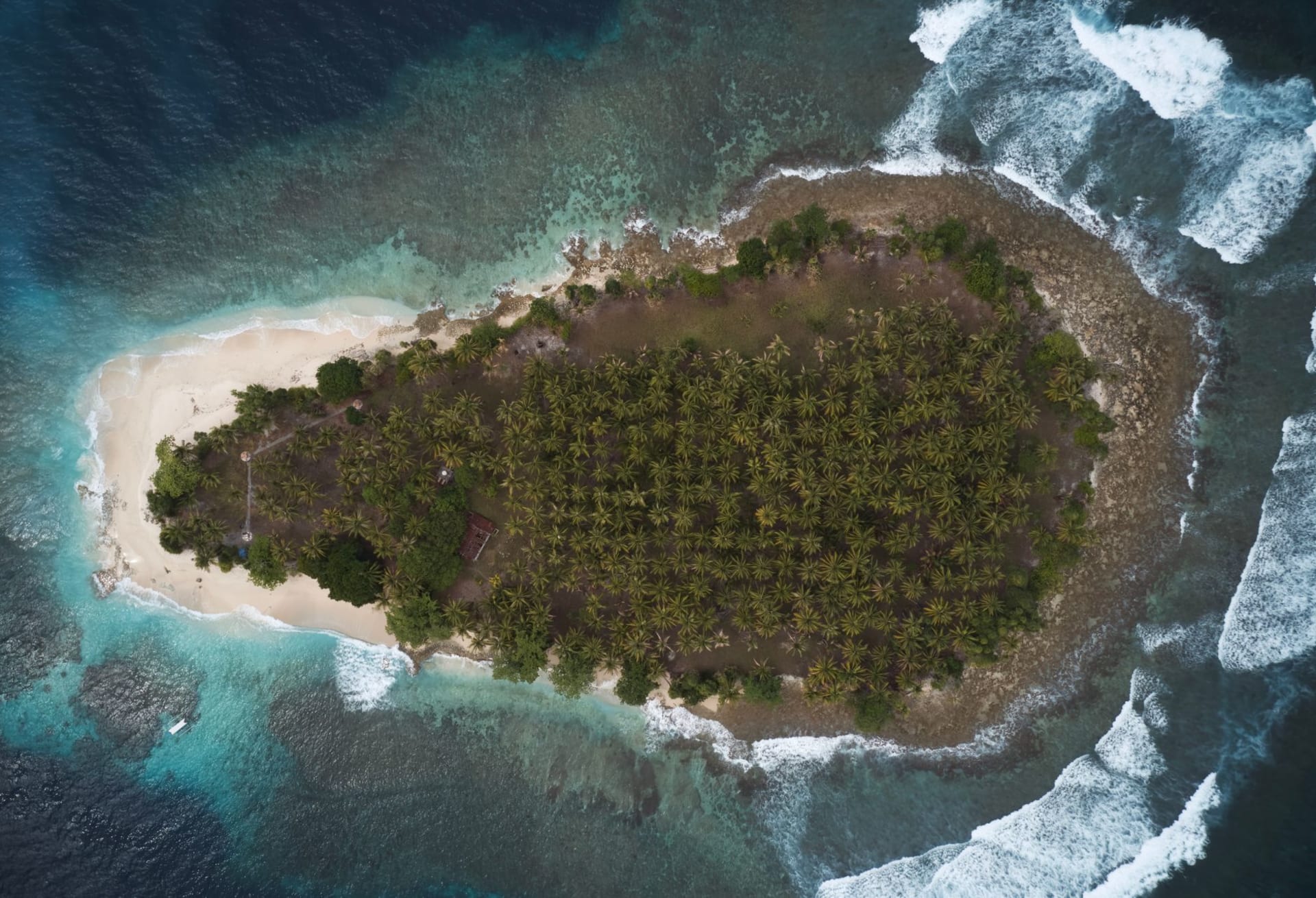
Rennell Island
"The lake is two hours from anywhere and feels like the beginning of the world."
Rennell is not easy to reach, and the island has clearly decided this is fine. There’s a small airstrip near the northern end serviced by Twin Otter flights from Honiara, twice or three times a week if conditions allow. The road south to Lake Tegano — the centrepiece of the UNESCO World Heritage site — is roughly ninety minutes on a track that tests the confidence of even serious four-wheel-drive operators. I was in the back of a pickup truck, holding on with both hands, watching the forest close overhead.
Then the lake appeared at the end of the track and I stopped thinking about the road.
Lake Tegano
Lake Tegano is the largest lake in the Pacific Islands — about 155 square kilometres — and it sits inside the raised coral atoll that forms the southern two-thirds of Rennell Island. It was originally a saltwater lagoon that, over thousands of years of geological uplift, became enclosed and gradually freshened to brackish. Today it’s neither fully fresh nor saltwater, occupying a category of its own that has produced endemic species found nowhere else: particular fish, a distinctive bird population, and aquatic life that evolved in isolation.
The Rennell shrikebill. The Rennell fantail. The Rennell white-eye. These birds exist on this island and nowhere else on the planet, in forest that has never been logged because the terrain has always made logging uneconomical. That accidental conservation is now UNESCO-protected, though the mechanism that saved the forest — its inconvenience — is more honest than most preservation stories.
Out on the Water
Getting onto the lake means arranging a dugout canoe with someone from Tingoa, the village nearest the lake shore. The lake’s water is clear, slightly tinted green, and warm. From the canoe you can see limestone pinnacles rising from the water — remnant reef structures from the atoll’s original lagoon phase — and the forest comes to the lake edge everywhere, dense and unbroken, with frigate birds and boobies working the thermals above the tree line.
I spent most of a day on the water. The silence on the lake has a quality I found hard to account for — not quiet, exactly, because the forest is loud with birds, but isolated in a way that made the idea of cities feel genuinely abstract. There are no resorts on Rennell. There is one guesthouse in Tingoa that provides basic accommodation and will organise food. That’s the infrastructure.
The Limestone Forest
The forest covering most of Rennell is karst limestone — a dense, tangled, spectacularly biodiverse ecosystem that grows directly from the coral rock. Walking in it requires either a guide or an acceptance that you will get thoroughly turned around. I went in for an hour with a young man from Tingoa who moved through the undergrowth with the specific competence of someone who grew up playing in it, pointing out a Rennell Island giant imperial pigeon in a fig tree with the casual pride of someone introducing a personal friend.
The birdwatching alone justifies the trip for anyone with even mild ornithological interest.
When to go: April through November is the most reliable window. The Twin Otter flights to Rennell are notoriously subject to weather cancellations, so build buffer time into your plans — being stuck a day or two longer than expected is common. The wet season from December to March brings heavier rain that makes the track to the lake significantly worse. Rennell rewards patience; don’t try to do it as a quick day trip.