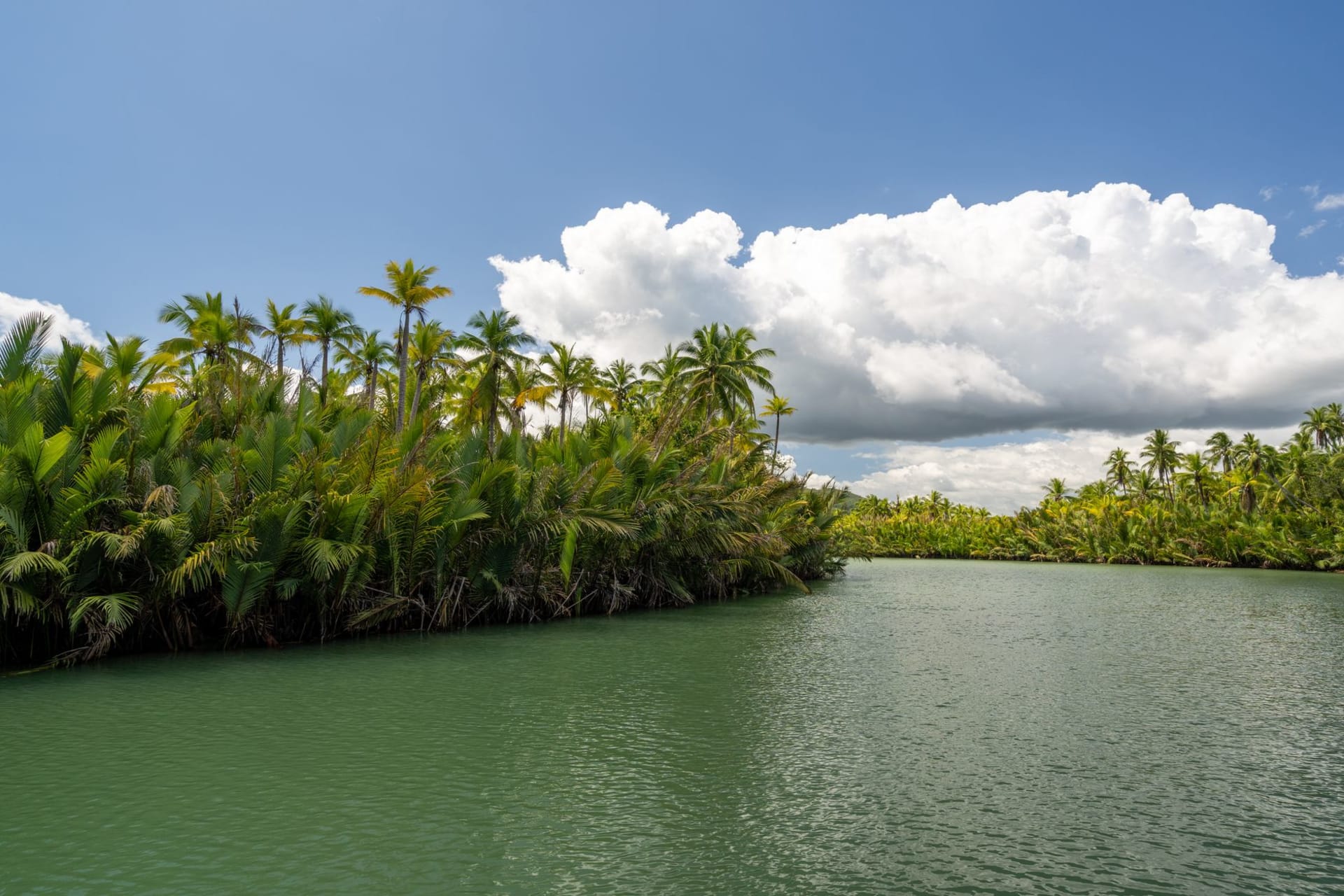
The statistic that Marovo is the world’s largest saltwater lagoon doesn’t prepare you for the actual visual experience. I’d read the description a dozen times before arriving, but when the small prop plane banked over the lagoon on descent into Seghe airstrip, I genuinely gripped the armrest. The colour was wrong, in the best sense — too vivid, too graduated, the kind of impossible turquoise that looks Photoshopped until you’re standing ankle-deep in it and can see your feet on the sand four metres below.
The lagoon sits in New Georgia Province in the Western Solomons, formed by two parallel barrier reefs that enclose roughly 700 square kilometres of sheltered water. Villages line the islands between the reefs, connected by motorized canoe, and the whole system has been inhabited continuously for thousands of years.
Out on the Water
The primary mode of transport here is the fiberglass banana boat with an outboard engine, and I spent most of my time in Marovo either in one or watching one cut a white line across the lagoon from the porch of my guesthouse. The guides who run diving and snorkelling here know their reef with the kind of proprietary familiarity that comes from a childhood spent in it — not as a certification but as a livelihood and a kitchen.
I went snorkelling off a reef edge near Uepi Island and spent an embarrassing amount of time just floating facedown doing nothing useful. The coral formations were intact in a way I hadn’t seen since before bleaching events started tracking as global news. Staghorns and table corals in configurations that looked architectural. A school of bumphead parrotfish — genuinely large animals, the size of Labradors — drifting past in a group of maybe forty, crunching through the reef edge with a sound you can hear underwater.
The Wood Carving Villages
Marovo is as known for its woodcarving as for its water. Villages along the lagoon have been producing decorated ebony carvings for generations — not as a tourist industry but as cultural practice that predates tourism by centuries. The designs draw on ancestral imagery: frigate birds, bonito fish, sharks, dolphins rendered in the island’s dense black hardwood.
I stopped at a carving village near Mbili Passage where a man named David was working on a panel maybe a metre long, using a small gouge to pick out detail in a frigate bird’s wing. The finished piece took him two weeks, he said. The price he named was, frankly, embarrassingly low. I bought the panel and a smaller shark carving and felt vaguely guilty about the economics of it the whole boat ride back.
Diving the Passages
The passages between the outer reef and the inner lagoon are where serious divers go. The tidal flow creates nutrient-rich upwellings that attract everything from grey reef sharks to mantas on the right days. I dived Mbili Passage twice — once on an incoming tide, once outgoing — and the character of the dive was completely different each time. On the outgoing current I was essentially flying down a canyon of coral at three knots, trying to look in all directions at once.
Uepi Island Resort runs the most professional diving operation in the lagoon, but village-based homestay options give you a more grounded experience of how the lagoon actually functions day to day.
When to go: April through November is the best window, with the Southeast Trades keeping humidity manageable and visibility in the lagoon consistently excellent — often exceeding 30 metres. December through March brings the wet season and periodic cyclone risk; some operators scale back or close entirely. Book ahead regardless of season — accommodation options are limited and fill up.