Vilenica Cave
"This cave has been open to visitors longer than most European countries have existed in their current form."
Europe's oldest tourist cave, opened to visitors in 1633, with a natural concert hall that has hosted a literary prize ceremony every autumn since the 1980s — caving and culture sharing the same limestone chamber.
Vilenica doesn’t advertise itself the way Postojna does, and most people driving through the Karst plateau toward the coast pass the turnoff without noticing it. That’s a mistake, because Vilenica has a claim that neither Postojna nor Škocjan can match: it’s the oldest tourist cave in Europe, with visitor records going back to 1633, nearly two centuries before Postojna opened its own doors to sightseers.
A Cave With a Long Memory
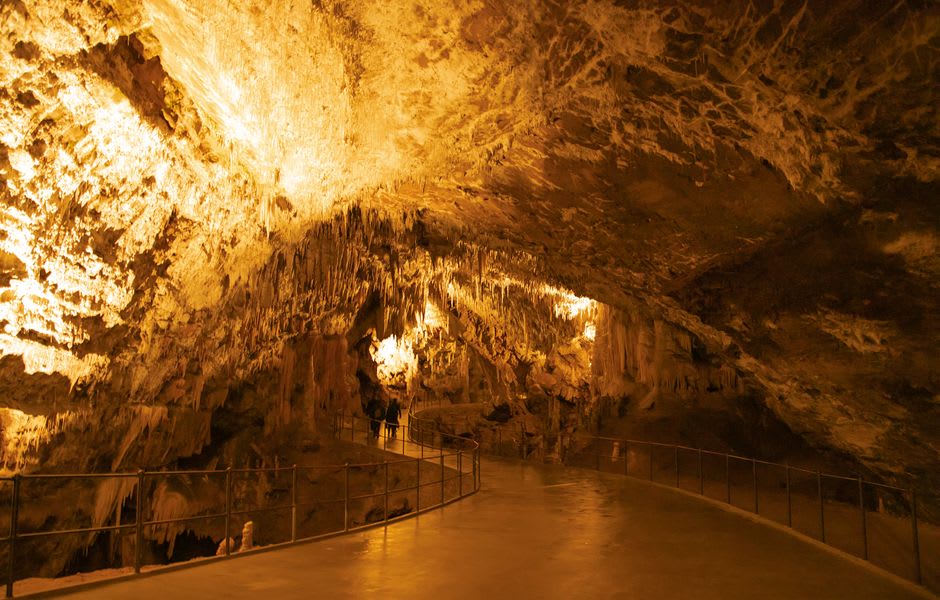
The cave sits near the village of Lokev, close to the Italian border, and its long history as a visited site means it carries a strange accumulated texture — 17th-century graffiti scratched into the walls by early visitors, alongside the same slow limestone formations you’d find in any of the region’s caves, built on a geological timescale that makes even the 1633 date look recent. Walking through, I found myself thinking less about the stalactites and more about the specific people who’d stood in this exact spot four hundred years ago, holding torches instead of the LED lighting strung along the modern path.
The Concert Hall, and a Literary Prize
The cave’s largest chamber, unimaginatively but accurately named the Concert Hall, has genuinely been used for concerts and cultural events, and since 1986 it’s hosted the ceremony for the Vilenica International Literary Prize, a prize awarded to a Central European writer each September in a stone chamber lit for the occasion with a formality that feels almost surreally out of place a hundred meters underground. I happened to be in the region in early September and caught the tail end of the festival’s public program in nearby Lokev and Sežana — readings, small crowds, an unusual amount of literary chatter for a village this size.
The Village Above
Lokev itself, the settlement above the cave, is a small, unhurried Karst village worth a slow walk before or after the cave visit — stone houses, a modest church, and none of the tour-bus infrastructure that surrounds Postojna a short drive away.
When to go: Spring through autumn for standard tours; early September if you want to catch any residual buzz from the literary prize ceremony, though the award event itself is by invitation.
Keep exploring
More from Slovenia
 slovenia
 Vintgar Gorge
A wooden walkway threaded along a limestone gorge outside Bled, where the Radovna River runs a color that makes you forget the crowds at the lake entirely.
Explore slovenia
 Vipava Valley
A wind-scoured wine valley between the Alps and the Karst, where the same violent bora that terrifies drivers also produces some of Slovenia's most distinctive white wines.
Explore slovenia
 Vogel
A cable car climbing 1,000 meters above Lake Bohinj to a ski station turned summer viewpoint, where the whole Julian Alps range spreads out at once.
Explore slovenia
 Vršič Pass
Fifty hairpin turns over the highest road pass in the Julian Alps, built by Russian prisoners of war and driven today for the view, not the destination.
Explore slovenia
 Žužemberk
A ruined medieval fortress rebuilt after wartime destruction stands guard over the Krka River in southern Dolenjska, one of the region's most photogenic and least-crowded castle ruins.
Explore slovenia
 Ankaran
A sleepy former monastery town at the northern edge of the Slovenian coast, with the country's best sandy beach and almost none of its tourist traffic.
Explore