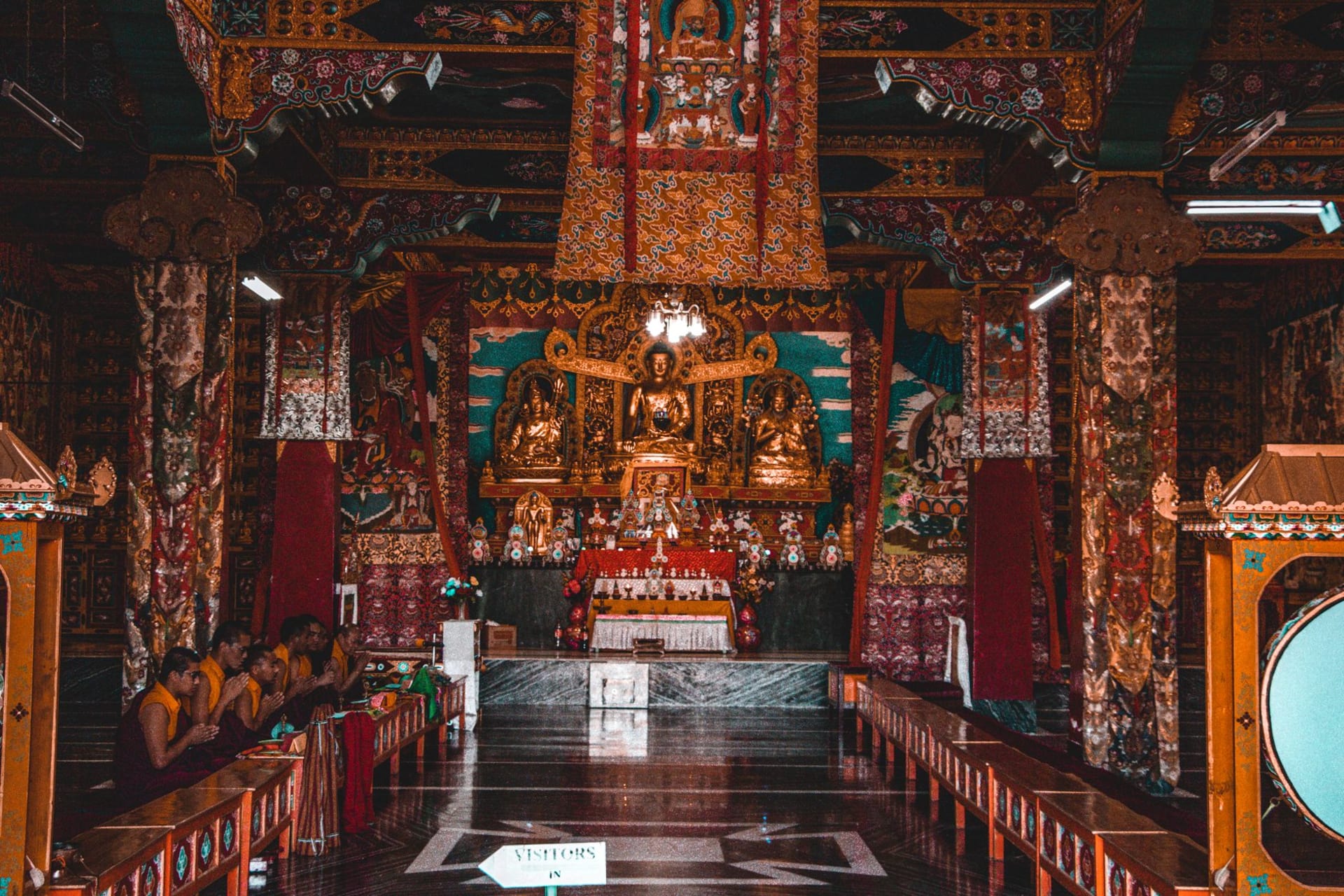
Yuksom
"Three hundred and fifty years ago they crowned a king here in a forest clearing. The stone is still there, and so is the silence."
Yuksom is the kind of place that rewards arriving without expectations. I’d read enough to know it was historically significant — the first capital of the Chogyal kingdom, site of the first coronation in Sikkimese history in 1641 — but nothing quite prepares you for how small and forest-quiet it actually is. The main street takes three minutes to walk end to end. Beyond it, the trees start immediately, dense and old, draped in moss and the sound of the Rathong River somewhere below.
Most people come to Yuksom as a trailhead for the Goecha La trek to Kangchenjunga base camp. I came for a few days and ended up staying longer because I ran out of reasons to leave.
Norbugang and the Coronation Site
A short walk from the town center, through a grove of oak trees so large they’ve grown into each other overhead, brings you to Norbugang — the site where the three Tibetan lamas met and established the Sikkimese kingdom. The coronation stone is a flat rock with a footprint carved into it, surrounded by a simple low wall. A chorten nearby holds relics. The whole site sits in a kind of natural amphitheater of trees.
I went at nine in the morning when nobody else was there and stayed for an hour reading about the history on my phone, which felt absurd but useful. The silence in that grove is very specific — not empty, but held.
The Dubdi Monastery Walk
Dubdi, consecrated in 1701, is considered the oldest monastery in Sikkim. Getting there requires a forty-five-minute climb through forest above the town, on a path that starts behind the school and winds up through chestnuts and rhododendrons. I slipped twice on wet roots and arrived breathing harder than I wanted to admit.
The monastery is small and unrestored in the best sense — no renovation crews have improved it into blandness. The wooden beams are dark with age. The caretaker monk made tea on a small stove and we sat on the porch looking down into the valley below. He spoke some Hindi and I spoke less, but the tea was good and the view required no translation.
The Kangchenjunga Trail: Just the First Hour
The Goecha La trek is a serious multi-day undertaking requiring permits and a registered guide. I did none of it. What I did do was walk the first hour of the trail, past the Tshoka meadows and into the old-growth forest where the path climbs into proper Himalayan terrain.
The transition is sudden. Within twenty minutes of leaving Yuksom, the village sounds vanish and you’re walking under trees so tall their canopy blocks the sky. The path is used by local villagers as well as trekkers and is well-worn, soft underfoot with decades of footfall. I went as far as a log bridge over a fast stream, sat on the bank for a while, and turned back feeling like I’d been given a partial answer to something.
Where to Eat and Sleep
Yuksom has a handful of guesthouses aimed at trekkers — functional rather than atmospheric, but the meals they serve are surprisingly good. The dalbhat at the guesthouse where I stayed arrived in a shallow tin thali with a rotating assortment of vegetables depending on what the kitchen had, refillable without extra charge. I ate more than I’d eaten in days. The woman who ran the place grew the cilantro in a pot by the kitchen door.
When to go: October and November are ideal — clear skies, cool temperatures, and the rhododendrons are done so the forest floor is visible. March through May for rhododendron bloom on the Goecha La trail. Avoid monsoon (June–September): the trail to Kangchenjunga becomes genuinely dangerous and leeches claim the forest paths.