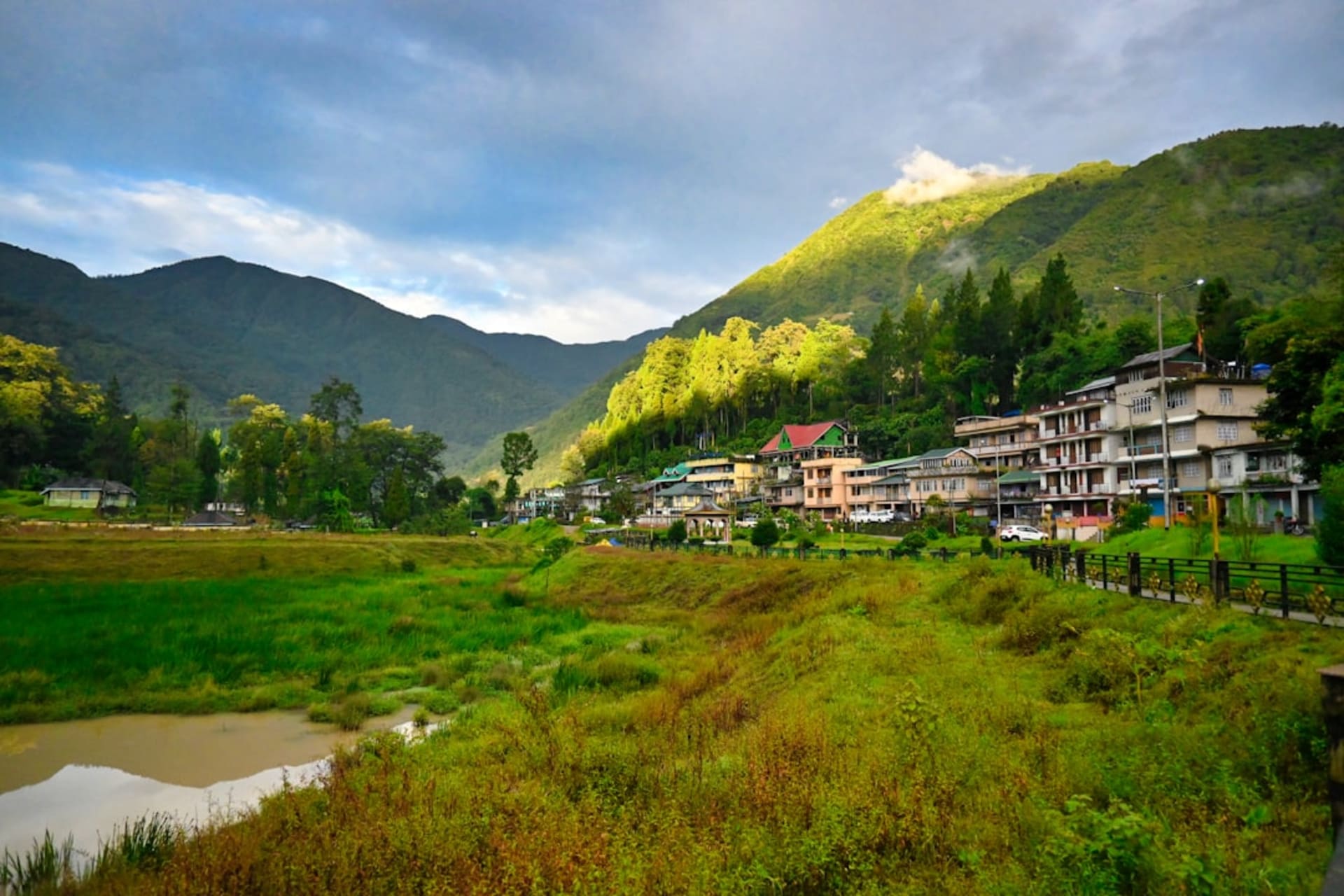
Ravangla
"A 130-foot white Buddha looking out at the third-highest mountain on earth. South Sikkim doesn't undersell itself."
I came to Ravangla on a recommendation that came from a recommendation — the kind of word-of-mouth chain that usually means either you’re going to find exactly what you’re looking for or it’s already been found by everyone else. Ravangla turned out to be somewhere in between: genuinely quieter than Gangtok or Pelling, still unhurried in the way of a town that hasn’t yet decided to become a destination, but not undiscovered either.
The town itself sits at around 2,150 meters on a ridge in South Sikkim, and on the right morning you can see the Kangchenjunga massif from the guesthouses on the western side without walking anywhere at all.
Tathagata Tsal — The Buddha Park
The main draw is the Tathagata Tsal garden, which contains a white Buddha statue of somewhat extraordinary scale — forty meters, the largest in Sikkim — inaugurated by the Dalai Lama in 2013. I walked there from town in twenty minutes, arriving when the morning light was still coming in low and warm from the east and the white stone of the statue was almost too bright to look at directly.
The park is manicured in the way that pilgrimage sites in India tend to be — swept paths, painted railings, flower beds — but the scale of the statue makes it impossible to reduce to a tourist attraction. The Buddha is seated, hands in meditation mudra, facing the entire Kangchenjunga range across the Rangit Valley. Depending on the cloud situation, this view is either spectacular or a wall of white. I had a good day.
Ralang Monastery
About ten kilometers below Ravangla, Ralang Monastery is one of the important Kagyu monasteries in Sikkim, and the site of the annual Pang Lhabsol festival in late August or early September — a Sikkimese Buddhist ceremony with masked Cham dances that honors Kangchenjunga as the guardian deity of the state. I was there in the wrong season, so I got the monastery without the festival, which was fine. The main hall has an enormous gilded statue of the Karmapa, and the monks I encountered were completely unbothered by a solitary French person wandering around with a notebook.
The road down to Ralang passes through a tea estate that goes on for longer than seems possible. The smell of processed tea leaves drying in the open air is the smell of this part of Sikkim, and it hit me every time the road curved through a patch of open hillside.
The Evening Ridgeline Walk
Between the Buddha park and the edge of town, a dirt path follows the ridgeline south for about three kilometers before it becomes unclear. I walked this at five in the afternoon when the light was golden and the shadows were already long across the valley. The path passed through patches of silver fir forest and open meadow where a woman was cutting grass with a sickle, loading it into a basket on her back, ignoring me completely.
The Teesta Valley appeared below to one side, the Rangit to the other, and for a few minutes the whole of South Sikkim was visible at once. These are the moments that make the bus journeys worth it.
Where Things Stand on Food
Ravangla’s restaurants are simple. I ate gundruk soup three times in two days because I kept choosing the same place by accident and then being too committed to change. The soup — made from fermented mustard greens with ginger and dried chilies — is sour in a way that wakes you up without caffeine, and served with beaten rice (chiura) it constitutes an entirely complete meal.
When to go: October through December for mountain views and clear skies. March and April for rhododendrons in the surrounding forest and warmer temperatures. Avoid June through September — cloud cover removes the mountain views entirely, and the roads can flood. The Pang Lhabsol festival (August/September) is worth the weather gamble if you want to see the ceremony.