Lachung
"The village guesthouse owner brought us yak butter tea before we even asked. At that altitude, at that temperature, I understood why it exists."
Getting to Lachung involves a permit, a registered vehicle, and about six hours of mountain road from Gangtok that climbs through some of the most dramatic terrain I’ve seen at this latitude. The valley narrows the further north you go, the Teesta River running white and cold below the road, waterfalls dropping straight off cliff faces with enough force that you can hear them over the engine. By the time the road flattens into the village, the sky has shrunk to a strip of blue between the ridgelines.
Lachung is small — maybe a few hundred households — and organized around a traditional governance system called the Dzumsa, which predates any Indian administrative framework and still functions. The village headman, the Pipon, handles local disputes. Outsiders aren’t really supposed to rent houses or build hotels in the traditional sense. What exists has grown up around that constraint.
The Lachung Monastery
The monastery sits on a promontory above the village and is decorated in the bright primary colors that characterize Nyingma Buddhist architecture in this part of the Himalayas. I climbed up in the late afternoon when the light was going flat and found the door unlocked, a single butter lamp burning in the main hall. The murals were recently repainted — a vivid, almost cartoon-bright palette of blues and reds and golds that some monasteries attempt to replicate and most get wrong. These were right.
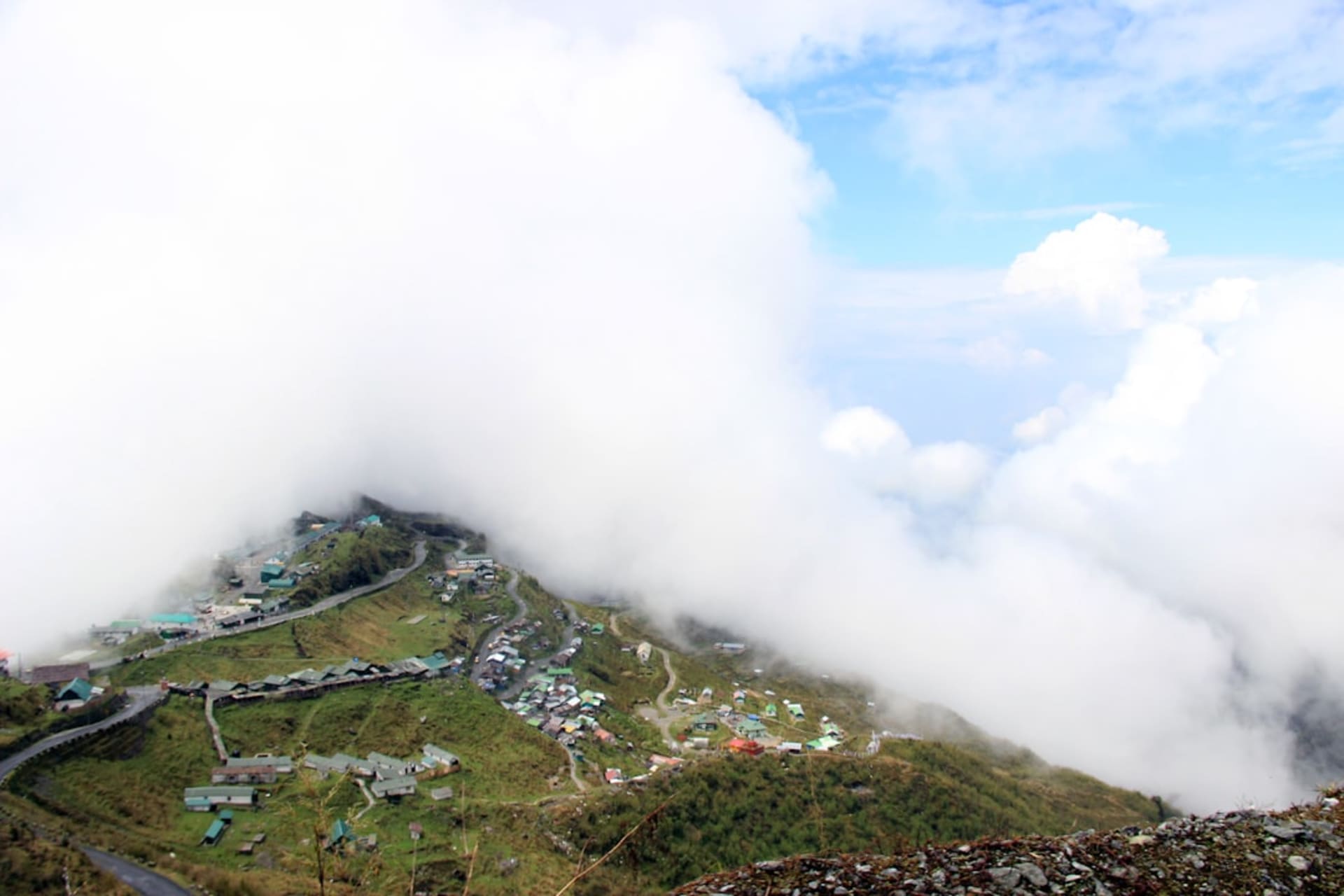
The view from the monastery’s front steps takes in the full length of the valley. On a clear evening you can watch the clouds filling up from the south and moving north like something being poured.
Yumthang Valley
The reason most people make the journey to Lachung is to access Yumthang, the “Valley of Flowers” at 3,564 meters, twenty-four kilometers further north. In spring — late March through May — the slopes fill with rhododendrons in a range of colors that turns the whole valley pink and red and white. I went in October, when the flowers were gone but the valley was empty of the tour groups that pack it in season.
What you get in October is a wide, flat valley floor with the Lachung River threading through it, flanked by high brown ridges dusted with new snow, the sky a specific shade of blue that only appears at altitude. Hot springs at the valley floor steamed in the cold morning air. I sat on a rock for an hour doing nothing useful. Highly recommended.
The Cold and What It Requires
Lachung at night in October drops well below freezing. The guesthouses have thin walls and quilts of varying quality. I wore everything I had. The upside is that the cold keeps the air extraordinarily clear — you wake up to a sky so full of stars it seems excessive, and by six in the morning the peaks above the village are catching the first light while the valley below is still dark.
Yak butter tea, which I’d been avoiding elsewhere in Sikkim, became suddenly comprehensible at this temperature. The combination of fat, salt, and heat is exactly what a body running on cold mountain air requires. I drank three cups before breakfast and felt like a completely different person.
Practical Matters
North Sikkim requires a Protected Area Permit in addition to the standard Inner Line Permit, both of which must be arranged through a registered Sikkim tour operator. Individual travel is not permitted — you must be in a group of at least two with a registered guide and vehicle. The bureaucracy is real but manageable if you plan ahead.
When to go: Spring (late March to mid-May) for rhododendron blooms in Yumthang. October and November for clear skies, empty trails, and first snow on the high ridges. The entire North Sikkim circuit closes during monsoon (June–September) due to landslide risk.