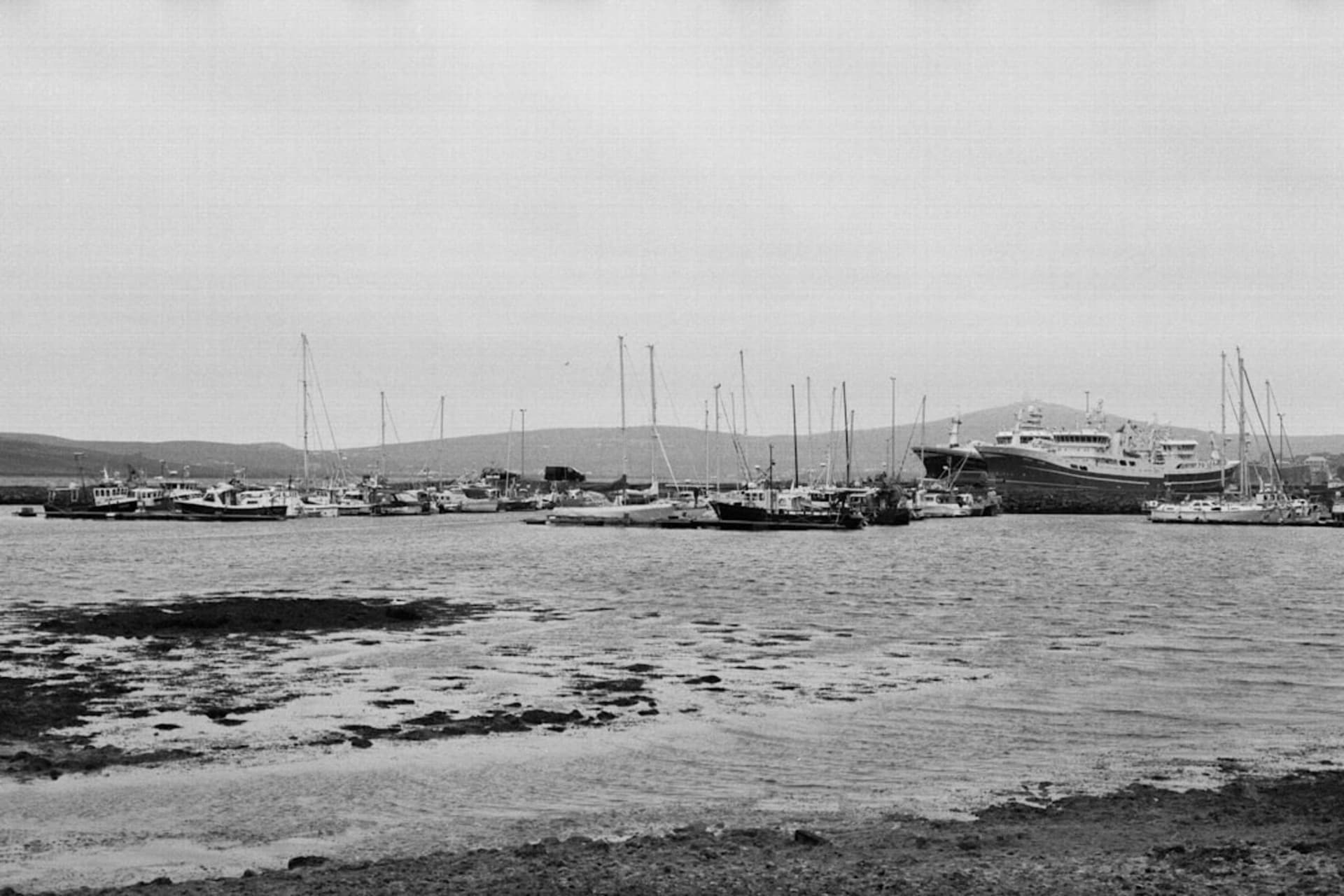
Yell
"Yell is what happens when you take away everything that isn't essential and find out what's left."
Transit Island, Unfairly Dismissed
Most visitors to Unst and Hermaness drive through Yell without stopping, regarding it as the passage between ferries. I did this on my first trip through Shetland and am still annoyed at myself for it. Yell is about thirty kilometers long and fifteen wide, and roughly sixty percent of its surface is blanket bog — great expanses of brown and amber peat, deeply inhospitable in rain, quietly extraordinary in good light.
The approach from the Ulsta ferry in the south puts you on the main road through the center of the island with the moorland stretching flat in all directions. The road dips and rises through the peat and you understand almost immediately that there are no hedgerows, no trees, no windbreaks of any kind. Just the bog, the sky, and the occasional lochan catching whatever light exists. In winter this can feel punishing. In late spring, with cotton grass tufting white across the moor and the slant afternoon light turning the wet peat to copper, it’s one of the stranger forms of beautiful I’ve encountered.
Otters in the Voes
The word “voe” is Old Norse for a sea inlet, and Yell’s coastline is full of them — deep-cut arms of the sea pushing into the island, sheltered and tidal and productive. Mid Yell Voe is the main settlement’s waterfront; smaller voes score the west and east coasts. Otters use them all.
Shetland has one of Europe’s healthiest otter populations, and Yell is considered among the best places to see them. The biology that makes this work: clean water, abundant fish in the voes, a human population that has coexisted with them long enough to develop a mutual tolerance. I found a large dog otter at Whale Firth on the west coast, hauled out on a flat rock not twenty meters from the road, grooming himself with the methodical thoroughness of someone who has nowhere to be. He looked up once when I stopped the car, assessed me as non-threatening, and returned to his activity.
The secret to otter watching is to drive slowly along the coastal roads and scan the seaweed at tide line. They’re most active morning and evening but can appear midday with no particular warning. When you see one, stop the engine completely.
The South End
At Burravoe on the southeast coast, there’s a small museum in an old house called the Old Haa that covers Yell’s history. The word “haa” means laird’s house in Shetland dialect, and this one dates from 1672. The museum contains exactly what you’d expect and some things you wouldn’t: fishing industry materials, knitwear samples, a natural history section with an otter exhibit that feels redundant given what’s available outside.
Nearby at Gossabrough there’s a headland with decent views south toward the Mainland. The shoreline here has the characteristic Shetland palette: dark rock, pale lichen, green kelp at the waterline, the whole thing reflecting whatever the sky is doing. On an overcast day this is monochromatic and austere. On the rare clear day it’s intensely saturated, like someone turned up the contrast while you weren’t watching.
Staying Longer Than You Planned
Yell has basic accommodation and a handful of community facilities, and there’s an argument for staying rather than using it as a transit. The island is genuinely quiet in a way that requires acclimatization — the kind of quiet where you start hearing things you’d tuned out, wind direction changes, distant sheep, your own breathing. It’s either peaceful or unsettling depending on what you came looking for.
When to go: Otters are present year-round; early morning otter watching in May and June coincides with very long daylight and calmer seas. The moorland flowers peak in June–July. Avoid the darkest winter months unless dramatic skies are specifically your goal.