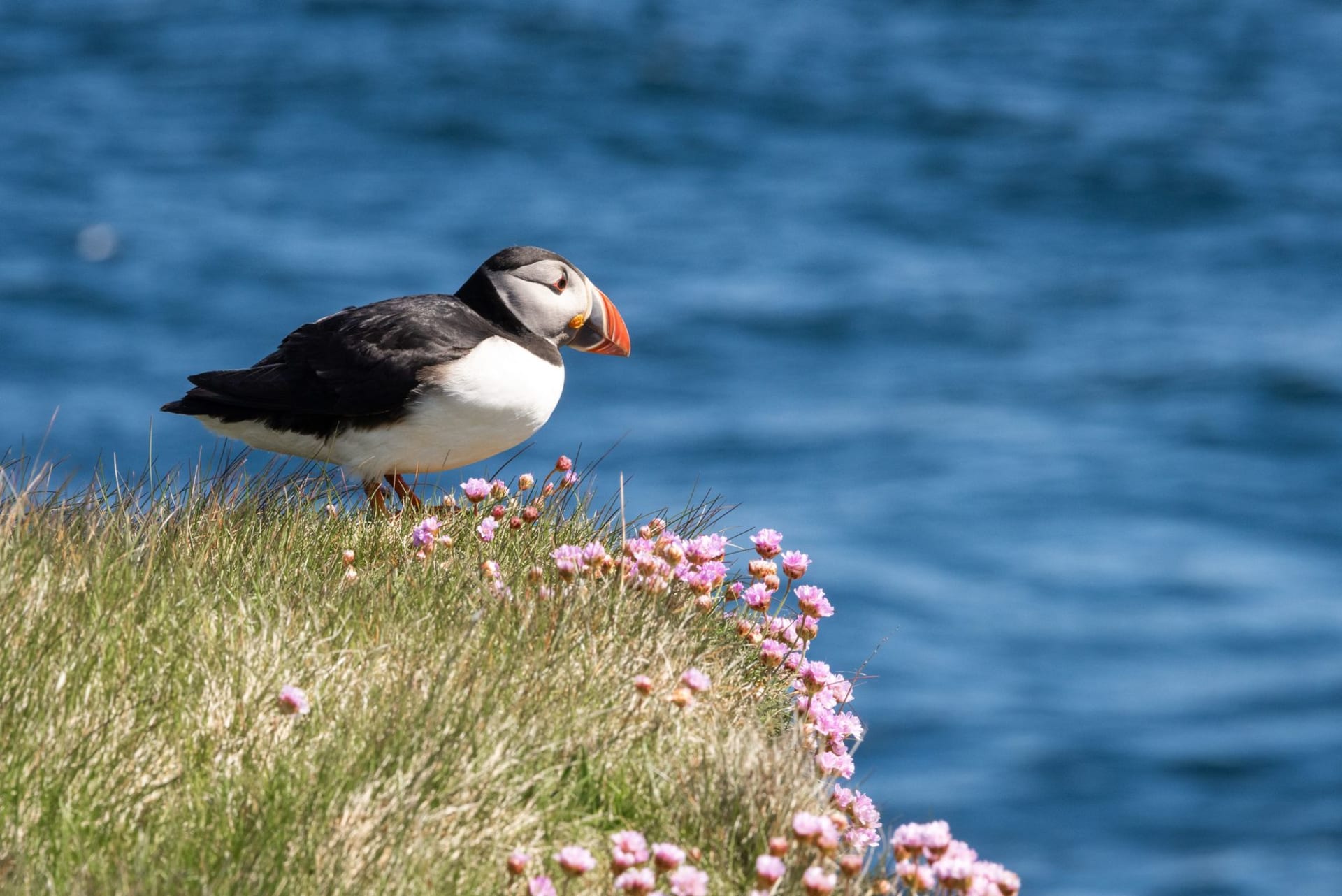
Noss
"I crossed to Noss in an inflatable dinghy and understood immediately that this was the correct way to arrive somewhere extraordinary."
Two Ferries to Wildness
Getting to Noss requires a modest sequence of commitments. First, you drive or take a bus from Lerwick to the Bressay ferry terminal — a six-minute crossing across the harbor mouth. Then you drive or walk the four kilometers across Bressay to the east coast. Then, between approximately ten in the morning and five in the afternoon on days when weather permits (and only when weather permits), an inflatable dinghy takes you the hundred meters of water from Bressay’s shore to Noss.
The dinghy is the correct detail. The crossing is too short to be dramatic but just uncertain enough to be committed — you are, briefly and definitively, on water between two islands, and Noss on its near shore is already showing you its cliffs. I made the crossing on a morning when a light wind was putting small whitecaps on the sound. The warden on the Noss side pulled the dinghy in by rope and helped me step onto a stone slipway. The sound of birds was already considerable.
The Noup
The eastern cliff of Noss, called the Noup, rises 181 meters straight from the sea. The sandstone is reddish-brown and the faces are colonized from sea level to clifftop by nesting seabirds, each species occupying a particular vertical range as reliably as floors in a building. Guillemots pack onto bare ledges at the base, stacked so tightly they seem to be propping each other up. Kittiwakes nest on tiny outcrops a little higher. Gannets occupy the upper sections, their white bodies visible from a kilometer away.
There is a circular walk of about six kilometers around the island that follows the cliff edge for most of its eastern length. The cliff path has no fence on the seaward side and the drops are serious and the wind comes from angles that require attention. I kept further back from the edge than I usually would. Not from fear exactly — from a practical acknowledgment that gusts at the Noup don’t give warnings.
The Noise and Smell
At peak summer, Noss hosts around sixty thousand breeding seabirds. The noise at the cliff is continuous and layered: guillemot growls on the low frequencies, kittiwake calls on the mid-range, gannet gargling on top, and beneath it all the movement of the sea on the rocks two hundred meters below. The smell is intense — salt, guano, fish — and clings to your clothes long after you’ve left.
I sat on the clifftop grass for an hour eating lunch and watching the gannets work the water offshore. They circle, stall, fold their wings, and drop in a vertical line, hitting the surface with an impact you can see from the cliff even without binoculars. They come up with fish or they don’t and they shake the water from their wings and start again. The repetition is completely absorbing in a way that requires no explanation, which is how I know it’s real.
The Island Interior
Noss is also grazed by Shetland ponies in summer, maintained by the nature reserve management as part of traditional grazing practice. The moorland interior is less dramatic than the cliffs but has its own calm — low heath and bog, breeding skuas in the flat sections (bring a hat), red-throated divers on the lochan at the island’s center. The walk takes two to three hours depending on pace. There are no facilities on the island: bring water, food, and clothing for all weather conditions.
When to go: May through August only, and only when the dinghy is operating — check the NatureScot website the morning of your visit as the crossing is cancelled in rough conditions. The peak of the gannet colony is June–July. Arrive at the Bressay dinghy point by nine-thirty to catch the first crossing of the day.