Mousa
"The walls are two thousand years old and something is living in them, and that seems right."
The Most Intact Thing
Mousa Broch stands thirteen meters high and is the best-preserved Iron Age broch in existence. Brochs are a specifically Scottish innovation — dry-stone towers with hollow double walls, tapering slightly as they rise, built between roughly 200 BCE and 200 CE and found only in northern Scotland and the islands. Nobody knows with certainty what they were for. Defense seems likely, or status display, or both. What’s certain is that Mousa was built to last and has done exactly that.
The ferry from Leebitton on the Shetland Mainland takes about fifteen minutes and drops you on a small pier. The island is uninhabited now except in summer by the boat operator’s sheep. You walk a flat grassy path for maybe ten minutes and the broch appears over a low rise in a way that still surprises me even knowing it’s there. It’s the completeness that does it — no collapsed sections, no modern repairs, just the original structure standing in the original landscape, which feels like an archaeological impossibility.
Inside the Tower
You can enter through the low ground-floor doorway and climb between the inner and outer walls via a narrow stone staircase that spirals to the top. The staircase is original. The stone steps are slightly polished from two millennia of feet. I climbed in one continuous motion because the passage is too narrow to pause comfortably, emerging onto the parapet with an unobstructed view of the island, the sea, and the Shetland Mainland to the west.
The interior hollow is open to the sky. From the top of the wall you can look straight down into it — grass growing on the floor below, a few jackdaws nesting on ledges. The broch is not quite a circle from above; there’s a very slight irregularity that the builders clearly decided was close enough. I found this humanizing.
The Petrel Nights
Mousa Broch is also one of the most important nesting sites in Europe for storm petrels — small, dark seabirds that nest in rock crevices and only return to their nests after dark to avoid predators. The void spaces in the broch’s hollow walls are full of them. The boat operator runs special evening sailings from late May through July, arriving at the island around eleven at night and staying until the birds come in after midnight.
I went on one of these night trips with Lia on a late June evening when the sky never got fully dark. The petrels came in around twelve-thirty, appearing as shadows against the pale northern sky, and the noise they made — a rapid, mechanical churring from inside the walls — was completely alien. You stand with your back to two-thousand-year-old stone and listen to something living inside it that has been doing this since long before the first human visited. The sound carries through the whole structure. You put your hand on the stones and feel nothing, but the noise continues.
The Island Otherwise
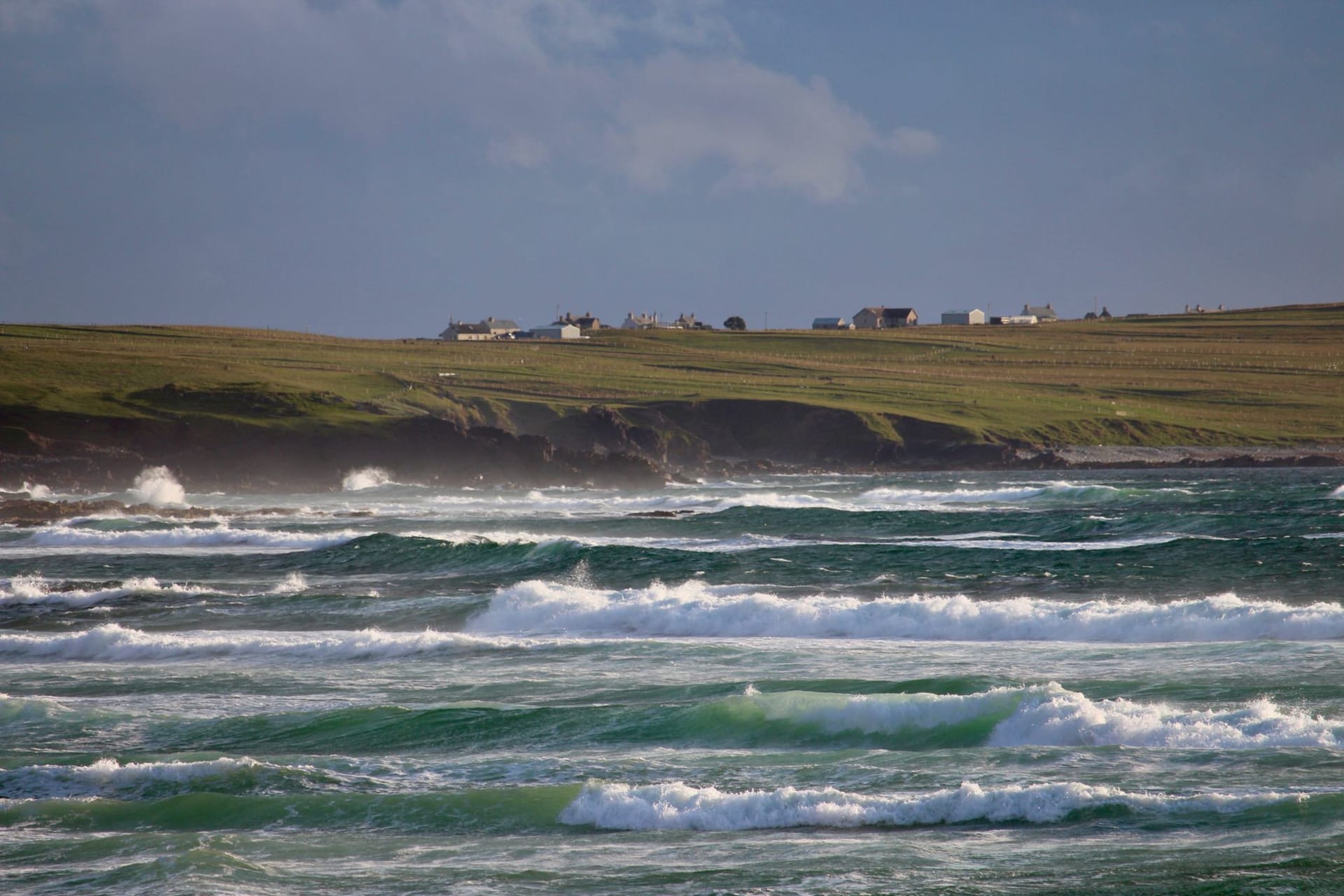
Beyond the broch, Mousa has seals hauled out on rocks at the south end, common in summer. The grass is grazed short and the wildflowers in June are disproportionately intense: thrift, sea campion, silverweed in yellow and white patches where the turf opens. There are no trees. There’s very little wind shelter. You are, pleasantly, completely exposed.
When to go: May through August for the day ferry and broch access. If you can arrange only one thing in Shetland, book the midsummer night petrel trip — check ahead as spaces are limited and it books out early in the season.