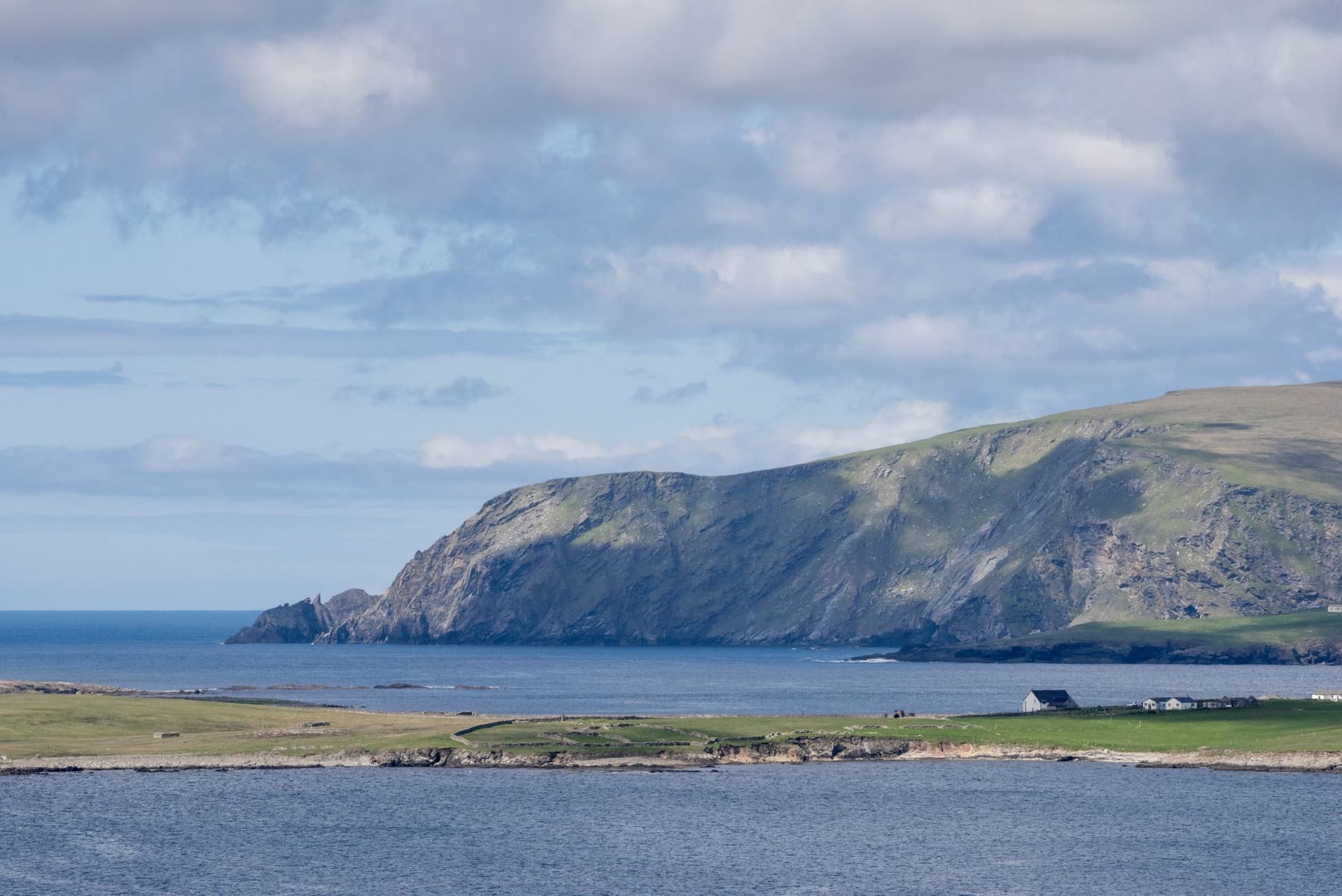
Fair Isle
"Fair Isle is one of those places where your reasons for leaving keep accumulating but you keep not leaving."
Getting There Is the Point
Fair Isle sits 38 kilometers southwest of the Shetland Mainland and 43 kilometers north of Orkney, which means it’s close to nothing. The ferry from Grutness near Sumburgh runs two or three times a week depending on season and weather, and takes about two and a half hours. There’s also a small plane from Tingwall airport that does the crossing in twenty minutes and requires a level of confidence in small aircraft that I found necessary to cultivate. Both options are weather-dependent. Both are correct.
I took the ferry out and the plane back. The ferry gave me time to watch Fair Isle resolve from a flat shape on the horizon into something with dimension — cliffs first on the south end, then the crofting ground across the middle, then the observatory buildings near the north end. The plane gave me the view from above of the whole thing at once, which is the most useful way to understand Fair Isle’s geography: a green rectangle of agricultural land, ciff-girdled, with a small harbor cut into the east coast that looks too modest for the ambition of visiting it.
The Observatory and the Birds
The George Waterston Memorial Centre and Observatory has been recording bird sightings on Fair Isle since 1948. The island sits on the migratory flyway between northern Europe and Britain, and in spring and autumn, exhausted migrants land here in concentrations that make serious birdwatchers genuinely emotional. I am not a serious birdwatcher and still found myself peering at things with borrowed binoculars at seven in the morning in a way that felt uncharacteristic.
The common residents — puffins on the south cliffs, gannets offshore, skuas on the moorland — are immediately compelling even without specialist knowledge. The autumn rarity season, when Siberian and North American vagrants turn up disoriented on the island, is what the observatory was built for. If you see a cluster of people with telescopes all pointing at the same bush, approach cautiously. Something unusual is in that bush.
The Knitting
Fair Isle knitting — the distinctive stranded colorwork patterns worked in wool, traditionally two colors per row from a rotating palette — is one of the more genuinely specific craft traditions in the British Isles. The patterns are not Norse, not Scottish, not specifically Celtic, though all three cultural streams contributed to the island’s history. The designs that became famous from the 1920s onward, when Edward VIII was photographed wearing a Fair Isle sweater at St Andrews, are a local synthesis.
The island community still produces authentic Fair Isle knitwear. I visited a crofter who sold from her home, where three finished jumpers were draped over a chair by the window. She explained the construction — worked in the round on circular needles, steeked and cut where armholes are needed — with the patience of someone who has explained this to curious visitors many times but doesn’t find it tiresome. The prices reflected what the work takes to produce. I bought a hat that I wear with uncharacteristic consistency.
The Community Itself
Sixty-odd people live on Fair Isle permanently, a number that has fluctuated over the decades. The island has a school, a medical nurse, a community hall, a shop. It generates much of its own electricity from wind turbines. The relationship between the resident population and the seasonal observatory guests and the visiting birdwatchers is not always tension-free — it never is in small island communities where visitors outnumber residents — but what I observed was a functioning place that had made peace with its own circumstances in a way I found genuinely admirable.
When to go: May for spring migrants and puffin arrivals; September–October for the autumn rarity season. Accommodation at the observatory must be booked well in advance. Check weather forecasts obsessively before travel — the island can be cut off by weather for several days at a time, which is either a disaster or a gift depending on your schedule.