Anse Lazio
"Some beaches make you sit down. Anse Lazio makes you stand at the waterline for a very long time, not quite ready to move."
The road to Anse Lazio crosses Praslin’s northern hump through a stretch of jungle that smells of crushed leaves and warm bark, climbing past houses with corrugated iron roofs and dogs sleeping in the shade, before dropping steeply toward the coast. The parking area at the top of the final descent is small and fills quickly. From there a path descends through takamaka trees — low, spreading, their roots visible above the sandy soil — for about five minutes before the beach opens below you. That moment of opening is worth something. The water announces itself first: a color you see before you see the sand.
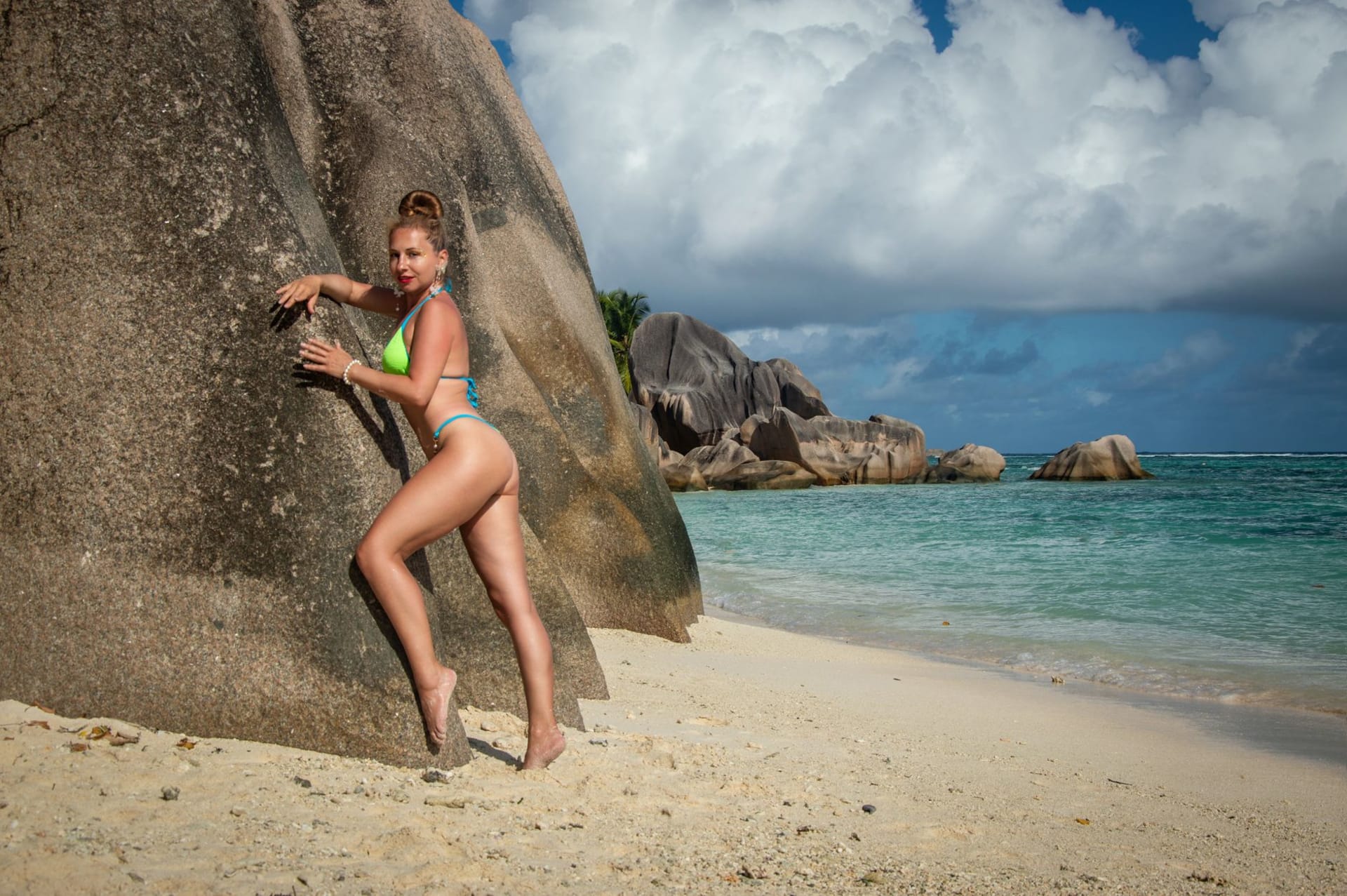
Anse Lazio is consistently listed among the world’s finest beaches, and I have spent enough time on fine beaches to be suspicious of such lists. But standing at the waterline here on a clear morning I understood the consensus. The bay is wide and sheltered, backed by a headland of rounded granite on either end, the trees reaching almost to the tide line. The sand is very white and very fine and squeaks underfoot in a way that seems impossible for something that fine. And the water — this is what the lists are trying to describe and consistently failing to — goes through a sequence of colors from the shore outward that I have not seen reproduced anywhere else: a pale mint at your feet, deepening to aquamarine in the shallows, then a sudden shift to a dense cobalt where the sandy bottom drops away toward the reef.

I arrived early enough to have the first hour largely to myself — a couple at one end of the beach, a man setting up snorkel gear near the rocks, otherwise empty. Swimming here in that pre-tourist hour has a quality I struggle to describe without sounding like I’m making it up: the water is so clear and so still that the sensation of being in it feels less like swimming and more like floating inside something liquid and transparent, and the reef fish visible below are not alarmed by your presence in the way reef fish usually are. A large parrotfish — blue-green, enormous — moved alongside me for perhaps thirty meters before peeling away toward the coral. I treaded water and watched it go.
The small beach restaurant at the northern end has been here for decades and operates on island time, which means the fish may arrive when it arrives and the service is paced to a rhythm that has nothing to do with turnover. I ate grilled job fish — a local name for a variety of snapper — with rice and a mango chutney that was sweet and sharp and insistent. The fish was cooked whole, the skin crisped on the grill, the flesh inside still moist. I ate it slowly, watching a pelican that had stationed itself on a granite boulder at the water’s edge and was performing its surveillance of the bay with a professional detachment.

By eleven the beach had filled to what I’d call comfortable capacity — perhaps forty people across the entire bay — and the atmosphere shifted from solitary to convivial in a way that was not unpleasant. French, Italian, German, Creole conversations drifted in patches across the sand. A child was building something ambitious in the wet sand near the waterline. The pelican was still on its rock, still conducting its surveillance, apparently indifferent to the human expansion of its beach.
When to go: Anse Lazio faces northwest and is most protected during the southeast trade wind season from May to September, when the water is flat and the snorkeling is clearest. October and November are also excellent. During the northwest monsoon from December through February, the swell can build on this coast and the beach becomes more dramatic than swimmable. Arrive before 9am or after 3pm regardless of season.