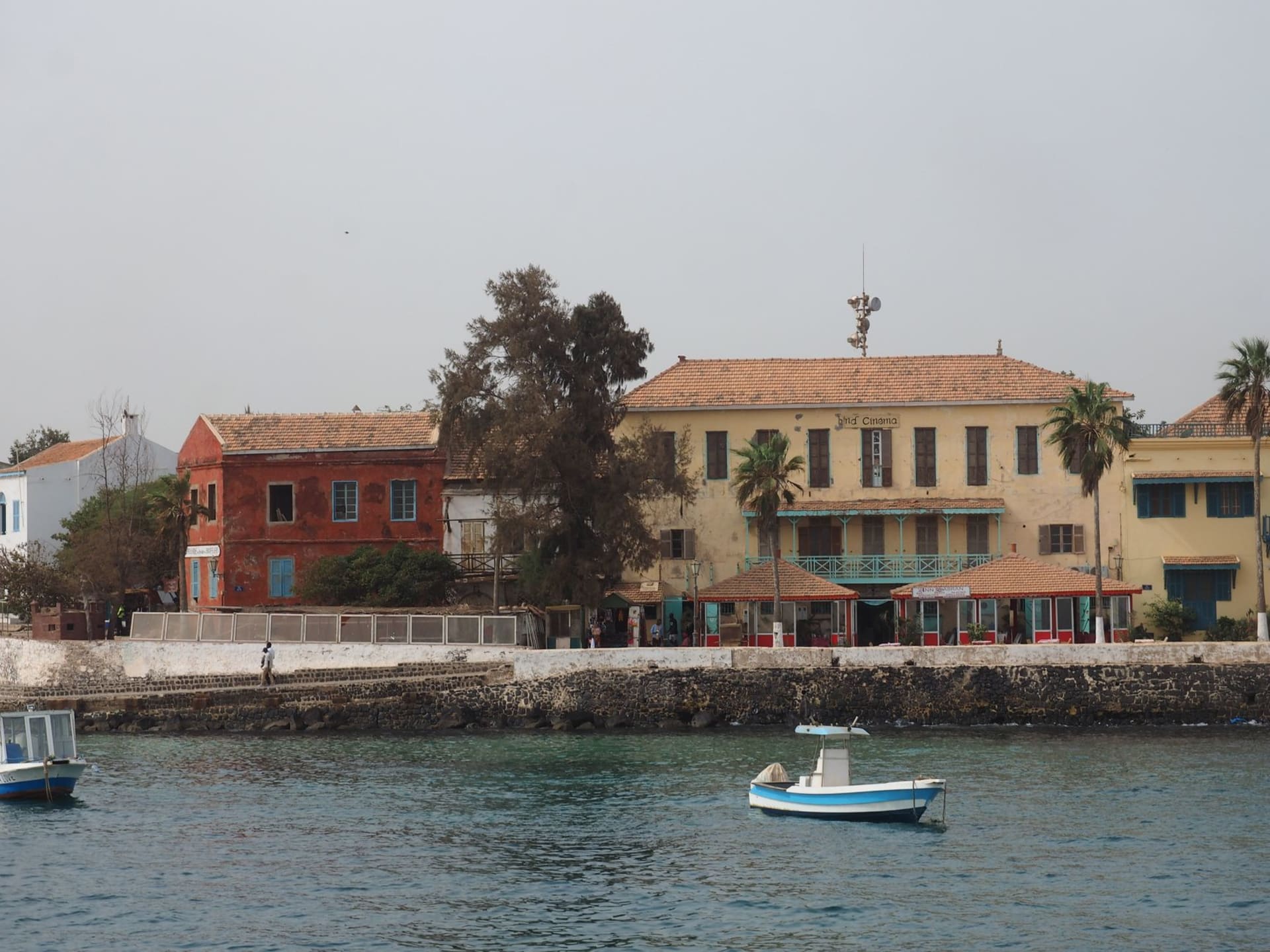
The crossing from Dakar’s port takes twenty minutes and costs almost nothing. You stand on the deck and watch the city recede — minaret tips, construction cranes, the heat shimmer above the Plateau — until you’re close enough to Gorée to make out the colors: ochre, pink, rust, the deep blue of shutters that haven’t been repainted in a generation. Then the ramp drops and you notice immediately: no cars. The absence of engine noise is physical.
The Maison des Esclaves
The House of Slaves is the reason most people make the crossing. The building is real: a two-story colonial house built around 1776 with holding cells at ground level and a doorway at the back that opens directly onto the Atlantic — the Door of No Return. The historical record of how systematically the building functioned in the slave trade is complicated and still contested by historians. None of that complexity makes it easier to stand in those low-ceilinged rooms where the stone stays cold even in afternoon heat and the light barely makes it through the ventilation slits. I’ve read the academic arguments about the site’s narrative weight. Standing there I mostly felt quiet.
The guide who led my group spoke for twenty minutes in a flat, exact voice. He didn’t perform grief. He stated facts and let them sit. Afterward, a French family behind me argued in low voices about what he’d said. I walked ahead so I didn’t have to hear them.
Bougainvillea Over Everything
The rest of the island resists the weight of what it holds. Children kick footballs in the alleyways between pink-washed houses. Women fry fish on portable stoves in doorways. Cats sleep on hot window ledges. Bougainvillea grows over everything with aggressive cheerfulness — purple and coral and white — as if the island decided years ago that beauty was the only viable response to history.
Gorée is essentially one neighborhood. You can walk the perimeter in forty minutes, or the full interior in twenty. Two old colonial forts sit on the hilltops, their cannons rusting decoratively toward France. The views from up there over the Atlantic are the best on the island — the long curve of Dakar’s coastline, the container ships waiting at anchor, the haze softening everything.
Staying Late
Gorée has a small community of artists whose studios and stalls cluster near the ferry dock. The usual carved masks, batik fabric, bronze jewelry. Worth browsing without much pressure to buy. But the real reason to stay past the last afternoon ferry is the light. When the day-trip crowds thin and the sun drops toward the water, the pink walls turn gold and then deep amber, and the island becomes somewhere that has made a certain peace with itself.
I stayed late once. Watched the fishermen unload their catch on the north beach while a boy tried to sell me a coconut. I overpaid and didn’t regret it. The return ferry was almost empty. Dakar came back at us loud and diesel-scented and lit up along the waterfront, and I was glad to have left and glad to be returning.
When to go: November through April for dry weather and the most pleasant heat. The crossing can be rough during the July-September rainy season, though the island itself is calmer when emptied of weekday tour groups. Weekday afternoons — after the organized tours leave — are the best window. Avoid Grand Magal weekend in Touba, which strains all Dakar transport.