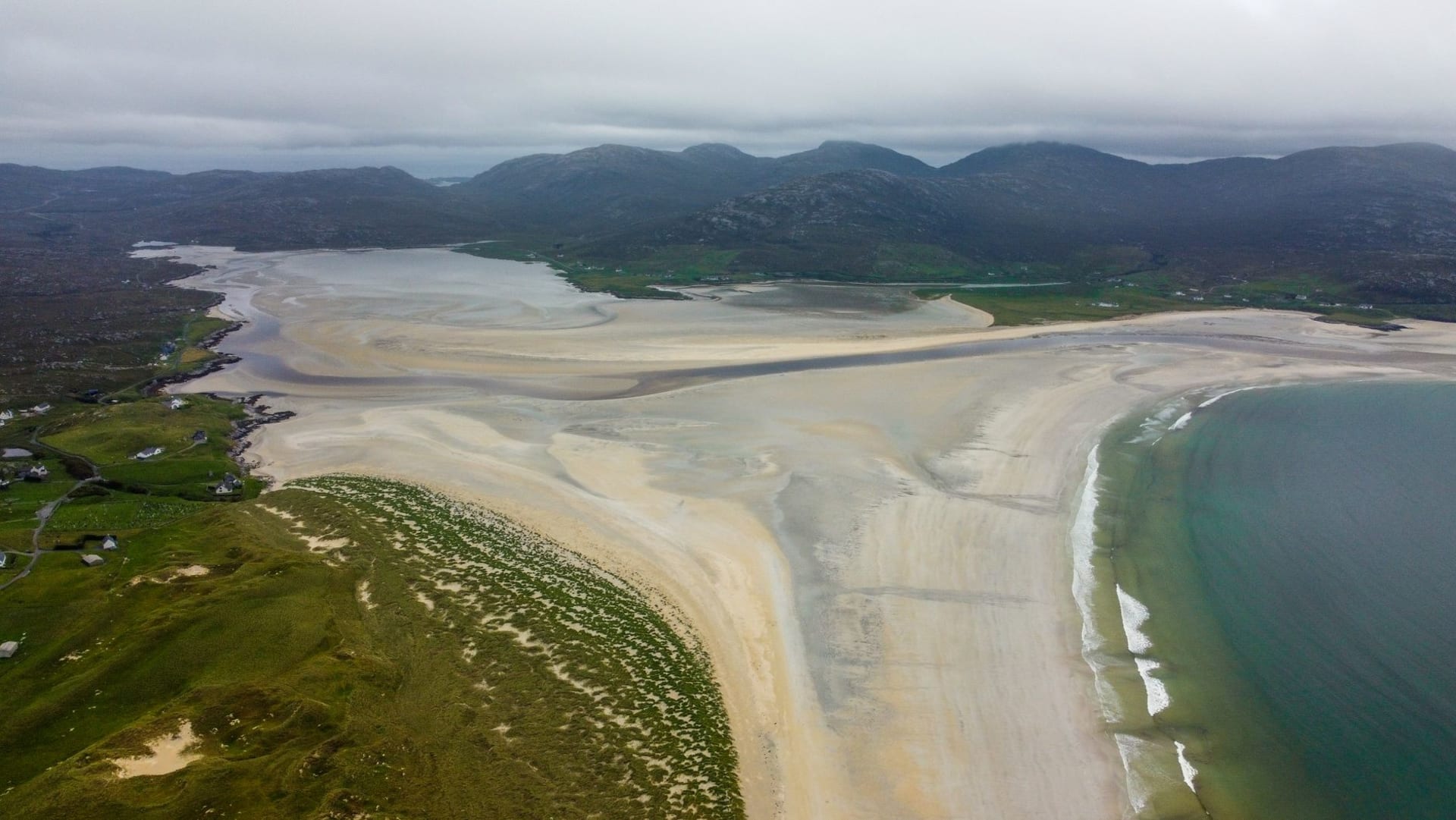
The first thing to understand about Luskentyre is that the photographs are not lying. That was my working assumption before I arrived — that some filter or blue-sky exception had inflated the color — but the water at Luskentyre really is turquoise in that almost Caribbean way, and the sand really is fine and white, and you really can stand there in a waterproof jacket in a fifteen-knot wind and feel like you’ve arrived in two places at once.
Harris is the southern part of the island it shares with Lewis — geologically the same landmass, administratively one council area, culturally treated as distinct. The north of Harris is all glaciated Lewisian gneiss: bare rock, lochs, and moorland that looks primordial because it is. The south is where the beaches are, strung along the Atlantic coast like something the Gulf Stream dropped and never came back for.
The Beach Problem
The problem with Luskentyre — and I mean this specifically — is that it ruined my ability to evaluate other beaches for the rest of the trip. I walked out across the sand at low tide and the water color shifted from pale jade to deep teal as it deepened, and the mountains of North Harris were behind me in gray-purple, and there was one other person, far away, with a dog. I sat on the sand for an hour and ate a gas-station sandwich and it was one of the better meals I’ve had in Scotland.
Scarista is quieter and more exposed, the Atlantic hitting it directly. Seilebost faces Luskentyre across the estuary and gives you the classic wide-angle view of the whole bay. Hushinish at the end of a single-track road in the far northwest is harder to reach and stranger — less pastoral, more exposed, the kind of beach that makes you think about the Atlantic as a fact rather than an abstraction.
Into the Peat
The east coast of Harris — the Bays area — is entirely different from the Atlantic side. The land here is rocky and divided into small crofts where families built lazybeds into pockets of soil between the outcrops. It looks difficult because it was difficult. The contrast between these shores and the tourist-magnet beaches on the opposite side of the same island is instructive and sobering.
I spent a morning driving the single-track roads slowly, stopping when I wanted, and saw almost no one. The peat bogs in the interior have a particular smell in wet weather — damp, ferrous, faintly sweet — and the silence up there is complete enough that it becomes its own kind of sound. I’ve been in quiet places, but Harris in cloud, on a Tuesday, in September, is in a category of its own.
Tarbert and the Tweed
Tarbert is the main village, a ferry port connecting to Uig on Skye and to the Uists further south. It’s small but functional: a few hotels, a good café, and several places selling Harris Tweed. The tweed is made here by individual weavers on pedal looms in their homes — the orb certification is strict and the cloth is genuinely distinct. I handled a length of it in a small shop in Tarbert and the weight of it was surprising, the texture somewhere between rough and reassuring.
The ferry crossing from Uig on Skye takes about one hour and forty minutes. Arriving by sea, watching the Harris hills come into focus from the deck, is a better introduction than any road approach.
When to go: May and June offer the best combination of light, weather, and manageable visitor numbers. July and August bring the crowds — the machair wildflowers are spectacular but the single-track roads are busy and parking at Luskentyre fills before nine in the morning. September is my preference: the heather is out, the light is golden and low, and the beaches are nearly empty again. Avoid January through March unless weather drama is genuinely what you came for.