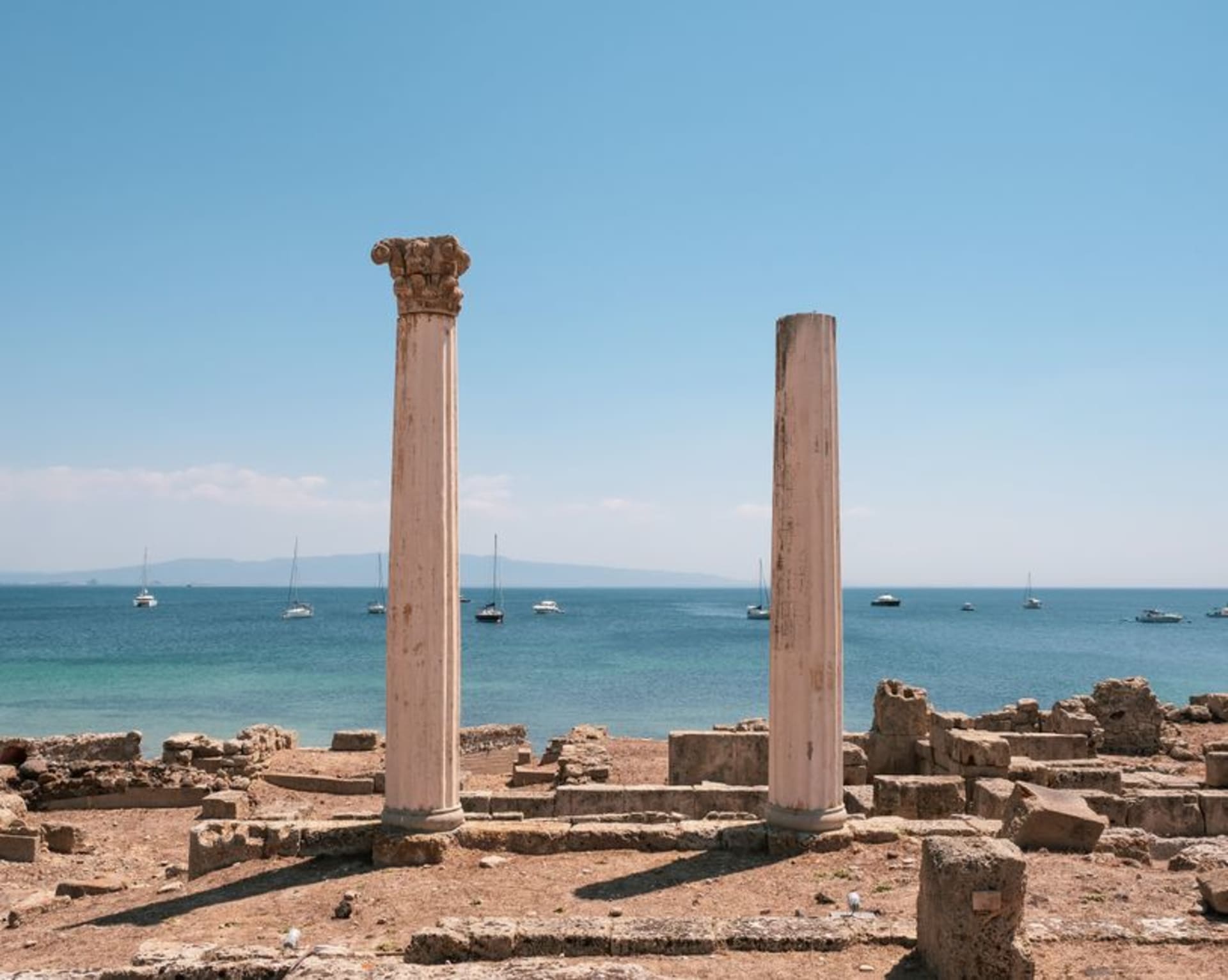
Tharros
"The wind never stops here. I decided the Phoenicians probably built somewhere else if they'd had the choice."
A wind-scoured Phoenician-Roman city on the Sinis peninsula where broken columns stand between two seas and the ruins under your feet go back three thousand years.
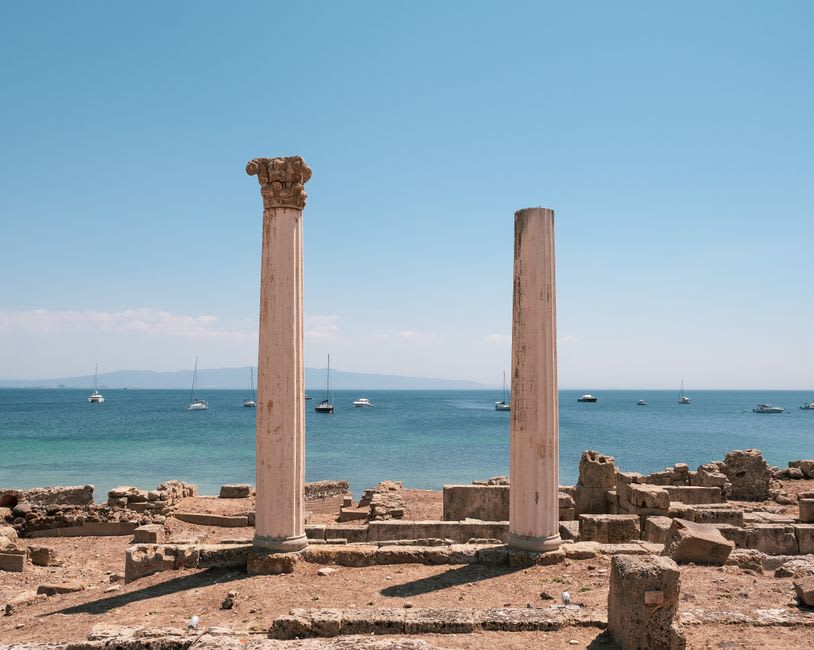
Tharros sits at the tip of the Sinis peninsula on Sardinia’s west coast, on a strip of land so narrow you can see the Gulf of Oristano on one side and the open Mediterranean on the other from the same low ridge. The wind that day was relentless — the same wind, I assume, that has been hitting this promontory since the Phoenicians founded a trading post here around the 8th century BC, later expanded by Carthaginians and then thoroughly rebuilt by Romans who left the two Corinthian columns that have become the site’s postcard image.
Walking the Grid
What struck me first wasn’t the columns but the street plan underfoot — a genuine Roman grid of basalt paving stones with the ruts from cart wheels still visible, worn deep enough that I could fit two fingers into the grooves. Walking the decumanus toward the sea, past the foundations of thermal baths and a paleo-Christian baptistery, I had the specific vertigo of realizing that ordinary Roman commuters wore this exact path smooth with their feet, on their way to buy fish or argue about taxes, two thousand years before I showed up with a water bottle and sunburn.
The Tophet and What Came Before Rome
Above the main Roman excavation, on a low hill, sits the tophet — a Phoenician-Punic sacred precinct where archaeologists found urns containing the cremated remains of infants and animals, evidence of a religious practice that historians still argue about the meaning of. It’s a somber corner of the site, unglamorous compared to the columns below, and I found myself lingering there longer than the columns, trying to imagine what certainty or desperation drove people to this hilltop three millennia ago. A few hundred meters on, the squat Spanish watchtower, Torre di San Giovanni di Sinis, added in the 16th century against Barbary raids, feels almost modern by comparison.
San Giovanni and the Long View
The tiny whitewashed village of San Giovanni di Sinis, just before the ruins, has one of Sardinia’s oldest churches — a stark 6th-century paleo-Christian building with none of the ornament you’d expect, just thick stone walls holding centuries of continuous use. I sat afterward on the rocks below the tower, eating a panino from the one shop in the village, watching the two seas meet the same wind at slightly different angles, and thought about how few places let you stand in three empires at once without a museum case in sight.
When to go: Visit early morning, both for the light on the columns and because the wind and heat build through the day with nothing to block either. April, May, and October avoid the worst of the summer sun on a site that offers almost no shade.